ar
- Democrats enter the midterms with a polling advantage. The outcome will shape Congress’s ability to change taxes, spending and government borrowing.
- The S&P 500 has averaged a 13% gain in the 12 months following midterms, but economic conditions, valuations and monetary policy help explain the historical returns.
- The Fed’s October pause leaves further tightening possible. With long-term Treasury yields around 5%, earnings growth and financing costs remain central to whether stocks can sustain a post-election rally.
Wall Street loves an election story. Democrats enter the midterms ahead in the polls, and analysts see a stronger chance of a Democratic House while the Senate looks more competitive.
What investors need to know is whether the bond market will play along. Treasury yields hit their highest level since 2002 this month and still sit near 5%, oil is above $100 and the Fed’s October pause has left the next rate move unresolved.
The Midterm elections, which take place on November 3, will shape Congress’s ability to change taxes and spending, with consequences for corporate profits and government borrowing.
What are the Polls Showing
A Reuters/Ipsos poll conducted October 22 to 26 showed Democrats leading Republicans by 47% to 36% among registered US voters nationwide, an 11-percentage-point advantage.
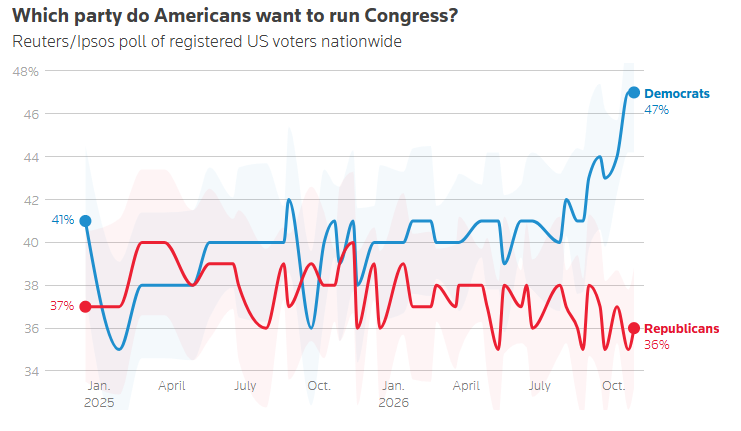
Analysts are expecting Democrats to regain the House of Representatives, while the Senate remains hard to determine. National voting preferences cannot settle individual state and district races, where turnout and local conditions will determine control. ⁽¹⁾
The results matter because they determine which policies become easier or harder to pass. Taxes, spending and government borrowing connect the link between the seat count and market prices.
How Stocks Have Behaved Around Midterms
Historically, stocks have done little in the run-up to midterms. Since 1974, the S&P 500 has averaged a gain of just 1.7% from August 1 to Election Day. One year drives that figure. In 1982, the index jumped more than 26% before the vote, as the recession ended and the Fed began to cut rates. ⁽²⁾
Take 1982 out and the other 12 midterms average a small loss, about -0.3%. One year of falling rates and a recovering economy was enough to outweigh the rest. ⁽³⁾
After the vote, the record looks much better. Morgan Stanley reports an average gain of 13% in the 12 months after the midterms, while Fidelity states that the S&P 500 posted positive returns in the 12 months following midterms 95% of the time since 1938. ⁽⁴⁾
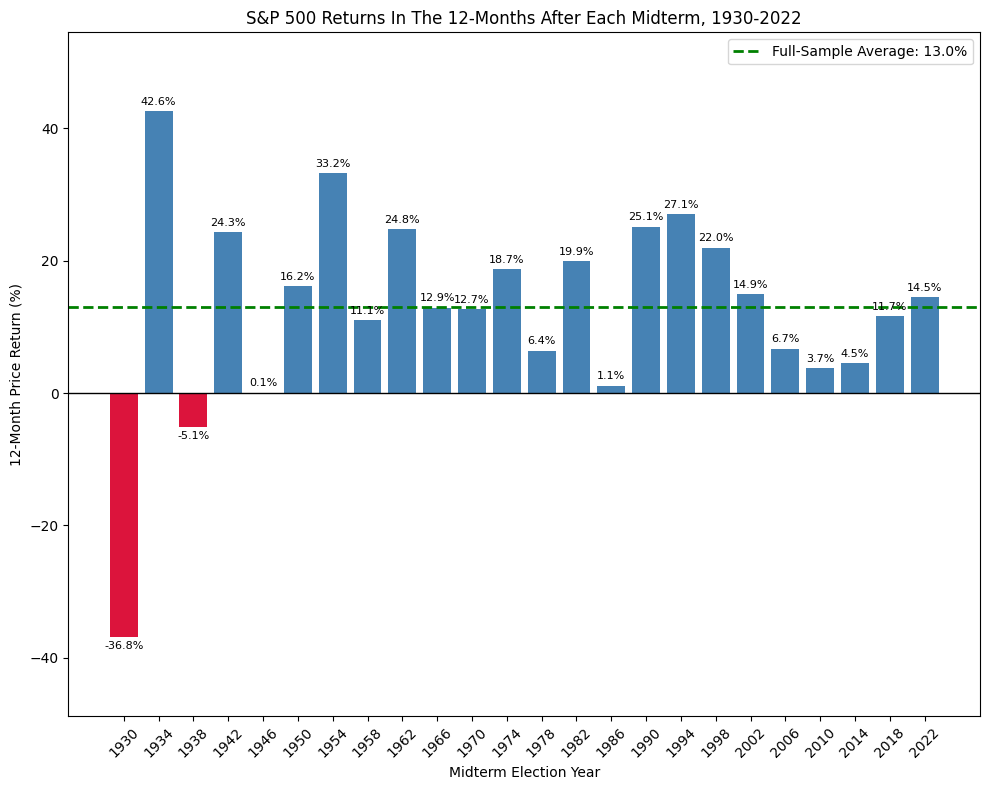
Morgan Stanley also found that, under a Republican president, the strongest average S&P 500 gain in the year after midterms came when Congress was split, at about 23%. ⁽⁵⁾
Even so, the figure comes from a small number of elections, where economic conditions, stock valuations and interest rates also impact returns, so a political event alone doesn’t explain the difference.
A reduction in policy uncertainty could help explain stronger post-election performance. However, the 1982 example also shows why interest rates deserve attention alongside the political result. A rally supported by falling borrowing costs would face different conditions from one occurring while investors still expect further tightening.
Why the Fed and Yields Matter More This Year
After an election, markets usually focus on earnings and the economy, but both face challenges this year.
The Fed held rates at 3.75%–4.00% on October 28 in a 10–2 vote, with Fed governor Lisa Cook and Cleveland Fed president Beth Hammack favoring another quarter-point increase. Policymakers described economic growth as strong while acknowledging that inflation remains elevated. ⁽⁶⁾
Chair Kevin Warsh avoided committing to a December decision. Traders still priced roughly an 80% chance of another hike early on October 29, leaving further tightening a risk if inflation fails to ease. ⁽⁷⁾

The 10-year Treasury yield stayed near 5% after the Fed’s October 28 decision, below its closing high of 5.31% on October 5. The reaction showed why a Fed pause does not guarantee cheaper financing.
During Warsh’s press conference, the two-year Treasury yield fell to around 4.70%, while the 10-year yield remained higher on the day at around 5.04%.
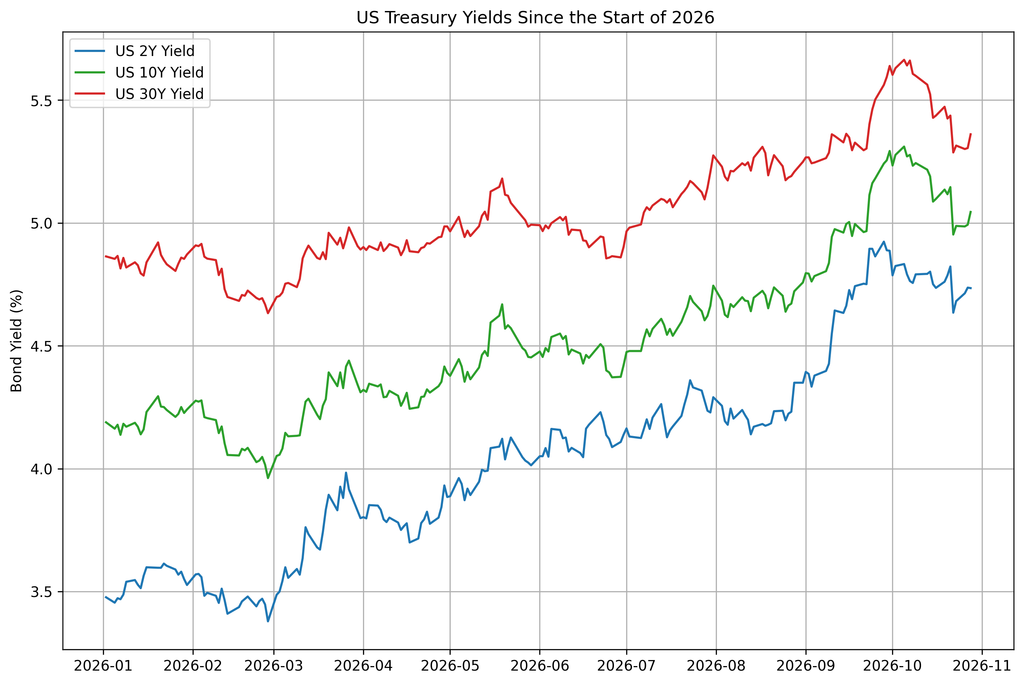
Government financing adds pressure. The US ran a $1.99 trillion deficit in fiscal 2026, and investors keep asking how much more debt the Treasury has to sell. Higher than expected borrowing can put upward pressure on yields even when the Fed leaves rates unchanged. ⁽⁸⁾
Where the Election Still Matters for Markets
Divided government could make major tax cuts or spending increases harder to pass. However, existing deficits and inflation could still drive long-term yields.
Morgan Stanley flags affordability as the campaign’s central theme, with gas, electricity and data center costs acting as regional pressure points. A Democratic House would also gain control of House committees. ⁽⁹⁾
Democrats could use hearings and investigations to examine energy costs and AI infrastructure.
How That Reaches Stocks and the Dollar
Tax cuts or stronger demand for goods and services could support stocks. For companies refinancing large debts, higher interest costs could reduce some of those gains, especially small-cap companies. Large-cap stocks, especially technology stocks, could face another test of whether their earnings growth can hold up with their valuations amid higher bond yields.
The last two US midterms show the dollar barely reacts to the vote itself. In 2018, Democrats won the House and Republicans kept the Senate, as markets expected. The US dollar dropped to a two-week low, because a split Congress made new tax cuts unlikely. However, the dip faded as traders still expected a December hike.
In 2022, with Republicans expected to win the House, the index remained around 110 with very little reaction. The real move came two days later, when US inflation hit 7.7% against a 7.9% forecast and the dollar had its worst day since 2005, down roughly 2%.
An outcome aligned with expectations could bring a small reaction to the dollar, with some dollar weakness if reduced borrowing expectations lower US yields compared to foreign rates.