ar
AI tools have moved from being a niche pursuit to an integral part of a trader’s set-up.
Automated bots and sentiment scanners now form part of popular AI trading strategies and can apply machine learning to market data to spot patterns and generate signals faster than a human can read a chart.
Yet widespread use does not mean they are foolproof. UAE traders getting to grips with AI trading strategies may find it challenging to work out:
- What actually counts as an AI trading tool now that the term gets applied to everything from a moving-average crossover to a reinforcement-learning execution model.
- Which AI tools are worth their time, with reports of some failing to hold up against live spreads and slippage.
The public record does little to settle it. For every screenshot of an AI-run account compounding on X, there’s a story of how AI bots have led to an expensive failure.
This article maps out how traders are incorporating AI trading strategies into their workflow, including the types of tools available to traders in the UAE and how traders are using them.
We’ll cover:
- What is AI Trading?
- What is the Difference Between AI Trading and Algorithmic Trading?
- How Investors Are Building Trading Strategies with AI
- Which AI Tools Do Professional Traders Use for Market Analysis?
Strategies and tools mentioned here are for illustration only and do not constitute a recommendation.
What is AI Trading?
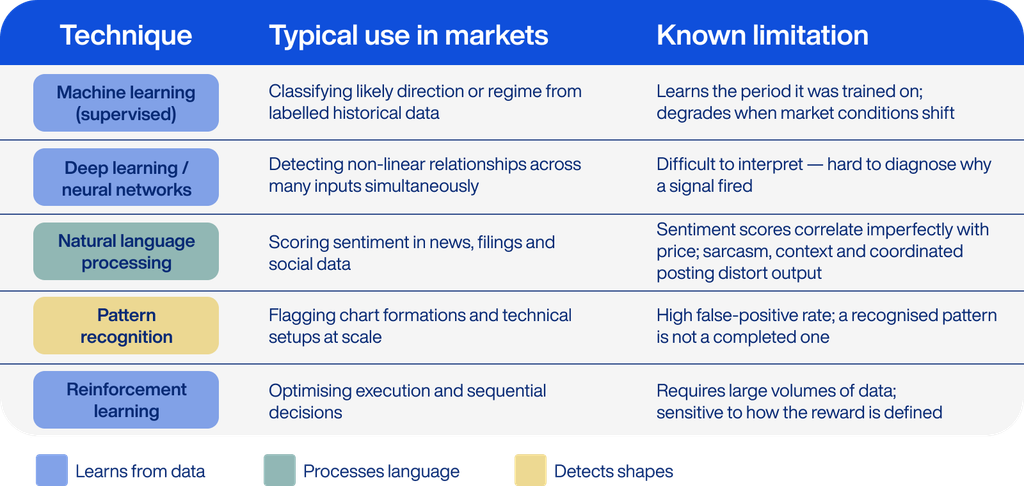
“AI trading” is an umbrella term that covers several distinct technologies. Each of these solves different problems, and traders need to understand how each one can fail, as well as succeed.
Artificial intelligence is the broadest term, and this spans several subsets, including:
- Machine learning, which infers patterns from vast amounts of historical data
- Deep learning, which uses layered neural networks to work out non-linear relationships within the data
- Natural language processing, which converts unstructured text (such as earnings calls and news wires) into something an AI model can score.
Many retail-facing AI trading tools operate within a narrower scope than their branding might suggest. In practice, these often focus on pattern recognition and signal generation and identify market conditions that resemble historical patterns. They use these to alert the trader to potential signals.
Key AI Trading Technologies
What is the Difference Between AI Trading and Algorithmic Trading?
Some of the discourse surrounding AI trading strategies conflates them with algorithmic trading, but the two methods describe different things.
Algorithmic trading is when a computer follows a predetermined set of rules to automatically carry out a trade.
An example could be a trader setting the algorithm to buy a stock when its price falls below its 20-day moving average, then sell it when it rises above it by 3%.
AI trading models, on the other hand, infer patterns from historical data to generate their own predictions or trading signals. These might be rules that the trader hasn’t thought of or even, in the case of deep learning models, decision logic that is difficult for humans to interpret or understand.
There is another important difference to bear in mind here. When algorithmic trading fails, the trader can usually trace the outcome back to a specific rule and adjust it.
When an AI system fails, it’s harder to detect the cause. Automation can easily repeat a flawed decision multiple times, and AI models tend to be complex – often, the underlying error is difficult to diagnose.
How Investors Are Building Trading Strategies with AI
Many beginner investors search for AI trading strategies that improve their performance, but there’s a danger to this. There are no reliable methods for guaranteeing higher returns. Indeed, if anyone promises this, then they are making false claims.
AI trading is a process of trial and error for most traders, particularly beginners. Some traders use similar processes to build what they believe to be effective AI systems, and use certain vocabulary to measure their results.
1. Data and Feature Engineering
Every trading model relies on a steady stream of reliable data. Price and volumes across timeframes were the bedrock of quantitative trading; Automated trading systems can now also incorporate alternative data, or information that falls outside conventional data.
Alternative data can include:
- News sentiment
- Positioning data
- Satellite imagery of storage tanks and shipping
- Card-spend aggregates
All of these may contain information that conventional market data misses, and traders can process large and messy data sets that would be extremely difficult to analyse manually.
Feature engineering turns this raw data into usable variables for AI models. Traders getting to grips with this find that Python’s pandas library is one of the most useful vehicles for this because it cleans and aligns datasets so that AI algorithms can detect potential relationships within them.
Flawed data is an obvious trap here. A model trained on it will give you confident output built on nothing.
Before judging what a model can predict, traders need to establish that the data feeding it is accurate in the first place.
Benjamin Roure L’Hermitte, founder of trading journal Tradoshi, describes the acceptance test his team used when integrating a broker’s data feed:
“The acceptance test was not ‘does it look right,’ it was realised P&L, commissions and swaps matching the broker statement to the cent. Until that (trading result) matches, every number downstream is decoration.”
This concept applies outside of broker integrations. A model can produce impressive results even when working with inaccurate or incomplete inputs, so traders must always make sure they are using high-quality data before measuring the strategy’s performance.
2. Choosing a Model Type
Choosing the right model depends on the problem you, as the trader, are trying to solve.
Supervised learning is useful when we can label historical examples, and the model needs to classify new situations. For example, logistic regression can, after training, use a set of historical inputs to estimate whether a stock is more likely to rise or fall.
Reinforcement learning, meanwhile, approaches it differently. This model is built to analyse sequential decisions, where each action affects what happens next, which makes it useful for problems such as trade execution and order routing.
The impressive capabilities of these models can give us a false sense of security, yet just because they are complex, it doesn’t mean that they are automatically better. A deep neural network can understand complicated relationships very well, but it can also mistake historical patterns for signals that will persist in live markets.
Research published in the Notices of the American Mathematical Society found that it’s easy to produce simulated performance simply by testing enough variations of a strategy. The more variations tried, the more likely the result is an artefact of the search rather than a finding.
The aim, then, is not simply to opt for the most sophisticated model, but the one that can capture useful patterns without simply memorising the past.
3. Turning Indicators Into Features
RSI readings, MACD crossovers, trend-following signals – all are familiar trading indicators to experienced traders, but they work differently in AI trading.
Each indicator might be enough to trigger a trade on its own in a conventional system, but it becomes just one input among many in an AI system. Its role has thus changed from instructing a trade to becoming a variable in an outcome prediction.
Experienced AI traders understand this and know not to rely on individual indicators to make decisions.
4. Backtesting and its Failure Modes
Every smart trader knows to backtest their strategy against historical data to estimate how it would have performed, but it is easy to make mistakes with this.
One of them is in-sample testing. This is when a trader assesses a model on the same data they use to train it. This might produce impressive results, but it does not show whether the model can handle data it has never seen before.
Instead, walk-forward analysis gives a more realistic picture by training the model on one period, then testing it on subsequent periods before moving the window forward.
Many traders, however, run into the problem of overfitting. A model can learn the quirks of historical data instead of patterns that are likely to continue. This can produce a strategy that looks excellent in testing, but withers in the face of unpredictable and changing conditions.
Slippage, changing spreads, and delays in execution can also lower real-world returns, particularly in areas such as forex trading. Traders need to factor these costs into their planning, and often forget to do so when trying out demos.
“Validating (trading models) on a demo account is a common mistake,” says Benjamin Roure L’Hermitte. “Fills are perfect, spreads are polite, and nothing slips; then (traders find that they) meet the real market with a system that was never tested against friction.”
5. Reading the output honestly
Quality backtesting should provide a set of insightful metrics, but traders should never take these as a guarantee of future performance.
The Sharpe ratio, for example, measures the level of returns relative to volatility, but it does not show how these returns are generated or whether the risk-adjusted performance will continue in live markets.
Maximum drawdown, meanwhile, shows us the largest decline (peak to trough) the strategy has experienced, so it indicates how severe losses could be during the test period. It cannot predict the size of future drawdowns or set out the maximum loss a strategy could incur.

The “hit rate” shows the percentage of trades that were profitable, but tells you little on its own. A strategy that wins three trades out of ten, for example, can still produce different results from one that wins seven. It simply depends on the size of its winning and losing trades.
Traders need to remember that these are just measurement tools, but do not confirm how a strategy will perform in live markets.
Which AI Tools Do Professional Traders Use for Market Analysis?
AI tools are diverse and new options regularly enter the market. We can, however, group them into three general categories according to their function.
1. Charting and Pattern Recognition
The trading fundamentals that have served traders well for years still play an important role. TradingView is perhaps the most well-known charting tool, and along with rival platform TrendSpider, it now includes AI-overlay scanners which can automatically flag formations across large symbol lists.
2. Automated Trading Signals and Bots
An AI trading bot converts a model’s predictions into actual orders, but to put it on autopilot needs several contributing factors.
A robot trader needs a reliable data feed, access to a broker or execution venue, position-size controls, and monitoring for conditions that are outside what the system was designed to handle. The bot also needs appropriate permissions or access to execute orders.
3. Sentiment and News Analysis
Many traders use general-purpose LLMs (large-language models) like ChatGPT and Claude as research assistants. These excel at natural language processing so they can summarise a filing, earnings call, or even a week of macro commentary in seconds.
Their access to live data, however, can vary, so many are not designed for markets. Sentiment and reality can easily drift apart, sometimes quickly.
Abdelali El Khadmaoui, founder and chief research analyst at Trading Market Signals, watched it happen. His team tested AI-generated summaries built heavily on news sentiment, and the models read a wave of glowing private credit headlines as bullish.
“The underlying fund data told a different story,” says El Khadmaoui. “Redemption requests were accelerating while liquidity restrictions were expanding. Had we relied on sentiment alone, we would have missed the real risk.”
The headlines may have been cheerful, but the fund flows certainly were not.
This is where broker-integrated tools show their worth. The Acuity Research Terminal, available through Daman Markets, scores sentiment against live market data inside the trading environment, which is useful for traders wanting to compare what the market is saying with what it is actually doing.
It sits alongside the rest of the platform, including MetaTrader 5 and AED-denominated accounts.
Sentiment tells you what people are saying. The next category of tool deals with what the price is doing.
AI trading tools are useful, but you still need a deep knowledge of the market to perform well. Sign up at Daman Markets to get regular expert insights to help you stay on top of the markets.