

 ar

October’s earnings season will test whether companies can keep delivering strong profits despite higher borrowing costs and persistent inflation.
The October 2 trading session captured that tension. Weak labor market data reduced expectations for another Fed rate hike, pushing the Nasdaq 100 up 1%. However, long-term bond yields remained elevated, with the 10-year yield trading around 5.28% and the 30-year at 5.63%.
With Q3 earnings coming up, companies must sustain growth while investors reassess how much they are willing to pay for it.
Inflation Relief Meets Elevated Energy Costs
The latest inflation figures showed some relief to the economy. August’s PCE index came in lower than expected, with the headline figure coming in at 3.4% YoY and core at 3%, both below their forecasts, but still above the Fed’s 2% target. Meanwhile, inflation-adjusted consumer spending rose 0.6%, showing that demand remained resilient. ⁽¹⁾
However, the release included revisions and changes to price measurement, so the improvement cannot be attributed entirely to easing price pressures.
Europe is more exposed to the energy shock. September’s flash CPI estimate came in at 3.8%, up from August’s 3.2%, with energy prices rising 18.8% YoY. Expensive fuel and utilities continue to threaten both household purchasing power and business margins. ⁽²⁾

Oil supply is improving unevenly. Goldman Sachs’ latest estimates showed that Gulf crude exports rose above their 2025 average, while diesel, gasoline and jet-fuel exports remained around half normal levels.
Last Friday, the G7 agreed to release 100 million barrels of crude and diesel from emergency reserves. Despite this, Brent still remained above $100 per barrel. OPEC+ agreed on October 4 to keep November production targets unchanged. ⁽³⁾
For companies, the practical test is whether these measures deliver sustained relief in transport and operating costs.
Three Central Banks, Different Decisions
The Fed’s upcoming meeting on October 28 follows a softer employment report, with September payrolls increasing only by 29,000, the unemployment rate rising to 4.2%, and annual wage growth slowing to 3.0%. July and August employment gains were also revised down by a combined 60,000. ⁽⁴⁾
Financial markets are currently pricing in an 18% chance of a rate hike, down from last week’s 64% as the weak labor report strengthens the case for a hold, but September’s inflation data could still change expectations. ⁽⁵⁾
The ECB faces a difficult inflation-growth trade-off after hiking its deposit rate to 2.50%.
The ECB meets on October 29, with higher eurozone inflation adding pressure to tighten, while its September forecast of just 0.9% growth in 2026 highlights the economic constraint. Policymakers must assess whether energy costs are spreading into wages and broader pricing. ⁽⁶⁾
France’s debt and budget concerns have widened its borrowing premium over Germany, showing how fiscal risks can push yields higher independently of central-bank policy, pushing the euro down to a 17-month low.
In the Far East, the Bank of Japan’s pace of tightening remains the main question for yen traders after September’s hike to 1.25%. Tokyo core inflation rose to 2.7% in September from 1.8% in August, adding more inflation concerns. Domestic demand and wage developments will help determine whether another immediate increase is justified. ⁽⁷⁾
Why a Fed Pause Might Not Lower Borrowing Costs
Long-term yields could remain elevated even if the Fed pauses. This is due to high government debt, inflation uncertainty and the higher compensation investors are demanding for holding long-term debt.
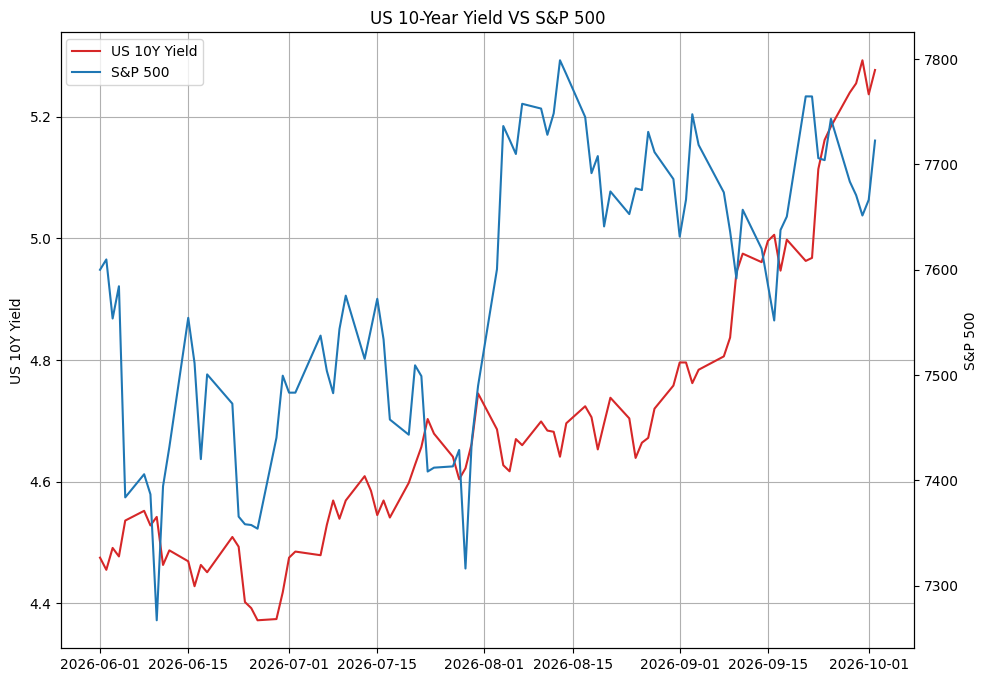
Friday’s early rally in Treasury bonds faded despite the weaker employment report.
The effect on earnings depends on each company’s financial health and debt structure. Companies with fixed-rate debt and distant maturities face less immediate pressure. Businesses refinancing using floating-rate loans or issuing new debt are more exposed to higher borrowing costs.
Valuations can react faster. Higher yields make bonds more attractive and can reduce the value investors place on companies’ future cash flows.
Gold faces a related challenge. Spot gold traded around $4,150 an ounce today and remains pressured by yields. Real yields matter alongside nominal yields: Treasury’s 10-year inflation-protected yield stood at 2.92% on October 2. Higher real returns on bonds increase the opportunity cost of holding gold, although demand for protection can offset that pressure. ⁽⁸⁾
Earnings Face a Higher Bar
Analysts expect S&P 500 earnings to grow 29.5% year over year in Q3, up from the 26.7% growth forecast made on June 30. Revenue growth is expected to reach 12.3%, with all eleven sectors projected to report higher earnings than a year earlier. ⁽⁹⁾
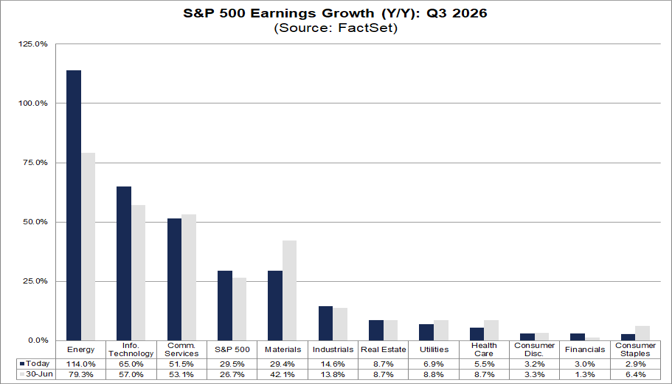
Guidance will continue to carry more weight in earnings. Investors need proof that demand, margins and cash generation can hold up through Q4. Strong results could offer limited support if companies downgrade their outlook or show rising financing costs.
For tech companies, investors are still questioning how AI revenue compares with the spending required to make it. Chip suppliers need to show high demand and profitability expansion. Cloud and software companies need to show that their spending is bringing in paying customers and generating cash.
Banks face different challenges. Higher rates can increase income on loans, but deposits and wholesale funding costs threaten profits from loans. Their reports need to show stability alongside manageable credit losses. Increased provisions and delinquencies could show pressure on borrowers, even if the banks remain profitable and healthy.
Reports from consumer staples and discretionary businesses will show whether spending remains strong enough to support sales volumes. Recently, Nike’s fiscal Q1 2027 earnings showed a 4% decline in revenue, with the company also forecasting a high single-digit decline in revenue for fiscal 2027. ⁽¹⁰⁾
Nike faces company-specific challenges, so its results should not be treated as evidence of broad consumer weakness. However, they show that strong overall spending does not guarantee growth for every company.
Energy creates uneven outcomes across sectors. Producers can benefit from elevated prices, and some refiners may gain from tighter fuel markets. Airlines, transport businesses and manufacturers face higher input costs.
Valuations from these companies can also be tied to the bond market. A report from FactSet recently put the S&P 500’s forward P/E at 19.0, below its five-year and ten-year averages. ⁽¹¹⁾
Even so, shares can fall despite rising profits if higher yields make investors willing to pay less for future earnings.
What Would Change the Picture?
October’s outlook depends on whether the pressure surrounding corporate earnings begins to ease.
Broader inflation relief, improved energy supplies, stable or declining long-term yields and sustained earnings could help sustain the ongoing momentum in the stock market and give central banks some room to remain on standby.
The main question remains whether companies can keep generating profits under tougher economic conditions, and whether investors will continue paying the same valuations for that growth.


