ar
ar
- US business activity reached a five-year high in September, while eurozone growth strengthened and UK growth slowed.
- Higher energy and transportation costs are adding to price pressures, making it more difficult for central banks to manage both growth and inflation.
September’s flash PMI surveys from S&P Global show diverging trends among the world’s largest developed economies. US and eurozone firms are expanding at their fastest rates in years, while UK businesses are slowing.
Rising costs are a common challenge across all three regions. Companies in the US and Europe are dealing with disrupted shipping routes and higher energy prices due to the conflict in the Middle East, increasing pressure on central banks as they consider further rate hikes.
US Growth Hits a Five-Year High
The composite PMI index for the US rose to 58.4 in September, reaching its highest level since July 2021, up from August’s 56.0 reading. According to S&P Global, September’s survey pointed to annualized economic growth of around 5%, while the third-quarter survey data indicated growth of around 4%. ⁽¹⁾
The manufacturing PMI also surprised economists, jumping to 57.0 from August’s 53.9 reading and well above expectations of 53.6, The reading marked its strongest performance since May 2022 as production growth rebounded after weakening for three months. ⁽²⁾
The services PMI expanded with a strong reading of 58.7 from 56.5, its highest reading in over five years. New orders rose the most in over four years, supported by strong demand from domestic consumers, enough to reduce lower export orders as tariff uncertainty deterred some international clients. ⁽³⁾
Input prices climbed to their highest level since October 2022, and suppliers reported the longest delivery delays since mid-2022. Higher energy and transportation costs, along with supply constraints tied to the Middle East conflict, drove the increase.

Businesses across manufacturing and services stepped up in hiring to work through their backlogs, but many said they are having trouble finding qualified staff. Economists warn that this combination of gains could give companies more room to hike their prices, which could complicate the inflation outlook. ⁽⁴⁾
Euro Zone Expansion Beats Forecasts
Across the Atlantic, the eurozone’s composite PMI index rose to 53.1 from 52.0, coming in above its forecast. Growth was broad-based, with both manufacturing and services expanding at 52.7 and 53.0, respectively, as new orders rose at their fastest pace in more than four years, supported by stronger exports. ⁽⁵⁾
Firms in the eurozone are also facing higher input costs tied to energy prices, and many of them have started passing these costs on to consumers. The ECB hiked rates recently for the second time this year and warned that price pressures could persist. Financial markets are pricing in three additional rate hikes by 2027. ⁽⁶⁾
Britain Slows as Inflation Pressure Builds
UK growth slowed, with the services PMI falling to a three-month low of 51.7 from 52.5. The composite PMI also declined to 51.7 from 52.5. ⁽⁷⁾
S&P Global estimated quarterly growth of just 0.1%, a sharp slowdown from 0.4% in the previous quarter. Prices charged by service firms rose at their fastest pace in four months, adding to concerns already facing the government ahead of its October budget. ⁽⁸⁾
Manufacturing was a bright spot, with its index rising to 52.0 from 51.7, supported by stronger domestic orders. ⁽⁹⁾
On Tuesday, before the PMI release, markets were pricing in roughly a 60% chance that the Bank of England would raise rates at its November meeting, as policymakers weighed soft growth against building price pressure. ⁽¹⁰⁾
Dollar Shines, Euro and Pound Drop
The strong data supported the US dollar and pushed Treasury yields higher. The 2-year yield rose 10 basis points to 4.88%, while the 10-year yield climbed to 5.08%, its highest level in 19 years, as expectations for a Fed rate hike increased.
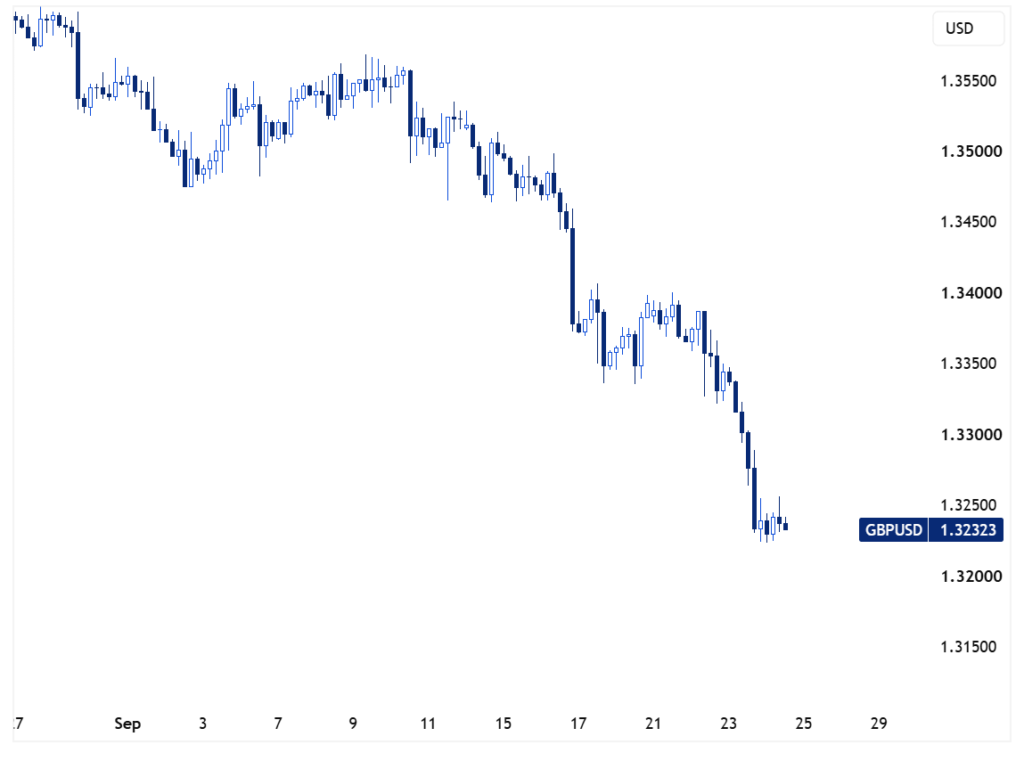
The pound fell more than 100 pips after business activity slowed and missed expectations. The euro slipped 0.5% despite strong PMI results, as concerns over energy supplies resurfaced.