ar
ar
- Oil trades through a globally connected market, while natural gas remains more regional: Henry Hub represents the US, TTF Europe and JKM Northeast Asia.
- The US shale boom helped break the historic link between US gas and oil prices. A shared chokepoint like the Strait of Hormuz can still pull both prices back into sync during a crisis.
- The UAE imports gas from Qatar through the Dolphin pipeline while expanding domestic production and LNG export capacity, making both regional gas developments and global oil benchmarks relevant to GCC traders.
Oil and natural gas come out of many of the same wells. Both are priced in dollars, and both sit at the centre of GCC energy exports.
The price of natural gas still doesn’t move like the price of oil.
Oil trades on a handful of global benchmarks. Brent and WTI respond to OPEC+ decisions, tanker routes and demand from Asia, Europe and the US all at once. A barrel loaded in the Gulf can reach almost any refinery on earth within weeks.
Natural gas doesn’t have that flexibility. It trades on separate regional prices instead: Henry Hub in the US, TTF in Europe and JKM in Asia.
The large differences between oil and gas prices say less about their relative value than about how differently the two fuels are transported, traded and priced. ⁽¹⁾
Why Gas Splits Into Three Markets and Oil Doesn’t
Oil is a liquid and can be pumped onto almost any tanker and delivered almost anywhere, which is why the world settles on one or two reference prices for it.
Natural gas is considerable more difficult and expensive to transport. To move it any real distance, it either needs a pipeline or it needs to be chilled into liquefied natural gas, shipped, then turned back into gas at the other end. ⁽²⁾
That infrastructure is expensive and regional. A pipeline built to move Qatari gas to the UAE cannot easily redirect that gas to Japan.
The result is three distinct benchmarks that respond primarily to regional conditions, although growing LNG trade increasingly connects them.
Henry Hub reflects US production, storage and weather. TTF reflects European storage, pipeline flows and LNG imports. JKM reflects the price of spot LNG delivered to Northeast Asia, including shipping and regional procurement costs. ⁽³⁾
What Actually Moves Gas Prices Day to Day
Storage is the biggest driver in every region. When storage levels run low heading into winter, prices tend to rise quickly because there is little buffer left if demand spikes.
Weather does the rest. Cold winters lift heating demand. Hot summers lift power demand for air conditioning, which increasingly means gas-fired generation.
This is different from oil, where a single geopolitical headline can move the global price within minutes. Gas usually needs a supply or demand shift inside one specific region before its price reacts.
When a Shared Chokepoint Pulls Both Markets Together
The exception is when oil and gas share the same physical route.
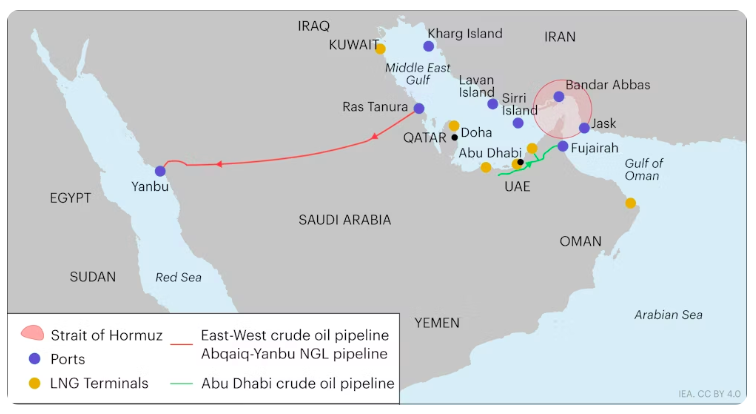
The Strait of Hormuz carries roughly one-quarter of globally traded seaborne oil. It also handles almost one-fifth of global LNG trade, including around 93% of Qatar’s and 96% of the UAE’s LNG exports. ⁽⁴⁾
During in July 2026, renewed tensions around the strait pushed oil prices sharply higher. European TTF gas prices moved with it, climbing above €60 per megawatt-hour by late July, close to levels last seen during the earlier phase of the conflict. ⁽⁵⁾
That correlation isn’t the normal state of the market. It only shows up when a single chokepoint threatens both fuels at once.
Gas Prices Can Also Move Without Oil Moving at All
Gas can swing hard on its own logic too. A mild winter that leaves storage fuller than expected can pull prices down even while oil holds steady.
New export capacity has the same effect. As more LNG terminals come online globally, added supply can weigh on regional prices independent of anything happening in oil markets.
The UAE is a live example of this dynamic. The UAE imports around 1.7 billion cubic feet of gas a day from Qatar through the Dolphin pipeline, a contract due to expire in 2032, while developing new LNG export capacity of its own, including the Ruwais plant and a reported new facility at Fujairah. ⁽⁶⁾
That expansion is aimed at gas self-sufficiency by 2030, a supply decision with little connection to where oil prices happen to be trading.
Takeaways
Oil and natural gas share wells, dollars and geography, but they price differently because they move differently. The mechanism comes down to a few forces:
- Oil moves as one global market because it ships easily.
- Gas trades as three regional markets because pipelines and LNG terminals tie it to specific routes.
- Storage and weather drive gas day to day, while oil reacts faster to global headlines.
- Shared chokepoints, like the Strait of Hormuz, can pull both prices together temporarily, even though they usually move apart.
For GCC traders, that means tracking two separate stories rather than just one. Oil price moves tend to ripple through the wider UAE economy directly, while gas price moves depend on which regional benchmark, and which regional weather pattern, is in play that week.