ar
ar
- Perpetual futures are entering US markets, offering non-expiring leveraged trades but raising concerns over funding costs, liquidations, and retail losses
- The CME is suing the CFTC over approval, while Coinbase is expanding into leveraged bets on private firms like OpenAI and Anthropic.
A new type of derivative is entering US financial markets.
Perpetual futures are contracts with no expiry date, allowing traders to hold leveraged positions without rolling them over.
Long popular in overseas crypto markets, these products are now making their way to the US, drawing interest from traders while also stirring debate among major exchanges.
What Are Perpetual Futures?
Perpetual futures are derivative contracts that have no expiration date. Unlike traditional futures, traders can hold their positions without rolling them over into new contracts.
To keep the contract price close to the underlying asset, perpetuals futures have what’s known as a funding rate, which is a periodic payment between buyers and sellers based on the contract’s premium or discount to spot value.
The structure offers greater flexibility compared to traditional futures, as perpetual contracts do not have an expiry date and therefore do not require contract rollovers.
They also provide access to leverage, which can increase market exposure, although it can amplify both potential gains and losses.
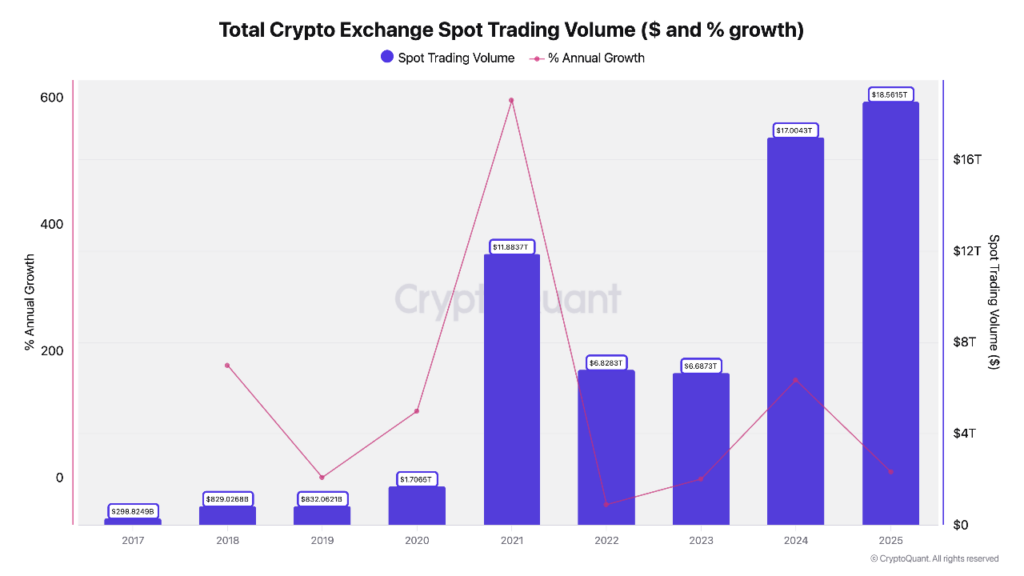
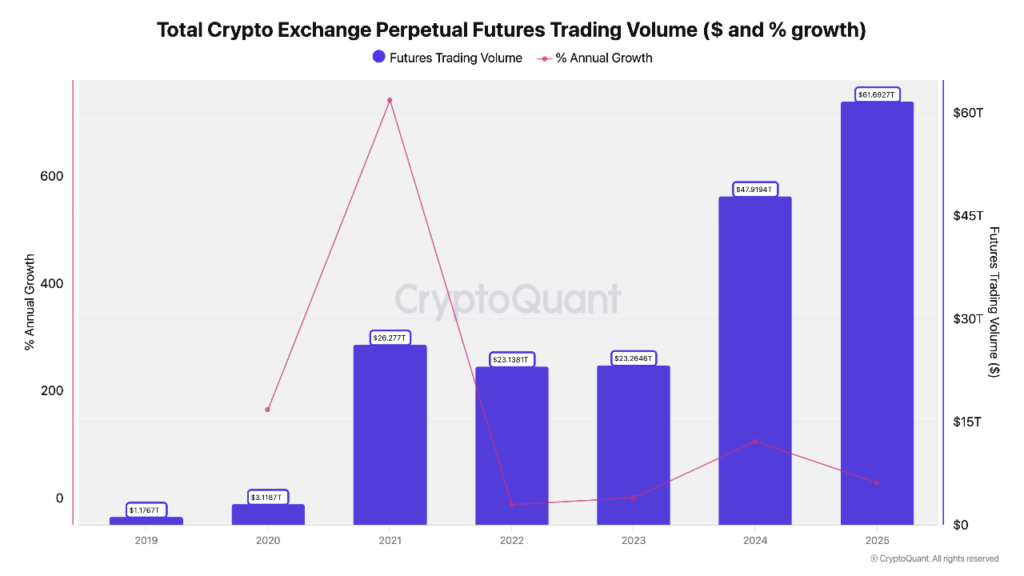
The charts highlight the growing dominance of perpetual futures in crypto markets. While spot trading volumes have recovered strongly, perps have grown much faster and now represent a much larger share of overall trading activity, reflecting the market’s shift toward leveraged derivatives.
The CFTC Opens the Door for Perpetuals
On May 29, the Commodity Futures Trading Commission (CFTC) gave the green light for perpetual futures tied to cryptocurrencies to be listed in US exchanges. Prediction markets received approval to list them, and Coinbase was allowed to give perpetuals access to its US clients. ⁽¹⁾
The CFTC also published a regulatory framework giving other registered US platforms a path to launching their own perps.
Crypto markets responded quickly. Within weeks of launch, Kalshi’s crypto-linked perps crossed $8.5 billion in trading volume. Coinbase, for its part, has recorded more than $211 billion in notional volume from perpetual-style contracts since July 2025. ⁽²⁾
The Old Guard Pushes Back
However, the growth of perpetual futures has also raised some industry concerns. CME Group CEO Terry Duffy has warned that traders need to fully understand how these products work, especially when leverage is involved.
One area of focus is the auto-liquidation mechanism, which can automatically close positions during sharp market moves. While this feature helps exchanges manage risk and keep markets functioning, traders should be aware that it can also amplify losses if positions are not properly managed.
When President Trump announced a surprise 100% tariffs on China late last year, the event resulted in a selloff that erased more than $19 billion in leveraged positions in a matter of hours. ⁽³⁾
CME filed its lawsuit against the CFTC on June 18, 2026, arguing that Kalshi’s perpetual contracts should be treated as swaps under Dodd-Frank rather than listed as futures. The CFTC, Kalshi, and Coinbase pushed back, framing the lawsuit as resistance to competition rather than a defense of investors. ⁽⁴⁾

Coinbase Goes Further: Pre-IPO Perps
Coinbase isn’t just pushing for perpetual crypto. The exchange recently launched perpetual futures contracts tied to private companies that have not yet gone public, including OpenAI and Anthropic. Eligible non-US traders can now take a leveraged position on the implied valuation of these firms without buying actual shares. ⁽⁵⁾
Instead of trading on a per-share price, these contracts are tied to the company’s overall valuation. A contract priced at 1,800, for example, implies a $1.8 trillion valuation for the company. Profits and losses are settled in stablecoins. ⁽⁶⁾
These contracts carry no shareholder rights, no voting power, and no equity, they are purely a bet on where traders think the company is valued.
What It Means for Markets
The arrival of perps in the US could signal something bigger than a single product launch. Crypto exchanges are positioning themselves as all-purpose speculative markets, packaging exposure to assets, from oil futures to private-company equity, using crypto infrastructure.
Whether that is a genuine expansion of market access or a new way to expose retail traders to products they do not fully understand is a question regulators, investors, and the courts will be figuring it out for some time.