ar
ar
“How to start CFD trading” is a search term of high interest in the UAE financial markets right now. Many people are looking for smarter ways to access global markets, and CFD trading can be one of them.
Yet, like with all trading, there’s a risk. Get CFD trading right, and you have a useful financial instrument in your hands. Get it wrong, and the losses arrive before the lessons do.
As a trader new to this discipline, it’s easy to fall into certain traps, including:
- Opening a live position before grasping how CFD margin, spreads, and closing prices work.
- Underestimating the exposure a seemingly modest position can carry.
- Choosing a broker or platform that isn’t built for a UAE market governed by different regulations and protections.
None of these are unusual mistakes, but you can avoid them with some groundwork before you begin.
This guide is an example of that. What follows is a practical look at how to start CFD trading in the UAE: we’ll look at how CFDs work, what local regulation looks like, and which strategic approaches are worth understanding before real capital goes to work.
- What is CFD Trading?
- CFD Trading for Beginners: Which UAE Regulations Should You be Aware of?
- How Leverage and Margin Work in CFD Trading
- What Can You Trade? CFD Markets and Asset Classes
- CFD Trading Strategies for Beginners
- How to Start CFD Trading with Confidence
Knowing how to trade CFDs is a useful skill, but only if you use the right platform. Open a live or demo account with Daman Markets today and make the best possible start to your CFD trading journey.
What is CFD Trading?
A CFD (contract for difference) gets its name because it’s an agreement between you (the trader) and the broker to exchange the difference in an asset’s price between when the position opens and when it closes.
If you expect the price to rise, you take a long position. If you think it’ll fall, you take a short position. Both directions are available to you at any time, which is one of the more practical advantages CFDs hold over traditional instruments.
What’s the Difference Between CFD Trading and Spot Trading?
In spot trading, you own what you buy. CFDs work differently: you open a position on price movement and settle the difference at closing, and the underlying asset never changes hands. The CFD tracks the underlying asset, which can be a stock, index, commodity, or currency pair, hence why it’s called a financial derivative.
What changes, often quickly, is your exposure. CFDs introduce leverage in a way that spot trading typically does not.
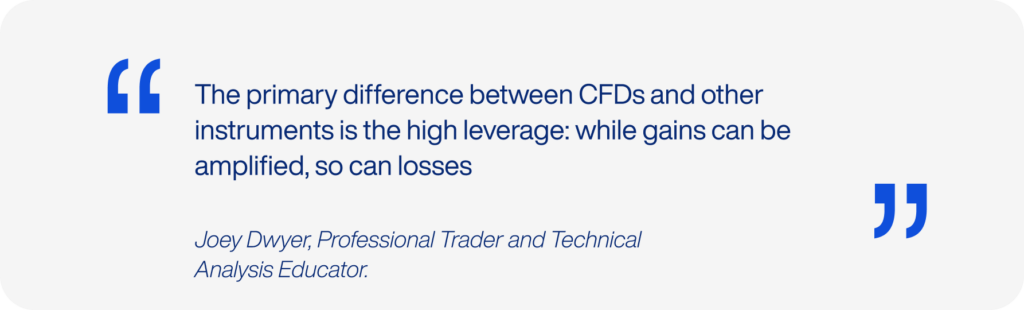
“The primary difference between CFDs and other instruments is the high leverage: while gains can be amplified, so can losses,” says Joey Dwyer, a professional trader and technical analysis educator. “It is important to determine the max amount of money you are willing to risk on the trade as well as the price level where your thesis is invalidated.”
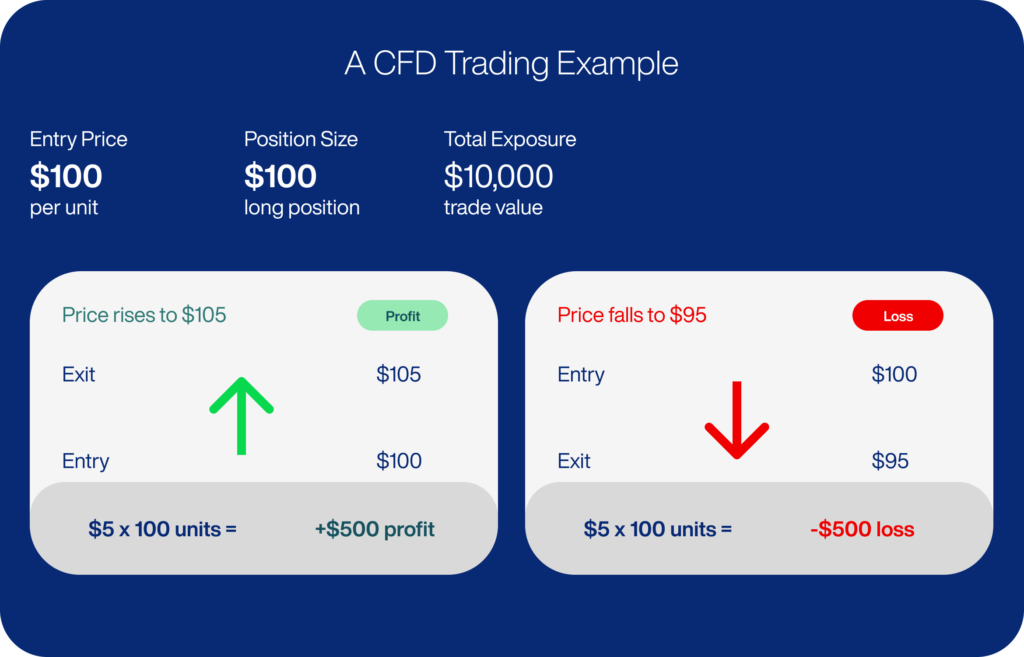
Let’s take a look at a simplified CFD trading example (without leverage) to make this crystal clear:
- You open a long CFD position on a stock priced at $100, with a position size of 100 units.
- The market price moves to $105.
- At closing, the profit is $500, which is the $5 difference multiplied by the 100 units.
The same is true for losses. Had the price dropped to $95 instead, you’d have made a loss of $500.
A CFD Trading Example
One more detail the example above doesn’t show is the spread (also called the bid-ask spread). Every CFD has a buy price and a sell price, and the gap between them is where the broker’s cost sits. A position starts slightly in the red for this reason, so the asset’s price needs to move enough to cover the spread before a trade turns profitable.
CFD Trading for Beginners: Which UAE Regulations Should You be Aware of?
You could spend weeks researching CFD trading, but it doesn’t mean much if lax regulation puts your trade in danger. Thankfully, the Capital Market Authority (CMA), formerly known as the Securities and Commodities Authority (SCA), oversees CFD trades in the UAE, including the financial instruments used and the brokers that offer them.
The CMA is a federal body, and any broker providing CFD access inside the UAE must hold its license. This will make sure they offer the right protections, provide the correct disclosures, and have the correct recourse should a trade go wrong.
You may have traded in other markets previously. If so, then you should be ready for some key regulatory differences. The CMA framework is different from Cyprus’s CySEC and Australia’s ASIC, but that could be favourable if you’re a new CFD trader.
“The CMA framework actually helps (new traders) by enforcing stricter oversight, clearer leverage limits, and stronger client protections compared to many offshore regulators,” says Deepak Shukla, founder of Pearl Lemon Invest, a business financing firm.

Some of the regulatory protections include margin requirement disclosures – where you are told exactly how much capital is required to open and maintain a position – and mandatory risk warnings – where brokers must ensure traders understand the implications of the positions they are entering.
While not an SCA requirement, some locally regulated brokers also offer AED-denominated accounts alongside USD equivalents, which takes away the currency conversion layer that comes with offshore platforms. For traders whose financial life is based in dirhams, it’s a detail that quietly pays for itself.
Working with a CMA-regulated broker like Daman Markets means you automatically operate within a framework built for this market.
What Can You Trade? CFD Markets and Asset Classes
Many traders get lost among different setups for different asset classes, but the right CFD trading account will let you access a range of markets from one place.
Here’s a look at some important examples.
Forex and Stock CFDs
Forex CFDs cover the world’s major currency pairs, including EUR/USD, GBP/USD, USD/JPY, and work similarly to spot forex but with no physical exchange of currency.
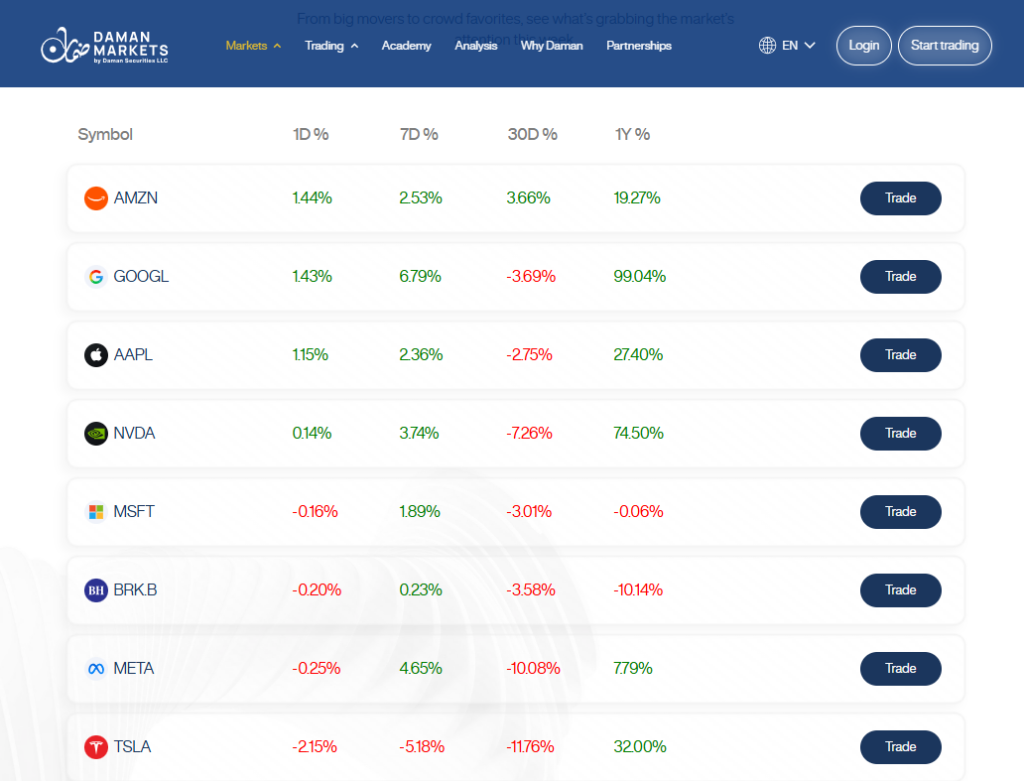
Stock CFDs work in the same way for equities. Say you take out a position on Tesla: your CFD will track the share price, but without the overheads (such as custody fees) that come with actually owning the share.
The best online trading platforms in the UAE come with a wide selection of these CFDs, and should make it simple for you to move between asset classes without friction.
Daman Markets’ Wide Selection of Stock CFDs
Index and Commodity CFDs
Index CFDs provide you with exposure to price movements in benchmark indices like the FTSE 100 without owning assets like index funds or exchange-traded funds.
Commodity CFDs cover hard assets like crude oil and gold, which UAE-based traders tend to follow closely. Even though CFDs simplify the entry point into these markets, it’s still a wise idea to study how to trade crude oil futures and how to invest in gold in the UAE before opening a position.
Crypto CFDs
We all know about the volatility of Bitcoin and other cryptocurrencies, but you can sidestep the infrastructure risk and start trading on price movement alone. That means no wallets, no private keys, and exchange risk.
How Leverage and Margin Work in CFD Trading
Leverage isn’t unique to CFDs, but the way it behaves in practice catches more traders off guard than most would admit.
The concept is familiar: you control a position larger than the amount of capital you’ve deposited. However, a leveraged CFD position can respond surprisingly quickly to a market movement when real money is involved.
Here’s what this can look like in real terms, including margin and volatility.
Margin
A quick reminder: the margin is the percentage of a position’s total trade value that you, the trader, must put up. A 10% margin requirement on a $10,000 position means you must use $1,000 of your capital, while the broker extends the rest.
This works both ways: a 10x leveraged position that moves 5% in your favour returns 50% on committed capital. The loss is the same if it moves 5% against you. Potential profits and potential losses scale with leverage in equal measure.
Volatility and Leveraged Positions
The more leverage you have, the more market exposure you get. A market move of 1% isn’t drastic normally, but with a leveraged CFD, it has a much deeper impact.
The more prepared and less complacent you are, the less you’ll be punished by a fast market that moves the wrong way.
Potential Leverage Limits in the UAE
The CMA recently proposed a ceiling on leverage (which varies by instrument type) to avoid these multipliers becoming unmanageable.
This new limit would be prudent if it came into effect, but it may appear conservative if you’re arriving from a market with higher allowances.
CFD Trading Strategies for Beginners
The best CFD trading strategies are those that provide a framework for making consistent decisions in unpredictable markets, instead of promising a quick-win formula.
It’s worth understanding the following strategies before putting down your hard-earned capital.
1. Day Trading
CFD day trading avoids overnight exposure and lets you open and close positions within a single day.
It works well for traders looking for control via defined risk windows and lets them watch price movements in real time.
2. Swing Trading
Swing trading looks at the longer-term picture of several days or weeks and targets larger price movements rather than intraday noise.
With this, you’ll spend less time on your screen than day trading, but it requires more tolerance for positions moving against you before they might move in your favour.
3. Hedging
CFDs are an effective mechanism for hedging existing positions.
If you would like to protect against short-term downside in a long-term stock, then a short CFD lets you offset some of the risk without closing your original position.
The chart below shows how this works in practice.
One Position Falling, One Position Gaining: Hedging in Action
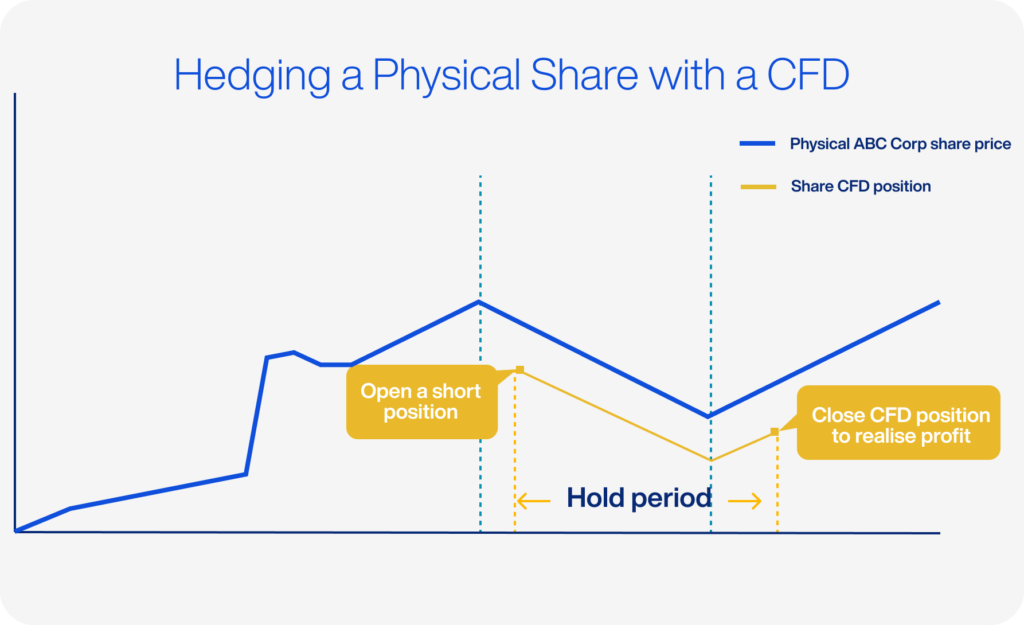
Note that the CFD position doesn’t eliminate the loss on the physical share; it offsets it, buying time without forcing an exit. For traders more interested in momentum than protection, the next strategy takes a different approach entirely.
4. Trend Following
When you believe a market is moving in a certain direction, trend following lets you open positions that align with that direction, instead of calling reversals. This is where the best trading indicators, like moving averages, RSI, and momentum signals, come into play.
“A simple approach to the markets for a beginner starts with identifying a status quo within the price action,” says Joey Dwyer. “This could be either an EMA or SMA that the price is riding along, or a trend (i.e., defined by higher lows and higher highs, or lower lows and lower highs). You can then set up plays for continuation of the status quo, or wait for a shift to activate a counter-trend trade.”
In other words: identify what the market is doing, then decide whether to trade with it or wait for it to change.
Trend following works better in trending markets rather than choppy ones, where it’s much more difficult to confidently identify a market trend.
How to Start CFD Trading with Confidence
The best CFD trading strategy in the world means little if you’re using a platform that can’t execute it correctly.
Certain foundations must be in place before you open your first position. In the UAE, that means using a broker that’s SCA-regulated, locally experienced, and built for the instruments you intend to trade.
Daman Markets provides fast access to an array of global markets with its wide range of regulated CFDs. You can go long or short as conditions change and manage open options across multiple asset classes from a single trading account – with transparent fees and conditions.
You can take your first steps with a demo account, where you can get familiar with the platform and its features while testing real market conditions with virtual funds. You also get access to Daman Markets Academy, where you can learn the risk management tools that separate informed trading from expensive guesswork.
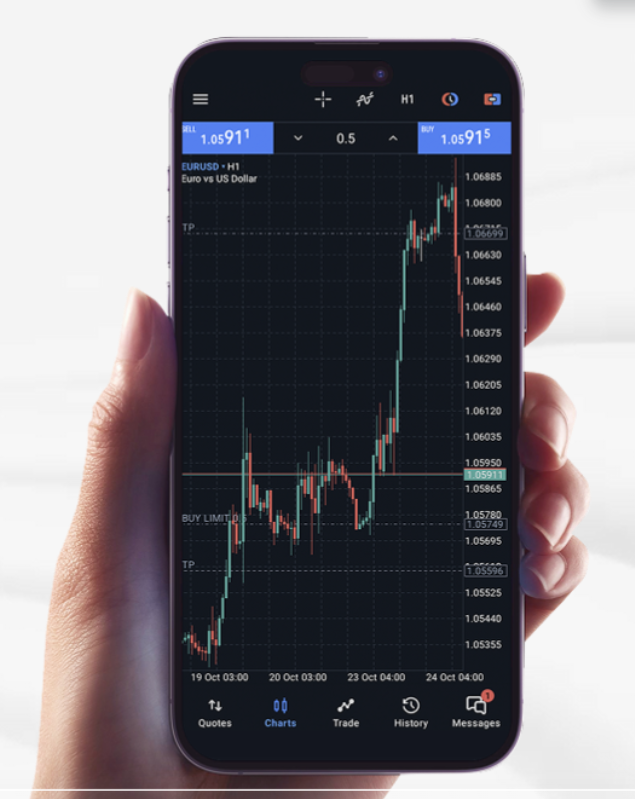
When you are ready to go live, Daman Markets works in tandem with MetaTrader 5, an award-winning platform with real-time pricing, advanced charting tools, and execution speeds that hold up when markets move fast. The platform is available on desktop and mobile, which is useful when markets move faster than your commute.
Access Your Trading Account From Your Smartphone
If you’re based in the UAE, you get an AED-denominated account that removes the currency conversion friction that offshore CFD trading platforms quietly introduce.
With twenty‑five years of regional expertise behind it, Daman Markets’ platform puts that experience to work for you from your very first trade.
Want to start trading CFDs with confidence? Sign up with Daman Markets today to trade with precision, speed, and trusted local support.
FAQs
How to trade CFDs for beginners?
Many people rush into CFD trading with real money, but make a loss because they haven’t had any first-hand experience
A demo account with a regulated CFD broker is a great way to go for a test drive. It lets you get familiar with the platform and practice managing positions without risking real capital.
Once the basics feel solid, such as knowing how margin works, how to set stop-loss orders and take-profit levels, and how to size a position, then it’s time to move to a live CFD trader account
Start small, pick one or two markets, and treat the first few trades as part of the learning process.
Is CFD trading good for beginners?
It can be, providing you put in the right groundwork.
While CFDs give access to a wide range of markets from one place, they also come with an amplified risk, which is why experienced traders use a risk management strategy.
Is CFD trading profitable?
CFD trading can generate returns in both rising and falling markets, which gives it a structural advantage over instruments that only profit in one direction.
Yet it’s difficult to call it profitable because so many other factors come into play. You must have a clear idea of your risk tolerance, build your strategy around that, and make sensible trading decisions.
Many retail investors lose money trading CFDs simply because they underestimate leverage and trade without a clear strategy – or by using the wrong broker.
Is CFD trading halal or haram?
This is a general guide and not the right source for the answer to this question. Instead, a qualified Islamic finance advisor will be able to guide you through the permissibility of CFDs under Islamic finance principles.