

 ar
The availability and cost of US dollars are some of the most powerful forces shaping global financial markets.
It’s widely known that when the greenback strengthens, it doesn’t just move currency markets, but also all financial markets.
Recent market behavior has indicated what drives the dollar and other markets. While headlines typically focus on individual assets in isolation, understanding dollar liquidity reveals the common thread connecting cross-asset volatility.
USD Funding: The Global Reserve Currency Effect
The US dollar remains the world’s dominant reserve currency, with over 60% of global foreign exchange reserves held in USD.
This means countries, corporations, and investors worldwide need dollar funding to conduct international trade, service debt, and maintain financial stability.
As the world’s dominant reserve currency, the US dollar continues to drive cross-asset movements, particularly during periods of geopolitical stress or shifting Fed policy expectations.
Over the past 2 years, liquidity conditions have remained tight as interest rates sit higher. This has kept Treasury yields up, alongside persistent geopolitical tensions.
Emerging Markets: A Consistent Relationship
The US dollar and emerging markets tend to have an inverse relationship, meaning that as the dollar weakens, emerging markets (EM) usually rise, and vice versa.
Since April 2024, emerging markets have benefited from a weaker dollar. As risk-on sentiment improved during that time, emerging markets rallied due to capital inflows, more stable currencies, and easing external financial conditions, all of which supported EM stocks.
While gains have been notable across several emerging economies, the rally has been uneven rather than a broad-based surge across the entire asset class.
However, when the dollar strengthens, emerging markets face threats from three fronts:
- Safe-haven demand back to US assets
- Currency depreciation
- Rising debt pressures
Countries like Argentina, Brazil and South Africa borrow heavily in US dollars during loose interest rate periods, which explains the sensitive relationship between the US dollar and emerging market currencies. A stronger dollar makes it more expensive for these nations to pay back their debts.
The charts below normalize both assets to a base of 100, setting a common starting point to clearly compare their performance over time despite differences in price levels.
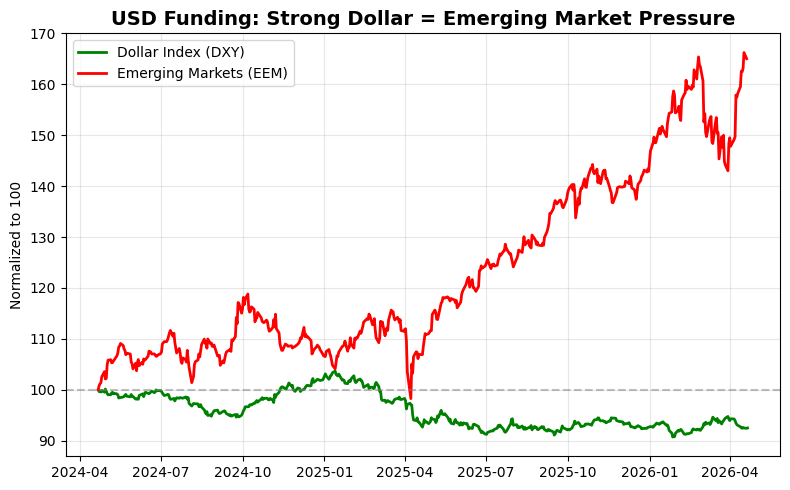
The chart above compares the US dollar index and the emerging markets ETF. EEM’s performance, driven by improved GDP growth in key economies, corporate earnings expansion, and currency appreciation, shows that not only did EM currencies outperform during dollar weakness, but EM stocks rallied as well.
In 2024, China was suffering with a weak property sector alongside deflation, which weighed on emerging markets progress. By the middle of the year, fiscal and monetary support drove major rallies, especially in tech.
Additionally, strong growth and equity inflows in India also provided support for emerging markets. Global growth supports global sentiment, which boosted EM exports while cyclical sectors benefited.
Alongside these factors, the US dollar started to weaken as markets priced in aggressive rate cuts from the Federal Reserve. But it turned out that inflation remained persistent, which kept the dollar higher.
During 2025, dollar weakness drove gains in emerging markets as capital rotated outside of US assets as a result of President Trump’s tariff shock.
Then, 2026 came with a new set of geopolitical tensions that sent oil prices above $100 per barrel, sparking panic across global financial markets while the US dollar thrived due to expectations of a more restrictive Federal Reserve policy as inflation surged above 3%.
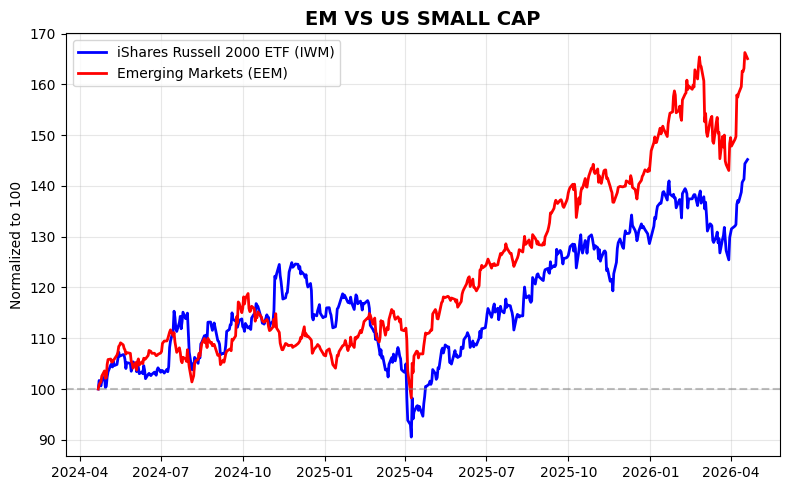
Since mid-2024, both the Russell 2000 and emerging markets have displayed heavy movements, as both are sensitive to changes in liquidity conditions, but not in the same way.
Emerging markets are mainly impacted by external factors such as currency movements, capital flows and debt exposure (mainly in USD).
On the other hand, US small-cap stocks are driven by domestic financial conditions. Unlike large-cap indices such as the S&P 500, which benefit from stronger balance sheets and international revenue diversification, small caps are more vulnerable to shifts in dollar liquidity.
Higher borrowing costs, tighter credit conditions, and changes in interest rate expectations can heavily impact smaller companies, which are usually dependent on financing conditions.
? Did you know?
Dollar liquidity does not impact markets directly, but instead transmits through multiple channels, globally through currencies and capital flows, and domestically through financial conditions.
Risk Sentiment: The Fear Factor
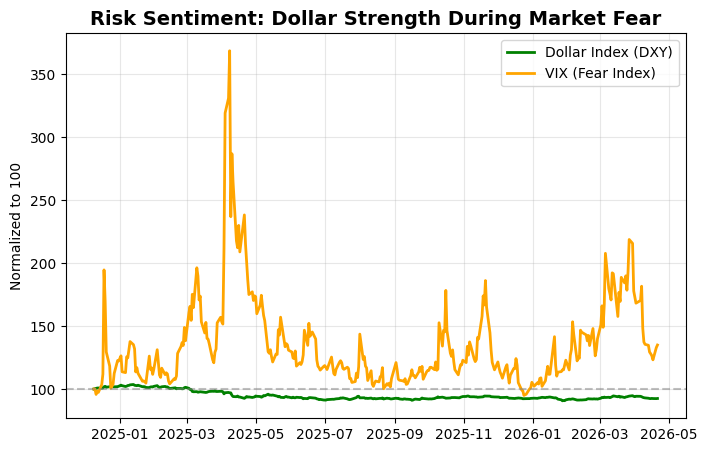
Moving on, here we will break down the relationship between the volatility index (VIX) and the US dollar. Usually, when fear enters the market, the VIX rises, as does the US dollar.
During periods of broad risk aversion, the relationship holds, with both the VIX and the US dollar acting as safe-haven assets. However, sometimes the shock becomes more US-focused, where the relationship could break down.
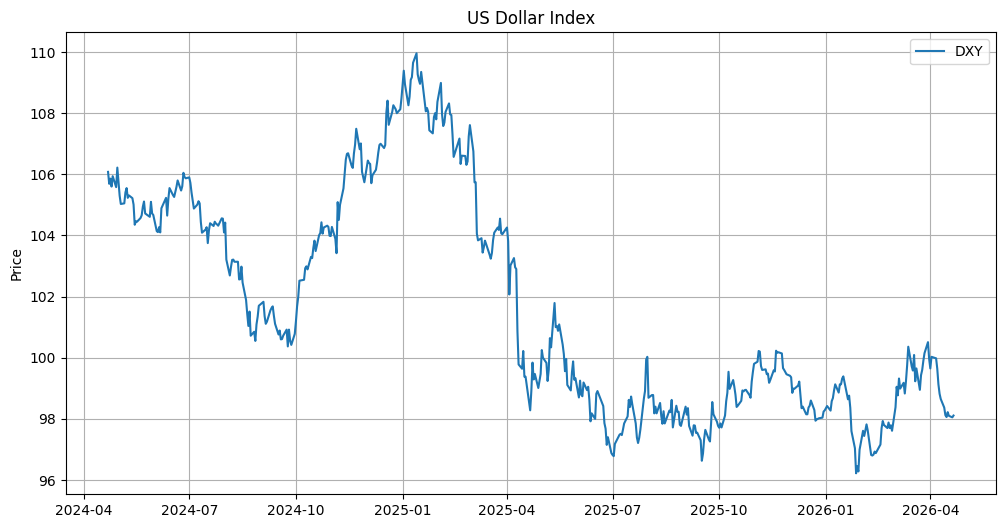
For example, during last year’s market turbulence in April, the US dollar index dived, dropping from January 2025 highs of 109 to 98 in April 2025, while the VIX soared to extreme levels due to the tariff shock.
Asset allocation showed shifts into other safe-haven assets such as precious metals, US Treasuries, and international equities as investors stepped away from US assets.
Recently, the relationship between the two assets has improved, as fears returned to the market due to inflation concerns from high energy prices.
This led to rapid repricing in Fed policy expectations, causing the US dollar to rise. Additionally, since oil is priced in dollars, higher crude prices further supported the greenback’s strength. In this environment, the dollar is no longer just a safe haven, but also a reflection of tighter financial conditions.
Final Thoughts
Dollar liquidity remains the backbone of the financial system. Its influence, however, is not predictable, as the effects transmit through various channels simultaneously, from international markets to domestic markets.
Due to recent heavy market movements, the traditional safe-haven trade between the US dollar and riskier assets continues to evolve, mainly shaped by major changes in both US fiscal and monetary policies.


