

 ar
- The US dollar entered 2025 on a strong note, but became increasingly volatile as the year went on.
- The greenback remained supported by safe-haven demand and higher Treasury yields, despite rising concerns over fiscal policy.
- Currencies and precious metals took advantage of the dollar’s volatility, which helped them outperform the world’s primary reserve currency.
The US dollar remained a central force in the FX markets throughout 2025. Many assumed that “King Dollar” would continue to reign throughout last year, even institutions like Bank of America revised their forecasts for a stronger dollar.
The US dollar looked extremely strong with interest rates high and resiliency in the US economy.
However, reality proved different. Instead of extending its triumph among currencies, the US dollar index saw volatility throughout the year, witnessing a major drop due to changes in both monetary and fiscal policies. As markets anticipated Federal Reserve rate cuts and narrowing yield differentials, the dollar lost its momentum.
2025 did not mark the collapse of the US dollar, but it did indicate large changes for the currency.
USD’s Resilience Amid Volatility
The US dollar had two different trajectories in 2025, one during the first half of the year and another in the second half. Earlier this year, the US dollar was extending its gains from 2024 with macro factors supporting the greenback.
Analysts stated that the driving force wasn’t just higher interest rates, but also aggressive monetary policy tightening from the Fed, strong economic data and global uncertainty that caused capital inflows into the safe haven US dollar. ⁽¹⁾
As 2025 went on, the dollar’s path started to change, becoming choppier as time went on. By the middle of the year, the dollar’s path suddenly changed from the best performer to one of the worst, which resulted in a 10% drop for the year.
This reversal surprised many market players and indicated changes in the outlook, where markets began pricing in a cooling US economy, leading to rising expectations of more monetary policy easing from the Fed. Uncertainties around US politics and trade, with the Trump administration implementing aggressive tariff policies, further impacted sentiment. ⁽²⁾
By the end of the year, the dollar had stabilized from its lows, even rebounding around 2% from a September drop amid renewed US growth optimism.
Interest Rate Differentials and Capital Flows
The dollar was supported by the interest rate differential, where interest rates in the US were high throughout 2025. The Federal Reserve’s aggressive rate hike cycle, which started in 2022, had caused interest rates to rise to multi-decade highs before entering 2025, while other central banks were trying to catch up.
At the start of the year, traders were thinking twice about whether they bet against the dollar, especially when it offered attractive yields. But, before 2024 had ended, the Fed began its rate cut cycle in September 2024, where it cut rates by 50 basis points to 5% and then resumed cutting rates a year later.
The US dollar had an advantage over other currencies due to its attractive yield alongside robust stock market performance, which attracted capital. Funds were also poured into the US during times of uncertainty due to the US dollar’s safe-haven appeal. The US attracted around 41% of global gross capital inflows in 2022–23. ⁽³⁾
The dollar’s usage remained strong despite de-dollarization fears from BRICS, supported by the unmatched depth and liquidity of US markets and the strong global appetite for Treasuries as safe assets. Even after the Fed cut rates in December, the dollar didn’t move much, supported by the US economy’s strength and ongoing capital inflows. ⁽⁴⁾
US Dollar Effects on Commodities
As the US dollar faced volatility all year round, some commodities benefited from this, such as gold and silver. Due to rate cuts, global uncertainty and mixed economic outlooks, gold and silver started to rise. Back in April 2025, when Liberation Day kicked off, gold surged 30% from the start of the year, while silver rose 15%. Precious metals took advantage of the weak dollar and extended their gains throughout the year. ⁽⁵⁾
Persistent geopolitical risks and heavy central bank purchases also supported demand for precious metals. Gold is up 70% from the start of the year, while silver rose over 150%. Oil markets showed mixed signals from the effects of the dollar as prices encountered fluctuations from supply and demand shifts. ⁽⁶⁾
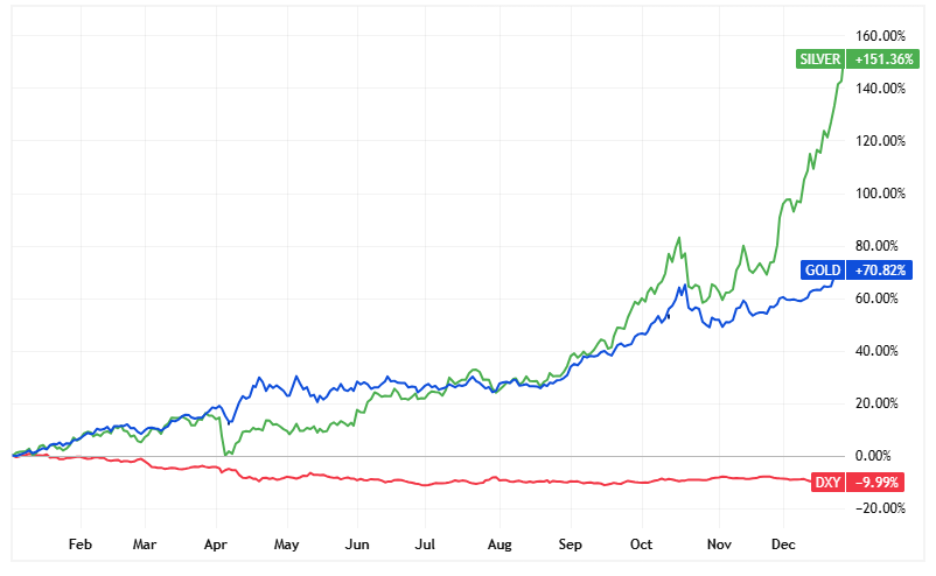
Gold, Silver and USD 2025 Performance / Source: TradingView
Growing Fiscal Concerns
The US continues to face growing fiscal deficits, which have fueled a debate on whether the dollar’s position might be at risk. Post-pandemic fiscal expansion had caused US budget deficits to rise over 7% of GDP on average, pushing federal debt above 100% of GDP – levels not seen since World War II. ⁽⁷⁾
In May 2025, Moody’s downgraded the US credit rating due to rising concerns over the fiscal outlook. A sharp rise in policy uncertainty around US finances led some to question the strength and stability underlying the dollar’s dominance. Bond investors demanded higher yields on US Treasuries, with 30-year yields breaching 5% for the first time since 2023, and before that since 2007, indicating nervousness around US debt. ⁽⁸⁾
The dollar’s privileged role allows the US to finance deficits more cheaply, but abusing this power carries risks. By year’s end, US policymakers faced a delicate balance, which is addressing fiscal imbalances while reinforcing low inflation credibility to ensure the dollar’s global standing stays undefeated.
USD vs. Other Currencies
The US dollar had a mixed year with other currencies. For example, the euro rose almost 15% against the dollar, backed by strong growth, rising bond yields denominated in euros, and credible fiscal policy in Germany. The euro also took advantage of the dollar’s weakness throughout the year.
Another currency that outperformed the US dollar was the Swiss franc. This safe-haven currency rose 13%, witnessing large inflows that triggered the rise against the dollar, especially during times of high volatility.
The Pound sterling rose almost 9%, while the Aussie dollar surged 8%. The Chinese yuan also gained this year, rising 4.5%.
The Japanese yen was the only major currency against which the US dollar remained broadly flat, with movements limited to below 1%. This was driven by the Bank of Japan’s delayed policy tightening and a fiscal package later in the year that weakened the yen, alongside continued support for the dollar from strong US growth and a gradual easing cycle by the Federal Reserve.
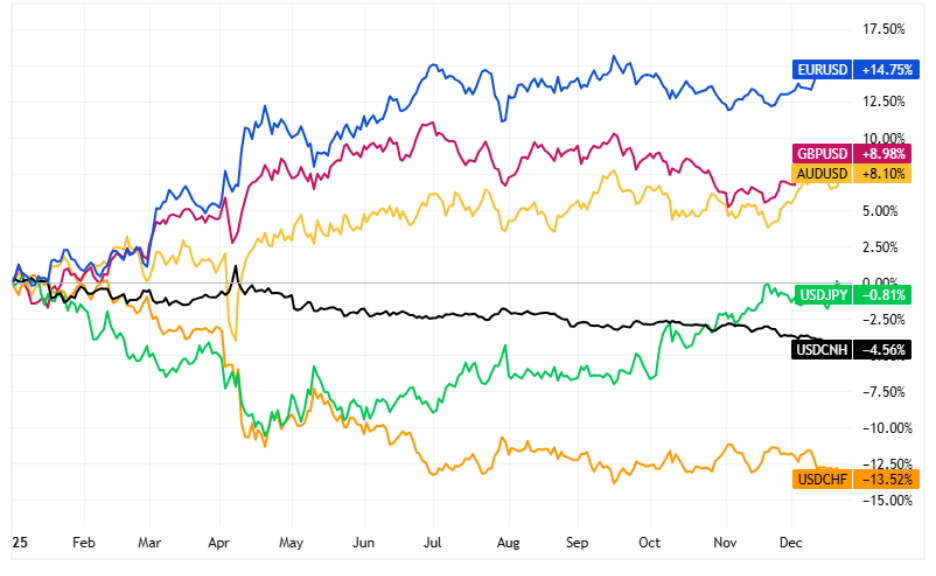
Currencies Against the US Dollar 2025 Performance / Source: TradingView
Looking Ahead
2025 did not dethrone the US dollar, but it did bring some major changes for the currency. The dollar remains the most important currency due to its reserve status, but its future mostly depends on monetary and fiscal policy credibility and the economic data.


