

 ar

- US stocks proved resilient in 2025, reaching new record highs, but gains were driven largely by mega-cap stocks, while small-cap stocks lagged.
- Investors refocused on company fundamentals, with valuations becoming a key consideration alongside earnings growth, falling inflation, and interest-rate cuts.
- Stocks also experienced sharp swings around tariff policy, highlighting both market fragility and the importance of flexibility.
2025 was a crucial year for US stocks, marked by new record highs, notable sector divergences, and a renewed focus on company fundamentals. All major US stock indices posted significant gains, but a few mega-cap and AI-driven stocks outperformed the rest of the market.
The year demonstrated the strength and dangers of concentrated market leadership against a backdrop of shifting monetary policy, tariff volatility, and changing investor expectations.
S&P 500 vs Nasdaq vs Dow
All major US stock indices reached new record highs this year, with the S&P 500 rising almost 18%, while the Nasdaq rose over 20% due to strong tech performance, mainly in AI-driven gains.

The Dow Jones also gained this year, but not as much as the others, ending the year with a rise of 14.27%. The Russell 2000 ended higher for the year but saw huge price swings due to the sensitivity of small-cap stocks to macro changes, especially during times of high volatility driven by tariffs.
AI, Tech, Defensives, and Laggards
Large-cap stocks emerged as winners this year, with tech equities leading the way. The technology sector ended the year with more than a 20% gain. Magnificent 7 stocks stayed in the spotlight the entire year, delivering massive returns.
In particular, Magnificent 7 stocks enjoyed strong earnings and pricing power, helping them manage bigger costs and higher interest rates. Earnings and cash flows also grew at a faster pace. ⁽¹⁾
This shift was particularly visible within semiconductors and AI infrastructure. Here’s a breakdown of each Magnificent 7 stock:
- Alphabet emerged as the biggest winner among the Magnificent 7 stocks, rising over 60% due to its robust search engine, cloud and AI integration.
- Nvidia almost rose 33%, due to massive AI-chip demand, data-center CAPEX, and strong pricing power.
- Microsoft ended the year with a 16.7% gain, driven by growth in Azure, AI expansion through its Copilot LLM and strong software demand.
- Apple rose 11.62% due to growth in services, stock buybacks and strong financials, but also faced slower hardware growth.
- Tesla almost gained 29% but faced pressure earlier this year following a feud between CEO Elon Musk and President Trump, along with brand controversy. Tesla was still supported by long-term AI and autonomous driving despite pressure from EV competition and margins.
- Meta jumped 10.74% this year, where growth was driven by strong advertising growth, aggressive cost cuts, and rising profits.
- Amazon rose around 4%, coming up behind its peers, and climbed on margin expansion, cost stabilization and growth in its cloud service AWS.

Magnificent 7 Stocks’ 2025 Performances / Source: TradingView
Other tech stocks such as Intel, AMD, Broadcom, and Palantir also saw impressive growth this year, indicating the strength behind the AI trade as investors moved towards mega-cap stocks that specialize in AI infrastructure, advanced chips and software platforms. ⁽²⁾
Here’s how the broader market performed:
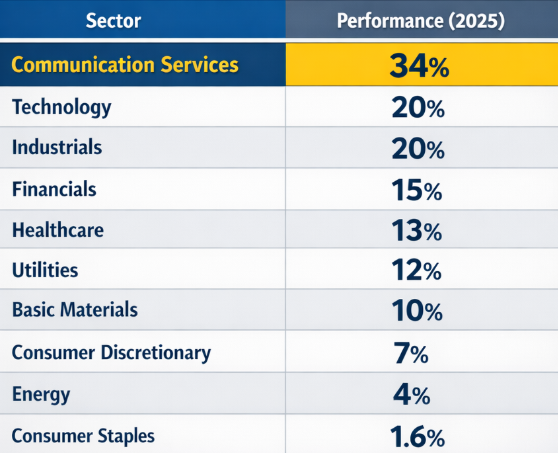
Sector Performances / Source: CNBC
Defensive stocks posted modest gains this year, offering stability rather than massive returns. Sectors such as healthcare and utilities remained strong during periods of volatility, especially during the beginning of the tariff period, where both sectors benefited from stable movements and predictable cash flows. However, consumer staples underperformed due to pressures from high interest rates and high valuations. ⁽³⁾
Analysts stated that defensive stocks did not act as a safe haven, with investors shifting to bonds for protection amid high yields. Defensive stocks underperformed the rest of the market as investors turned to growth and AI stocks. ⁽⁴⁾
US aerospace and defense stocks benefited this year (part of the industrials sector) due to increased military spending and geopolitical tensions, beating other defensive sectors.
Small-cap stocks remained under pressure as they navigated through higher interest rates that raised financing costs, weakened company financials that made earnings more sensitive to slowing growth, and the shift to large caps, especially those tied to AI. This left smaller companies struggling to attract capital. ⁽⁵⁾
Valuations vs. Earnings Reality: Fundamentals Matter Again
The major theme in 2025 was the balancing of stock valuations with actual earnings. The era of cheap money has ended, and with it the speculative excesses were reined in. Stocks that traded at extreme valuations needed to show real fundamental progress to justify those price levels. Otherwise, they faced pullbacks.
Earlier this year, the excitement in AI began, which gave a major boost to tech stocks and pushed valuations to historical highs. The Magnificent 7 stocks were trading at an average forward price/earnings multiple of roughly 36, and now, markets are expecting further growth. ⁽⁶⁾
When large companies announced major investments without clues on profitability, investors turned cautious, as Big Tech firms spent heavily on AI, which sometimes resulted in stock declines despite solid earnings and revenues. This led investors to question whether these investments made by these companies will be profitable.
Instead, markets favored strong fundamentals. Companies delivering robust earnings, high returns on equity, and strong cash flows that attracted capital, indicating that businesses with durable competitive advantages and healthy balance sheets were valued more highly. In the end, fundamentals were the core driver in companies. ⁽⁷⁾
Surprises and Lessons from 2025
2025 surprised investors, with the focus being on concentrated market gains. Many investors expected the market rally to spread across all sectors after the Trump administration took office. Mega-cap stocks drove most of the S&P 500’s gains, while the average stock saw modest growth.
Another major surprise was the return of volatility due to tariff fears. President Trump announced Liberation Day at the beginning of April. This led to the escalation of trade tariffs, sending shockwaves across the global financial system and wiping out $6.6 trillion from the markets. The S&P 500 dropped 13%, with mega cap stocks hit hard. ⁽⁸⁾
Yet the reversal was also surprising. By early May, sweeping tariff rollbacks triggered a powerful relief rally. Cyclical and trade-sensitive stocks rebounded, tech stocks surged, and markets quickly returned to record levels, indicating how fragile sentiment and how fast confidence can recover. ⁽⁹⁾
Investors were also surprised by how the US economy and corporate earnings were resilient. Despite concerns of an economic slowdown due to tariffs, the US avoided a recession as earnings kept growing. Falling inflation and interest rate cuts from the Federal Reserve have supported the stock market.
Overall, 2025 showed how uncertain forecasts can be and rewarded investors who stayed flexible.


