

 ar

Australia and New Zealand are both back in tightening mode, but they got there by taking two very different roads.
New Zealand is reacting to an oil shock, trying to keep a fuel spike from turning into a wage-price spiral.
Australia never really shook its inflation problem in the first place, and now, weak productivity is making it harder to fix. Both central banks are going in the same direction, but each has its own fight.
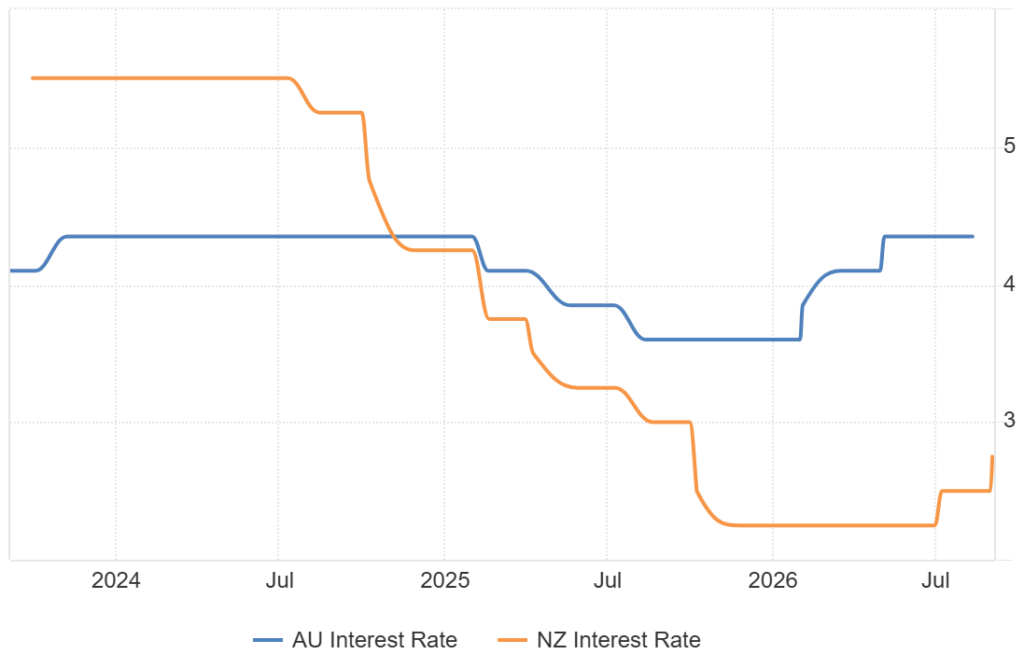
Australia currently holds a 160-basis point rate advantage with the RBA cash rate at 4.35% against the RBNZ’s 2.75% OCR. Whether that gap narrows or persists will be an important influence on AUD/NZD.
RBNZ: Tightening Despite a Fragile Economy
The RBNZ lifted the Official Cash Rate 25 basis points to 2.75%, its second straight increase since it began a new tightening cycle in July. The previous easing cycle had taken the OCR from 5.50% down to 2.25% between August 2024 and November 2025, a sharp reversal now well underway.
Fuel is doing most of the damage. Headline inflation reached 4.1% in Q2, largely on fuel costs tied to the conflict in the Middle East. Strip out vehicle fuel, though, and inflation drops to 2.9%, comfortably inside the RBNZ’s 1% to 3% target band. ⁽¹⁾
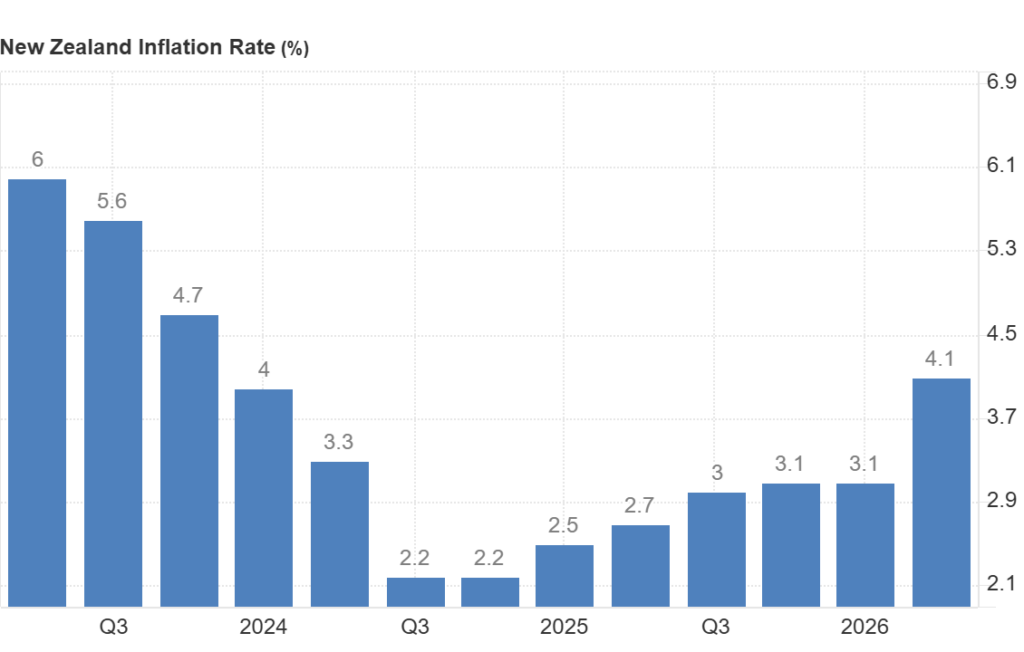
That gap between headline and excluding fuel inflation explains why the RBNZ isn’t trying to undo the initial price jump.
Monetary policy can’t reverse an oil shock. What it can do is stop that shock from feeding into transportation costs, food prices, and wages, and that’s the real fight.
The RBNZ expects inflation to remain at 3.9% through late 2026 before falling to 1.9% by early 2028, while the average OCR rises from 2.6% to 3.2%.
Underneath the inflation numbers, the labor market tells a weaker story. Unemployment climbed to 5.6% in Q2 and is expected to stay elevated through 2028. ⁽²⁾
Growth held up at 0.8% quarter-on-quarter in Q1 2026, up from an upwardly revised 0.5% the previous quarter, but real wages are still falling behind inflation, house prices remain soft, and households are saving more out of caution. ⁽³⁾
Markets are expecting the OCR to reach roughly 3% by year-end, a sign financial conditions are already tightening even before the RBNZ moves again.
RBA: Sticky Inflation Keeps Another Hike Alive
Australia held its cash rate at 4.35% in August, pausing after three straight 25bp hikes earlier in the year brought cumulative tightening to 75 basis points in 2026.
The pause doesn’t mean the fight is over. Headline inflation eased to 3.5% in July, but the RBA’s preferred trimmed mean measure stayed stuck at 3.6%, a sign underlying pressure isn’t fading on its own. ⁽⁴⁾
Unlike New Zealand, where fuel explains most of the spike, the RBA has said energy costs are simply adding to inflation that was already elevated. That makes Australia’s problem broader, and likely harder to unwind.
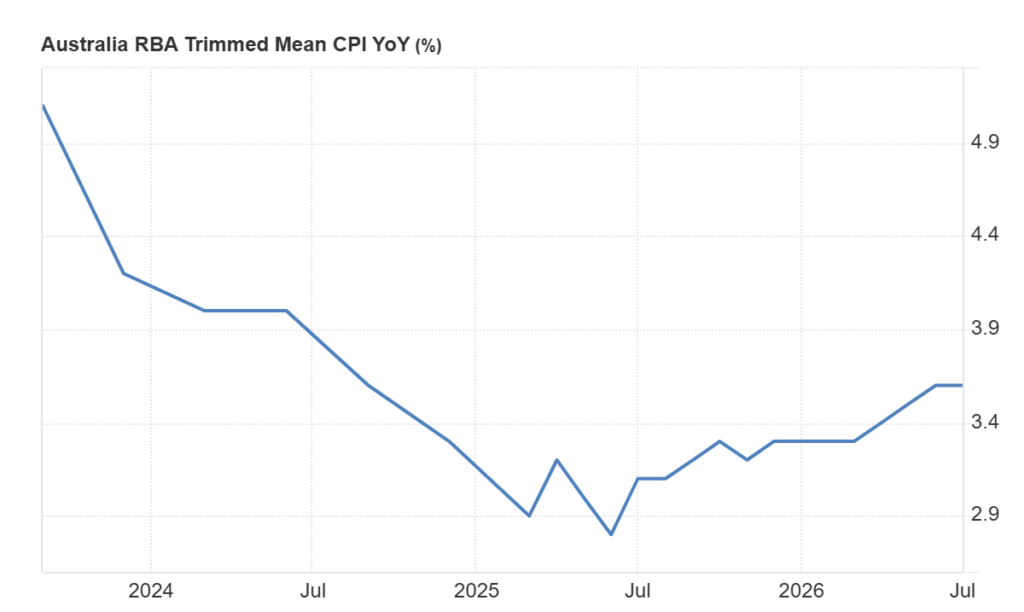
Weak productivity isn’t helping either. The economy is still running with limited spare capacity, and the labor market remains relatively tight even as it cools. The RBA doesn’t expect inflation to settle near its 2.5% target until late 2027 or early 2028, a long runway compared with New Zealand. ⁽⁵⁾
Growth, meanwhile, has been resilient. GDP expanded 0.4% in Q2 after 0.3% in Q1, pushing annual growth to 2.1%, ahead of the RBA’s own August forecast of 1.9%. Wage growth of 3.2% annually is running well ahead of a 0.2% drop in GDP per hour worked, meaning pay is rising faster than productivity can support, a combination that tends to keep inflation sticky. ⁽⁶⁾
Cracks are starting to show in employment. The unemployment rate ticked up from 4.4% to 4.5% in July as the economy shed 15,800 jobs. Even so, the RBA judges the labor market to be slightly tighter than full employment, and expects unemployment to drift up to 4.8% by the end of 2028. ⁽⁷⁾
Several Board members judged that upside inflation risks could materialize and require further tightening. The Board held anyway, betting that previous increases are starting to cool the economy and wanting more data before committing further. ⁽⁸⁾
Another hike isn’t off the table if inflation proves stickier than forecast, but for now policymakers are watching how the economy is absorbing the 75 basis points of tightening before doing anything else.
What the Divergence Means for AUD/NZD
Both central banks have raised rates, but they aren’t fighting the same war. The RBNZ is trying to contain the ripple effects of a shock it never chose.
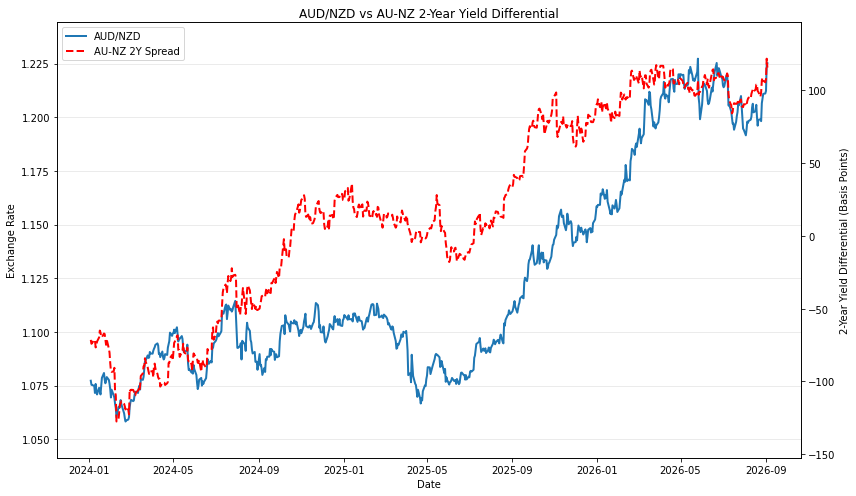
The 2-year interest rate differential shows up directly in the chart above. The AU-NZ 2-year yield differential has pushed out to roughly 100-110 basis points in Australia’s favor, near the widest it’s been in over two years, and AUD/NZD has tracked that widening closely, trading near the top of its 2024-2026 range around 1.22.
Two events will test whether that gap has peaked. The RBA will meet on September 29 while the RBNZ’s rate decision takes place on October 28.


