ar
- Several AI investments depend on the same spending cycle, leaving portfolios exposed to a common risk.
- Funds reducing exposure and investors closing bearish positions can amplify selling and buying.
- Broader participation, improving cash flow and the market’s response to interest rates help reveal whether a recovery has stronger foundations.
US stocks are moving sharply as investors pull back from crowded AI investments and reassess how much future earnings are worth.
The result is a market capable of reversing quickly, even while the questions behind the original selloff remain open.
The Same Bet on Different AI Stocks
Holding several stocks in a portfolio can help spread risk, but if those companies are influenced by the same market drivers, the portfolio may still be vulnerable to the same risks.
Chipmakers, cloud providers, data-center operators and power-equipment suppliers are all exposed to the AI cycle. A slowdown in that cycle can affect all of them at the same time.
Bank of America conducted a survey on November 6-12, which shows where portfolio managers saw the greatest crowding. ⁽¹⁾
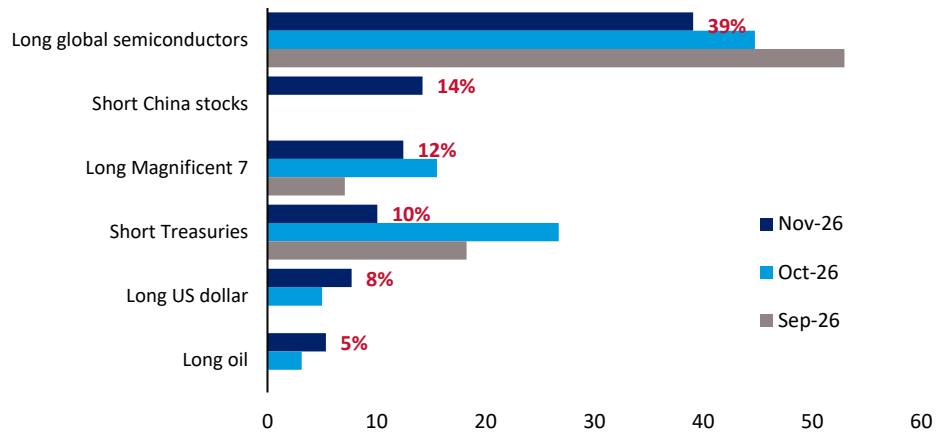
These percentages show how crowded these trades are, rather than portfolio allocations. The survey was conducted before the selloff and rebound, capturing managers’ views at that time.
Index concentration adds another layer. The S&P 500’s ten biggest companies accounted for 37.3% of its weight as of October 30, meaning that moves in just a few stocks can have a hefty effect on the whole index. ⁽²⁾
Concentration increases the influence of an index’s largest stocks. Crowding increases the risk of many investors adjusting similar positions at once.
Funds Are Reducing Exposure
BofA’s technology positioning measure dropped from a net 37% overweight in October to 12% in November, marking its sharpest decline since June 2006. This measures the balance between managers reporting overweight and underweight positions but does not mean their tech allocation was 12%. ⁽³⁾
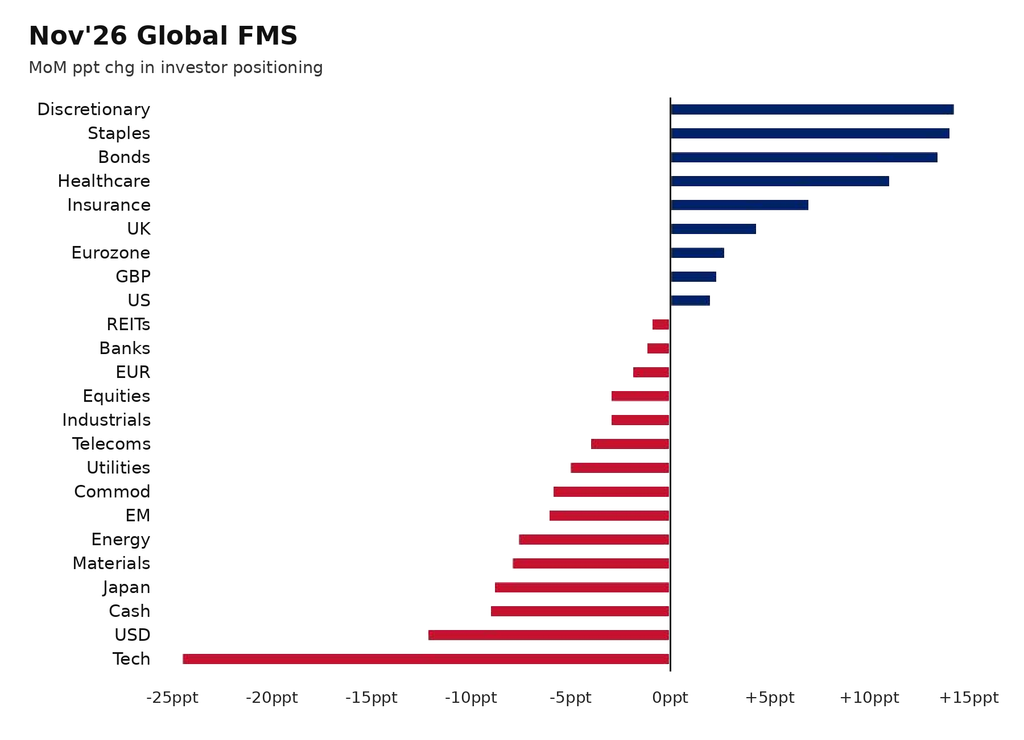
The following week brought heavier losses. JP Morgan estimated that global hedge funds lost over 3% last week, taking their average November loss to 4%. Nvidia fell 23% due to the resignation of its CEO Jensen Huang, while the Nasdaq 100 declined 9%. ⁽⁴⁾
Why Selling Can Turn Into a Buying Rush
Falling prices can force investors to sell more of their positions. A fund approaching a loss limit, or facing demands for additional collateral, might have to reduce holdings even if managers still believe in the companies’ long-term prospects.
IMF research explains how borrowing and shared exposures can turn these individual risk decisions into waves of selling across funds. ⁽⁵⁾
Positive news can reverse that selling pressure. Investors who were shorting the stock may buy back its shares to close their positions, while funds that closed earlier might rebuild their holdings.
The rebound on November 23 showed how swiftly prices could change. Nvidia rebounded 31.5% after Jensen Huang was reinstated as CEO, helping the S&P 500 and the Nasdaq 100 to rise 4.7% and almost 7% respectively. The rally size alone cannot determine how much buying came from renewed investment demand and how much came from closing short positions ⁽⁶⁾
Investors Are Still Questioning Spending
Huang’s return gave investors a reason to change their views on Nvidia’s leadership. Whether the wider AI buildout can generate enough returns remains a separate question.
In the BofA survey, 52% of the respondents expected a large AI cloud provider to announce lower capital spending within six months. These were expectations, rather than announced decisions. ⁽¹⁾
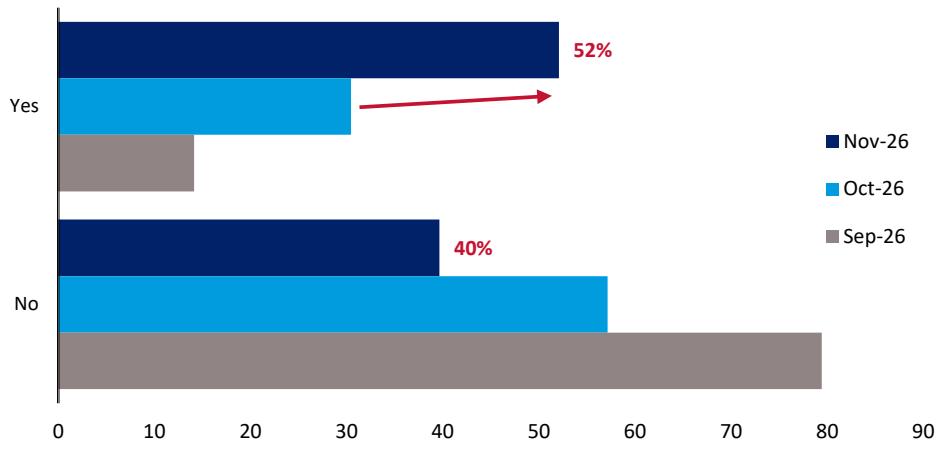
The same spending affects each part of the industry differently. Customers still have to turn that investment into revenue and cash flow.
Slower spending can preserve customers’ cash while weakening suppliers’ future orders. An announcement that helps one part of the industry may hurt another.
Stronger Growth Meets Hawkish Fed
New York Fed President John Williams said during his speech on November 23 that economic activity was strong and labor market conditions unchanged, with inflation still too high. ⁽⁷⁾
That puts stocks at a crossroads. Stronger demand can increase profits but can also strengthen the case for more monetary policy tightening. Higher interest rates lower the value of future profits.
Weaker growth can reduce expectations of further tightening while hurting sales forecasts. Investors are weighing these effects against each other.

What Would Support the Recovery?
The initial test is how many stocks will join in on the rebound. Comparing the S&P 500 with its equal weight version helps show whether gains extend beyond the largest stocks. The equal weight version is rebalanced quarterly, which resets every company to the same weight. ⁽⁸⁾
Gains across both indices and several sectors would provide more evidence of wider participation. The number of rising stocks relative to falling ones offers more evidence. Improvement across several sessions could carry more information on how the rebound will be instead of a strong single session.
The second test is whether earnings expectations improve. Rising stock prices could have a stronger foundation when analysts also raise their estimates on cash flow. AI companies still need to show whether new revenue covers infrastructure costs and leaves cash after investment.
Finally, the market’s response to bond yields matters. Equities can absorb higher yields if expected profits rise enough to compensate. Valuations face greater pressure when the return available on bonds rises while company profit forecasts stand still.