

 ar
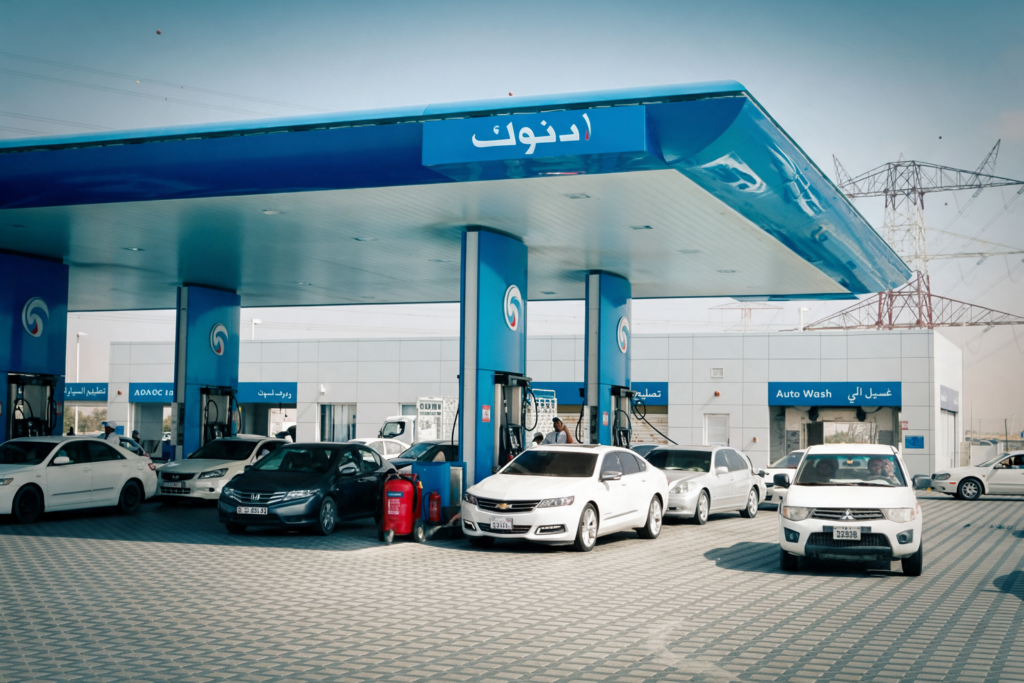
- Pump prices rose across every grade for October, but the shape of the increase flipped. Petrol rose roughly 15.8% to 16.6%, ahead of diesel’s 11.6%, a reversal of September’s pattern, when diesel’s increase ran more than double petrol’s.
- Every grade is above AED 4 a litre for the first time in more than four years, and diesel has reached a record AED 4.80, passing its July 2022 peak.
- The reversal reflects a stronger crude-oil move, rather than a fresh deterioration in gasoline refining margins. Brent gained roughly 13% to 14% in September as supply concerns and geopolitical risk intensified.
The UAE Fuel Price Committee confirmed new rates for every grade, effective October 1. ⁽¹⁾
Super “98” rose to AED 4.40 a litre. Special “95” moved to AED 4.28, and E-Plus “91” to AED 4.21, each up roughly 60 fils on the month.
Diesel climbed less steeply in percentage terms. It rose 50 fils, to AED 4.80, an 11.6% increase against petrol’s roughly 15.8% to 16.6%. ⁽¹⁾
That is a reversal of last month’s pattern, when diesel’s increase ran more than double petrol’s. It is worth asking what changed.
A Lag That Now Points Back at Crude
The UAE’s monthly pricing mechanism reflects international crude and refined-product prices, with the previous month’s market movements feeding into the next month’s pump prices. ⁽³⁾

That lag is why October’s prices read as a snapshot of September’s market, not a same-day reaction to anything happening now.
Through August, the story behind UAE pump prices was a diesel-specific refining squeeze, while Brent crude itself was easing. September flipped that. Brent gained roughly 13% to 14% for the month, its largest monthly advance since July, as supply concerns and geopolitical risk intensified, from attacks on Gulf shipping to renewed uncertainty over US-Iran diplomacy. ⁽²⁾
A major catalyst was diplomatic. Iran signalled in late September that it could reopen the Strait of Hormuz within a week, and Brent briefly eased to two-week lows on the news, as covered at the time. ⁽⁴⁾
That signal did not hold. Iran’s formal proposal, lifting US sanctions and ending the naval blockade on its ports in exchange for reopening the strait and resuming nuclear talks, was rejected by President Trump days later. ⁽⁵⁾
Brent briefly climbed above $108 a barrel on the rejection, ⁽⁶⁾ before settling back near $105.28. ⁽²⁾
Petrol Rose Even as a Key Refining Benchmark Narrowed
A key US gasoline refining benchmark, the RBOB-Brent crack spread, actually narrowed in September. It is a US measure, not a direct read on UAE refining margins, but it is one of the clearer available signals of how crude and refining costs moved relative to each other during the window the UAE formula references.
That spread fell from roughly $58 a barrel in late August to under $39 by early September. The move was largely seasonal, tied to the switch from summer-grade to winter-grade fuel, and it has stayed close to that lower level since. ⁽⁷⁾
A narrower US gasoline margin would normally point toward a smaller pump increase, not a larger one.
Petrol rose anyway, because the crude oil used to make it became markedly more expensive over the same window.
The Diesel Squeeze Has Not Gone Away
Diesel’s own refining-market squeeze, the story behind September’s increase, has not eased. It has simply been overtaken, in percentage terms, by the broader move in crude.
A crack spread measures the gap between crude and the refined product; it is not a refiner’s net profit margin. ⁽⁸⁾
By that measure, the US diesel crack spread first broke above $100 a barrel in August and remained exceptionally high through September, reaching successive records. ⁽⁹⁾
Some of the refinery damage behind that squeeze has also turned out to be more lasting than earlier coverage suggested. Bahrain’s Sitra refinery, hit in a March strike, suffered what Technip Energies’ chief executive has since described as permanent damage, not a repair timeline running into late 2026 as this outlet previously reported. ⁽¹⁰⁾
Diesel remains the most expensive grade in absolute terms, at AED 4.80 a litre. Its smaller percentage move this month reflects how much of its price was already elevated going into October, not an easing of the underlying refining constraint.
Reading the Reversal
For UAE-based drivers, October’s increase is largely a crude oil story arriving with its usual one-month delay, not a fresh shock.
For diesel-intensive sectors such as logistics, freight and construction, the refined-product supply squeeze remains significant, and some forecasts see global diesel tightness persisting well into 2027. ⁽²⁾
The wider picture is one markets are still pricing as unresolved. Physical crude exports from the Gulf have recovered sharply toward pre-war levels, helped by increased flows through Hormuz and alternative export routes, ⁽²⁾ even as the diplomatic track that would lift the risk premium keeps stalling, a pattern traced from the supply side earlier in September. ⁽¹¹⁾
That gap, between recovering physical supply and a risk premium that keeps resetting on every failed diplomatic signal, helps explain this month’s increase and will be one of the factors shaping whatever the formula prices in for November.
Sources: ⁽¹⁾ UAE Fuel Price Committee (via Gulf News, Khaleej Times, Economy Middle East), ⁽²⁾ Reuters, ⁽³⁾ UAE Government Portal (u.ae), ⁽⁴⁾ ⁽¹¹⁾ Daman Markets, ⁽⁵⁾ Al Jazeera, ⁽⁶⁾ Financial Times, ⁽⁷⁾ The Industry Spread, ⁽⁸⁾ RBN Energy, ⁽⁹⁾ DieselNet, ⁽¹⁰⁾ Middle East Economic Survey (MEES)


