ar

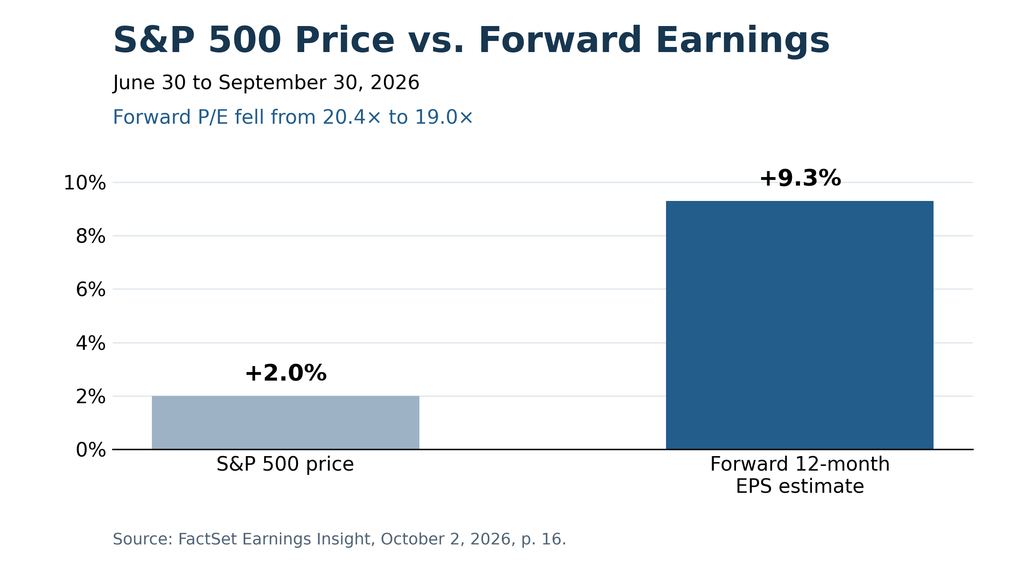
- Stocks can become cheaper relative to expected earnings even as prices rise. In Q3 2026, the S&P 500 gained 2%, while its forward P/E fell from 20.4× to 19.0× as earnings forecasts rose faster.
- The durability of that lower valuation depends on companies delivering the expected profits. If analysts cut their forecasts, stocks can become more expensive on earnings even when share prices stay flat.
Stocks can get cheaper even when prices rise. This happens when company profits grow faster than share prices. A company sells more, earns more on each sale, and analysts raise their forecasts. Investors then pay more for the share, but less for each dollar of profit.
That was already happening before the big November sell-off that followed the midterm elections. The S&P 500 was still rising, yet it was getting cheaper compared with expected profits. So how long can that last?
What Investors Pay for a Dollar of Profit
Say a stock trades at $100 and analysts expect it to earn $5 per share over the next 12 months. Divide the price by the expected earnings and you get a forward price-to-earnings (forward P/E) ratio of 20x. Investors are paying $20 for every dollar of expected profit.
Now, let’s say the company reports stronger sales than expected and analysts raise their earnings forecast from $5 to $6 per share. That’s a 20% increase in expected earnings. What happens to the valuation depends on how far the share prices move in response.
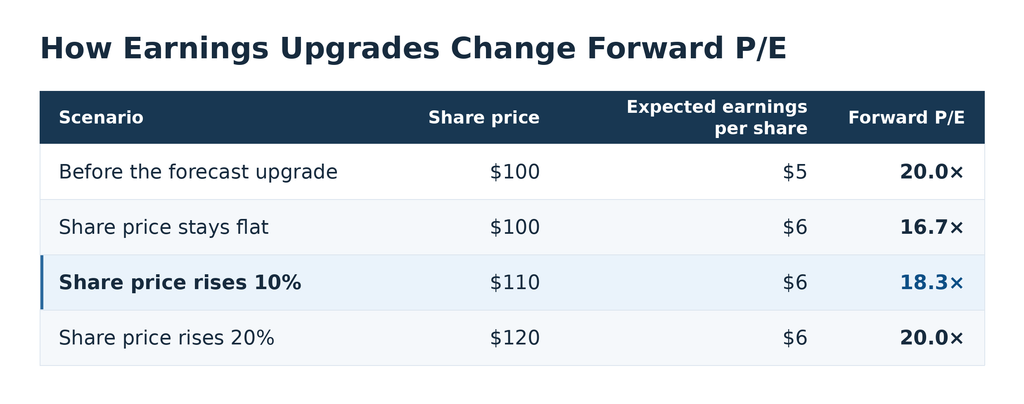
At $100, the buyer pays the same price for a share that’s now expected to earn more. At $110, the buyer pays more for the share, but the 10% rise in price is smaller than the 20% rise in expected earnings. Dividing $110 by $6 gives $18.33 per dollar of expected profit, down from $20. That decline in the ratio is called multiple compression.
The share price would have to reach $120 to get back to the original 20× valuation. At that point, the price and expected earnings would both have risen by 20%, so the ratio would be right where it started.
The S&P 500 Was Already Getting Cheaper Before November
The S&P 500 gained around 2% in Q3 2026, while its forward P/E fell from 20.4x to 19.0x. The same pattern showed up in late-2025. By mid-November last year, the S&P 500 ended just 0.7% higher than its September close, while its forward 12-month earnings estimate had risen 2.4% over the same period. ⁽¹⁾
Earnings forecasts rose faster than prices, bringing the forward P/E down from 22.8× to 22.4×. ⁽²⁾
Part of the change in forward earnings can come from the calendar. As more profitable quarters enter the next 12-month window, the estimate can rise even if analysts leave their forecasts unchanged for each quarter. ⁽³⁾
In 2026, there was clear evidence of upgrades as well. State Street found that analysts raised their estimate for the same year, 2027, by 15.3% between late February and early October. ⁽⁴⁾
Where the Extra Profits Came From
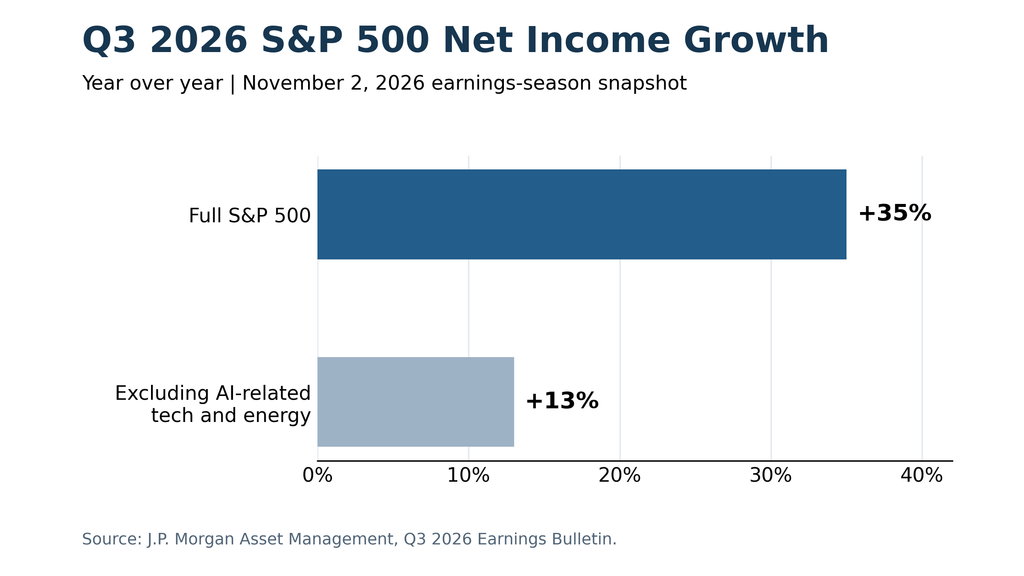
Earlier this month, J.P. Morgan estimated that Q3 net income was on track to grow 35% YoY, even without AI and energy stocks it was still growing 13%. There was genuine profit growth elsewhere in the market, but the headline figure got a much bigger lift from two different sectors with different purposes. ⁽⁵⁾
ExxonMobil earned $7.1 billion from its oil and gas production business in Q3, up from $5.7 billion YoY, even as global production fell 5.7%.
The energy titan estimated that higher crude and natural gas prices have added $3.7 billion to earnings before other factors offset part of the gain. The comparison with Q2 shows how that boost can fade. Output was broadly steady, but lower prices pulled earnings down from $7.9 billion. ⁽⁶⁾
The AI buildout played out differently. For AMD, its data-center operating profit rose from $1.1 billion to $2.9 billion YoY as demand for its server processors and AI chips grew.
In the same quarter, Google Cloud revenue more than doubled, while Alphabet spent $51.4 billion on property and equipment and recorded negative free cash flow of $9.1 billion. ⁽⁷⁾

AMD was already making more from selling chips. For Alphabet, earning back the money spent on new capacity depends on how much paying demand it generates over time.
What the November Sell-Off Changed
On November 5, the S&P 500 fell more than 4% as chipmakers came under pressure over concerns that tighter regulations could slow data-center construction.
The index was still up 7.4% from the end of 2025, while its forward P/E had dropped from 22.0x to 17.7x. During that timeframe, expected earnings rose 33.6%. The sell-off added to a decline in valuation that was already underway. ⁽⁸⁾
Stocks can get cheaper even as they rise if earnings forecasts climb faster than prices. The reverse is also true. If analysts cut those forecasts, stocks can get more expensive on earnings even when prices stand still.