ar
- Japan’s Ministry of Finance spent a record ¥15.399 trillion buying yen between late July and late August, the largest monthly intervention total on record.
- Tokyo recorded no currency intervention between September 29 and October 28, extending the pause that followed its record yen-buying operation in July and August.
- The Bank of Japan’s rate increase to 1.25% offered a potential source of longer-term support for the yen, but the market reaction showed that higher rates alone were not enough to reverse the currency’s underlying pressures.
Japan’s Ministry of Finance confirmed no currency intervention between September 29 and October 28, which extended the pause following its record July-August operation, while the Bank of Japan kept its policy rate unchanged at 1.25% last week.
But the absence of further intervention does not necessarily mean the central bank’s policy shift had stabilised the currency. The yen’s subsequent weakness suggests that the forces driving it lower remain in place.
A Record Operation in July and August
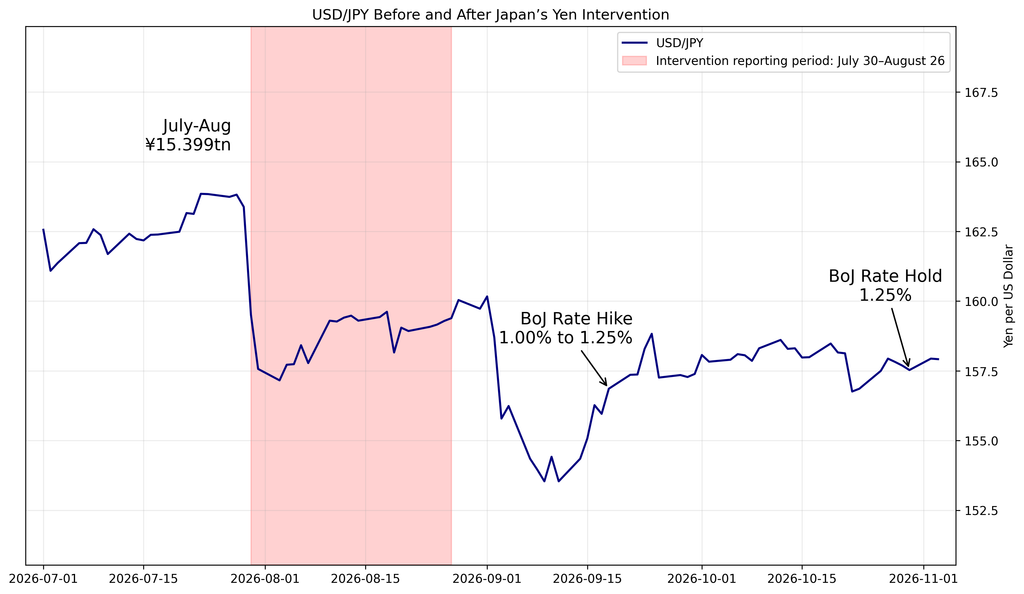
Between July 30 and August 26, Japan’s government and central bank spent ¥15.399 trillion buying yen and selling dollars. ⁽¹⁾ It was the largest monthly intervention total on record.
That operation brought Japan’s cumulative intervention spending for 2026 to more than ¥27 trillion by late September. That is above the previous annual record for yen-buying operations, roughly ¥15 trillion, set in 2024. ⁽¹⁾
The intervention followed a sharp fall in the yen. USD/JPY reached an intraday high of around 163.74 on July 30. Suddenly, the yen strengthened, with the pair plunging down towards 155.20 on August 3, before removing its gains again towards 160 later.
By early September, USD/JPY was trading around 155–156. The recovery proved temporary. ⁽²⁾
Why Buying Yen Only Does Half the Job
Intervention can curb excessive volatility and disorderly currency movements, but it cannot necessarily reverse the economic forces driving a currency lower. When the Ministry of Finance instructs the Bank of Japan to sell dollars and buy yen, the operation can disrupt one-way selling pressure and signal that officials are prepared to act.
Intervention can reduce excessive volatility and major swings in the currency, but it won’t reverse the economic drivers which are pushing the currency lower. When the Ministry of Finance tells the BoJ to sell dollars and buy yen, the operation can stop the bleeding in the sell-off and signals that officials are vigilant.
However, the intervention doesn’t change the view of traders and investors towards the main trend of the yen, except if economic data and interest-rate expectations shift sentiment. For much of 2026, the gap between US and Japanese interest rates has made borrowing in yen to fund investments elsewhere economically attractive.
Unless that gap narrows or market expectations change, the yen can weaken again after the immediate impact of intervention fades.
Narrowing the interest-rate gap is primarily a job for monetary policy, not the finance ministry. Even so, a higher Japanese policy rate will not necessarily strengthen the yen if investors believe US rates will remain elevated or expect the Bank of Japan to tighten only gradually.
A Rate Decision Offers Potential Support
On September 18, the Bank of Japan raised its policy rate by 25 basis points to 1.25%, a 31-year high. The Federal Reserve had delivered an identical increase two days earlier, leaving the policy-rate differential unchanged across the two decisions.
The yen weakened after the announcement. Two policymakers opposed the increase in the 7–2 vote, and their opposition, alongside the absence of more forceful guidance, tempered expectations for faster tightening. ⁽³⁾
Both central banks subsequently held rates in October. The Fed maintained its target range at 3.75%–4.00% on October 28, while the BoJ kept its rate at 1.25% on October 30. The BoJ’s decision passed by an 8–1 vote, with Hajime Takata favoring an increase to 1.50%.
The BoJ’s October outlook nevertheless judged underlying inflation broadly consistent with its 2% target and highlighted upside inflation risks. That strengthened the case for further Japanese rate increases, although support for the yen would still depend partly on how quickly the BoJ moved relative to the Fed.
A Pause Has Limits
Japan’s history with currency intervention suggests that officials focus on excessive volatility and disorderly market movements rather than committing publicly to a fixed exchange-rate target. The country’s yen-buying intervention in September 2022 was its first of that kind since 1998, when authorities intervened to support the currency during a rapid decline. ⁽⁴⁾
That history leaves room for Tokyo to act again. Mitsuhiro Furusawa, Japan’s former top currency diplomat, said in August that “intervention could take place again at any time,” adding that officials were unlikely to be fixed on a single exchange-rate trigger such as ¥160 or ¥162 per dollar. ⁽⁵⁾
The Japanese government has also kept the door open to joint action.
On November 2, Finance Minister Satsuki Katayama reaffirmed that Japan and the US will continue monitor FX rates, where she reiterated Japan’s readiness to act against excessive speculative movements in USD/JPY. ⁽³⁾
These statements underline that the ongoing pause does not represent an abandonment of intervention as a policy tool.
The currency pair is now trading around ¥157.8, recovering from its September lows. The yen remained stronger than at its July lows, but the dollar’s rebound showed that the underlying pressures on the currency are still active.
Whether Tokyo can continue to hold back from intervention will depend on the pace of further yen moves, expectations for interest rates in Japan and the United States, and the government’s assessment of market conditions.
Conclusion
Japan’s intervention pause continued through October, according to the latest figures from the Ministry of Finance. The Bank of Japan subsequently held rates at 1.25%, while government officials maintained their readiness to respond to disorderly currency movements.
Three factors remain central to the outlook:
- Intervention: Direct yen purchases can stabilize massive drops but cannot guarantee a major rebound.
- Monetary policy: Support for the yen depends on whether interest-rate expectations shift toward a narrow US-JP rate gap.
- The authorities’ response: Further intervention remains possible, including coordinated action with the US, if currency movements become excessive or disorderly.
For now, the pause is best understood as a period without further direct intervention, not evidence that the yen’s problems have been resolved. If the currency resumes a rapid decline, Tokyo retains the option of returning to the market.