ar

- Japan’s economy emerged out of contraction and avoided a technical recession, but growth came in less than expected.
- The Bank of Japan remains optimistic on economic growth, as it sees a cycle of rising wages and prices support by government spending.
- Prime Minister Takaichi is planning a record stimulus package and could suspend taxes to support the Japanese economy.
- Inflation has remained above the BOJ’s 2% target for 45 straight months.
- Business investment and exports have both underperformed due to uncertainty from US tariffs and the BOJ’s interest rate path.
Japan’s economy emerged from an economic contraction in Q4 2025, but the expansions came up short of its estimates.
Weak data out of Japan could raise questions about the country’s economic health as it continues to face pressure from inflation, weak spending and trade tensions with the US.
Weak Growth Avoids Technical Recession
Q4 GDP came in 0.1%, emerging from a 0.7% contraction that occurred in the previous quarter. This helped Japan’s economy avoid a technical recession, which happens when an economy contracts for two straight quarters.
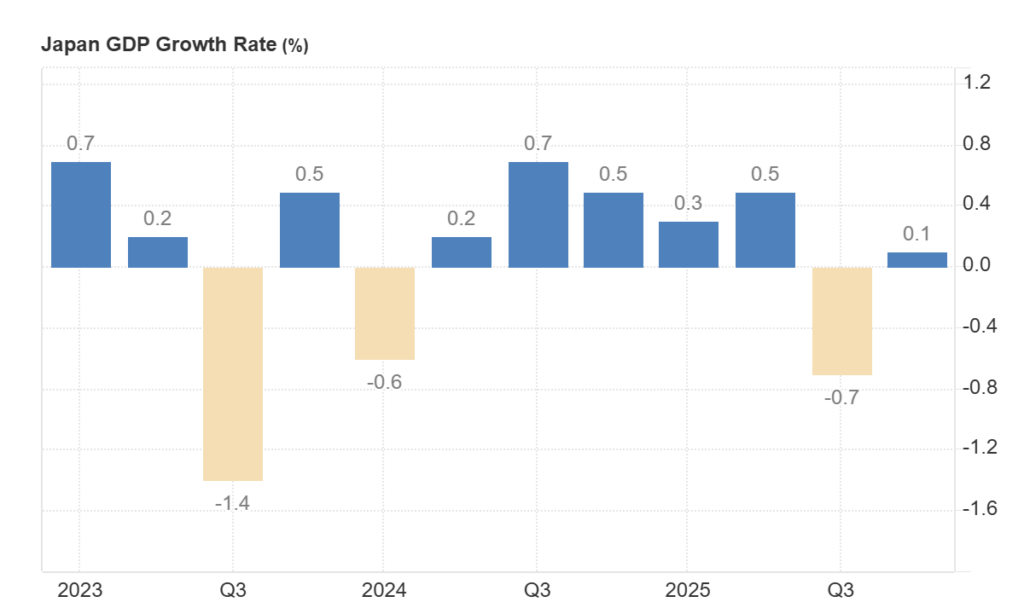
Japan Quarterly GDP / Source: Trading Economics
But the report still wasn’t great news. The actual figure came in way lower than the expected figure of 0.4%, and the annualized GDP only grew by 0.2%, also far below its forecast of 1.6%. ⁽¹⁾
Private consumption was the main force behind modest growth. This spending helped offset weakness in two other important areas, exports and government spending.
Bank of Japan Remains Optimistic
The Bank of Japan remained optimistic with its forecast for economic growth, as it upgraded its growth forecast from 0.7% to 0.9% for the fiscal year ending in March 2026. For fiscal 2026, it also revised its outlook higher to 1%, compared with the previous 0.7% estimate. ⁽²⁾
The BOJ believes the economy will continue to expand moderately as other countries also return to growth. It sees a positive cycle of rising prices and wages, supported by government economic measures and easy financial conditions.
New Prime Minister’s Economic Plans
Prime Minister Sanae Takaichi won a landslide victory in the February 8 Lower House election. After her win, she vowed to support economic growth by boosting investment through “proactive” fiscal policy, though she did not provide details.
Before the election, Takaichi had pledged to suspend food taxes for two years and increase defense spending to 2% of the country’s GDP. She also announced a record 122 trillion yen budget for the fiscal year starting April 1. This marks the second straight year of record government spending.
Inflation Remains Above Target
Japan’s inflation slowed to 2.1% in January, its lowest level since March 2022. Even so, prices have stayed above the Bank of Japan’s 2% target for 45 consecutive months. This ongoing inflation, combined with a weak yen, continues to put pressure on households. ⁽³⁾
? Did you know?
Japan has not experienced sustained inflation above 2% for this long since the early 1990s, marking a structural shift from decades of deflationary pressure.
Challenges Ahead for Policymakers
Weak economic data shows the challenge that Takaichi’s government is facing. High cost-of-living pressures are hurting consumer confidence and domestic demand. At the same time, the Bank of Japan is still committed to raising interest rates.
Economists note that the economy’s recovery momentum is not very strong. Consumption, business investment, and exports, the areas expected to drive growth, have all been weaker than hoped. ⁽⁴⁾
The soft economic performance may push Takaichi to follow through on her campaign pledge to suspend the consumption tax. Some economists believe the sluggish activity increases the chances she will not only suspend the sales tax on food but also introduce additional spending measures in the first half of the new fiscal year. ⁽⁵⁾
Business Investment Disappoints
Capital spending, which represents investment by companies, rose by only 0.2% in the fourth quarter. This was much lower than the 0.8% increase that economists had predicted. Business investment is important for creating jobs and driving long-term economic growth. ⁽⁶⁾
In fairness, investment data can change significantly when revised. Future updates might show the economy had more strength than initially reported.
Trade Impact Remains Uncertain
Exports dropped, though the decline was smaller after the United States set a 15% baseline tariff on nearly all Japanese imports. This was lower than the 27.5% tariff on automobiles that had been threatened. ⁽⁷⁾
The impact of tariffs appears to have been strongest in the July-September period. However, the latest results suggest that companies may continue to be cautious moving forward.
Looking Forward
Economists surveyed by the Japan Center for Economic Research predict annualized GDP growth of 1.04% in the first quarter of 2026 and 1.12% in the second quarter. These forecasts suggest modest improvement ahead, but much depends on government policy and global economic conditions. ⁽⁸⁾
Most experts say the latest GDP report is unlikely to change the Bank of Japan’s policy decisions immediately. However, with Prime Minister Takaichi’s election victory, there is increased attention on whether she will call for interest rates to be kept low. ⁽⁹⁾