ar
ar
- The Eurozone’s inflation climbed above 3% in May, driven mainly by higher energy prices and renewed price pressures in services.
- The jump could strengthen the case for a rate hike from the ECB, but weak growth might limit how far policymakers can go.
The eurozone had been ahead of other major economies in controlling inflation, with price growth falling below the European Central Bank’s 2% target earlier this year.
This fact allowed policymakers at the ECB to consider continuing cutting rates at a cautious pace.
Now the picture has changed. Inflation surged and extended its rise in May, driven by higher energy prices and rising inflation in the services sector.
Inflation Hits Highest Level Since September 2023
Headline inflation rose from April’s 3% to 3.2% YoY, aligned with its forecast, and reached its highest level since September 2023, sitting well above the ECB’s 2% target. ⁽¹⁾
The acceleration reverses a brief period of easing that had brought inflation below the ECB’s target earlier this year, before the Iran conflict outbreak that has disrupted energy markets.

Energy Leads the Rise, Services Follow
High energy prices drove the gains in the report, rising 10.9% YoY in May to mark its biggest rise since February 2023, and rising slightly from April’s 10.8%.
Services inflation also picked up, rising to 3.5%, up from April’s 3%. Non-energy industrial goods inflation edged higher as well, rising 0.9%. ⁽²⁾
The only category to offer some relief was food, alcohol, and tobacco, where price growth cooled to 2% from 2.4% from the previous month. ⁽³⁾
Despite the jump in headline inflation, policymakers could be more concerned about core inflation, rising to 2.5% from 2.2% recorded in April, indicating that price pressures aren’t just related to energy, but are also spreading out across various sectors in the economy. ⁽⁴⁾
Inflation Varies Across the Bloc
Price trends behaved differently across the region, with Germany’s inflation easing to 2.7% while France saw a slight increase to 2.8%. ⁽⁵⁾
Elsewhere, price pressures were more intense. Greece and Lithuania both saw annual inflation rates climb above 5% last month. Spain rose to 3.6% from 3.5%, the Netherlands jumped to 3.4% from 2.5%, and Italy rose to 3.3% from 2.8%. ⁽⁶⁾
The variance in inflation accounted for the differences in energy dependence, wage changes, and domestic demand.
Markets Price In ECB Rate Hike
Financial markets have moved swiftly to price in a policy response. Markets are currently pricing in a 94% chance of a 25-basis-point rate hike at the ECB’s meeting on June 11. One or two additional increases are expected later this year.
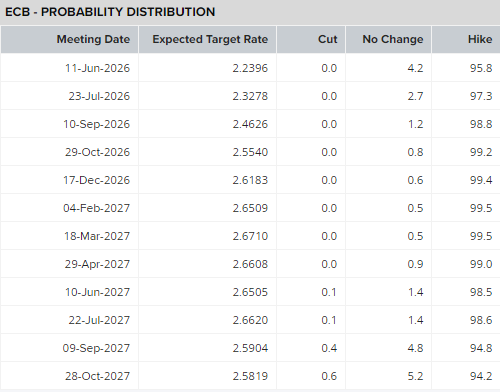
ECB policymakers have already stated that higher inflation could lead to more tightened financial conditions.
Growth Concerns Limit How Far the ECB Can Go
Despite the case for rate hikes, there are clear limits to how aggressive the ECB can afford to be. Business surveys and the central bank’s own data point to growing strain on the real economy. PMI data has also been weak across both the manufacturing and services sectors.
Europe, as a major energy importer, is facing many challenges, and has already experienced an energy shock before during the Russian invasion of Ukraine, and is also facing one now, alongside rising US tariffs on European goods.
The labor market is softer than it was during the 2022 inflation surge, which economists say should limit second-round effects on wages and prices. Households hold significant savings but tend to pull back spending quickly when confidence falls. ⁽⁷⁾