

 ar
- The ECB is expected to raise its interest rate by 25 basis points as war driven energy costs push inflation above 3%.
- Stronger economic growth and manufacturing activity give the ECB more room to tighten without immediately threatening the recovery.
- Markets will focus on the ECB’s updated forecasts and whether Lagarde leaves the door open to another rate hike later this year.
The European Central Bank looks almost certain to raise interest rates on Thursday, as the ongoing conflict in the Middle East keeps oil and gas prices high and pushes eurozone inflation further above target.
Markets have already priced in a hike, and policymakers appear ready to act, even as many expect this to be the last rate increase for a while.
September’s Rate Hike Is Already Priced In
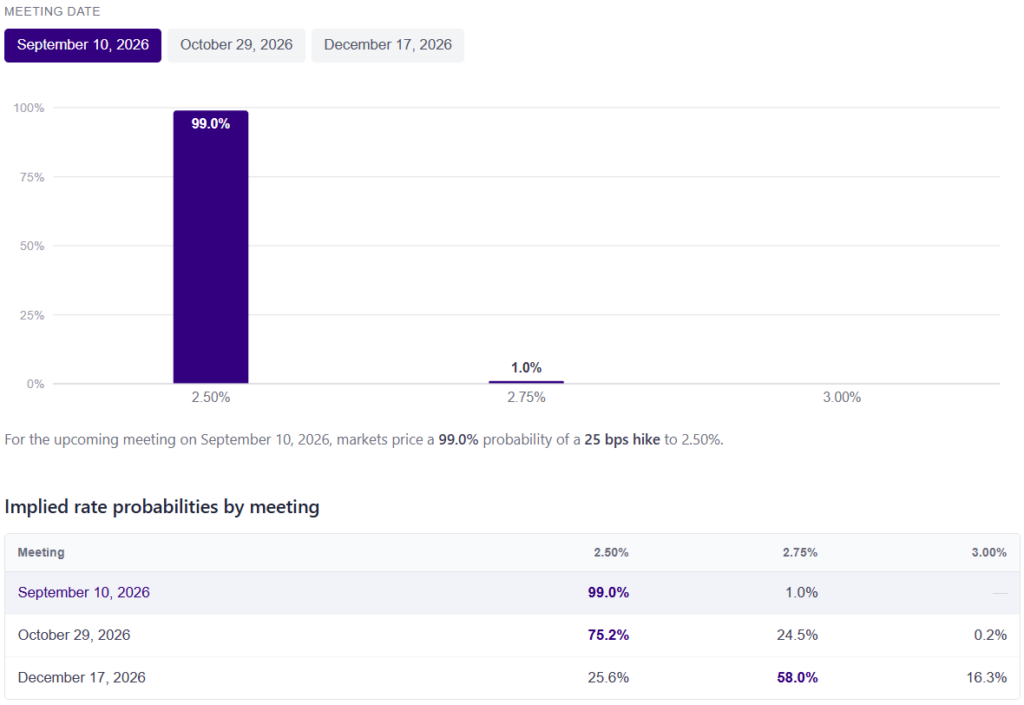
Traders have fully priced in the 25-basis point rate hike, which would lift the deposit rate from 2.25% to 2.50%.
The July meeting account showed that markets had almost fully priced in a September hike. However, the ECB has avoided formally committing to the move and continues to describe its decisions as data-dependent.
The case for a rate hike has been reinforced by the latest inflation figures, which rose from 2.9% to 3.3% in August, driven mainly by higher energy costs.
Energy prices tied to the Middle East conflict have pushed inflation higher, and the ECB wants to stay ahead of the problem rather than fall behind it. ⁽¹⁾
What Comes After September Is Less Clear
Part of the hesitation is that higher borrowing costs could weaken economic growth. Although rising energy costs are beginning to filter into some goods and services, evidence of broader second-round inflation remains limited.
Core inflation eased from 2.5% to 2.4% in August, while services inflation fell from 3.3% to 3.0%. Wage growth is also slowing, reducing immediate concerns about an energy-driven wage-price spiral. ⁽²⁾
New Forecasts in Focus
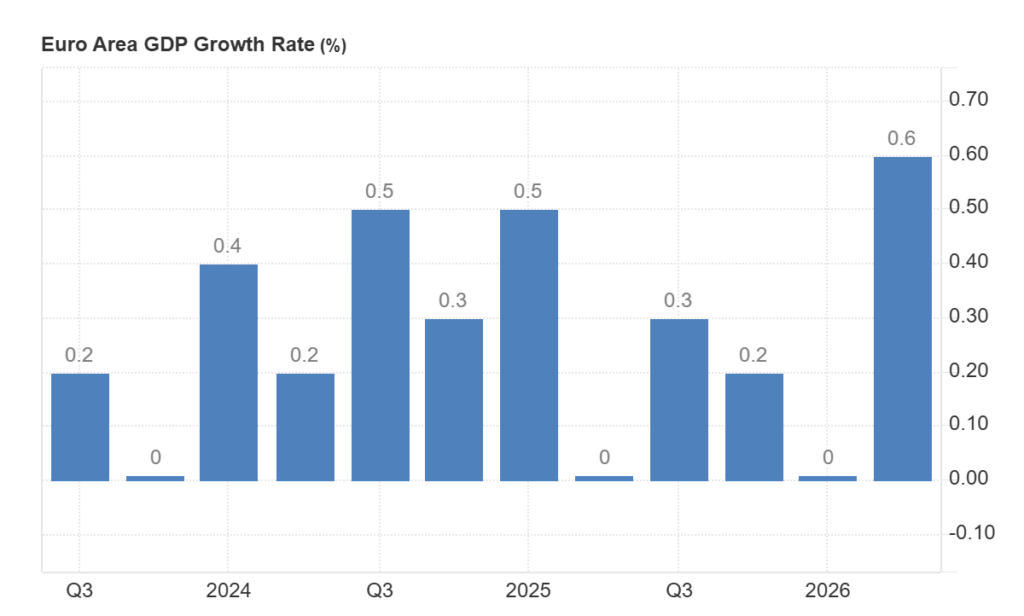
Alongside its decision, the ECB will release updated growth and inflation forecasts. Some economists expect the 2026 growth estimate to be revised slightly higher after the eurozone economy expanded by 0.6% in Q2, following no growth in Q1. ⁽³⁾
Business surveys also point to continued expansion. The eurozone composite PMI held at 52.0 in August, while manufacturing strengthened to 52.7, its highest level since May 2022. Services growth eased slightly, with the services PMI slipping to 51.6. ⁽⁴⁾
Why This Is Not 2022 All Over Again
The current inflation shock has some similarities to the surge of 2021 and 2022, when supply disruptions and sharply higher energy prices also played major roles. The difference lies mainly in how widely those pressures are spreading through the economy.
During the interest rate shock of 2022, the combination of supply constraints, recovering demand, higher energy costs and rising wages led to high inflation, reaching 10.6% in October 2022.
Nowadays, current price pressures are originating mainly from energy, while underlying inflation and wage growth remain contained. ⁽⁵⁾
This gives the ECB an advantage to raise rates more gradually, aiming to prevent the shock from spreading into other sectors of the eurozone economy.
Lagarde Is Unlikely to Commit to the Next Move
ECB President Christine Lagarde is expected to stick to her usual approach at Thursday’s press conference, avoiding firm commitments and stressing that future decisions will depend on incoming data.
Bundesbank chief and ECB policymaker Joachim Nagel was also cautious this week and avoided giving guidance beyond the upcoming decision. ⁽⁶⁾


