ar
ar
Trading cryptocurrencies with leverage has always been a double-edged sword.
Traders who rightly predict market movements can use crypto leverage to increase their purchasing power and amplify their returns. A 10% profit on a cash account can be a 500% return on a margin account with 50:1 leverage.
On the other hand, leverage can amplify losses when traders get their predictions wrong. A 2% drop in the market can wipe out the entire margin (collateral) with the same 50:1 leverage.
Many experienced crypto traders approach leverage with strict risk management rather than avoiding it altogether.
In what follows, we consider popular ways to trade crypto with leverage, why CFDs are popular as leveraged assets, and how to use crypto leverage wisely in the UAE. We’ll cover:
1. Crypto Trading with Leverage: The Various Options Available
2. Crypto Leverage Trading with CFDs: Why They Have Become Popular
3. How Experienced Crypto Traders Manage Leverage
4. How to Trade Crypto CFDs in the UAE
Looking to trade crypto CFDs in the UAE? Daman Markets offers regulated access to crypto CFDs and other leveraged instruments.
Crypto Trading with Leverage: The Various Options Available
Crypto traders looking to amplify their positions have many asset classes to consider. Below is an overview of the most popular ones:
1. Futures Contracts
Futures contracts are agreements to buy or sell crypto at a future date for a specified price.
Cryptocurrency exchanges allow leverage exposure to futures contracts, allowing traders to open positions larger than their actual capital.
These exchanges typically charge trading fees (also known as maker/taker fees) on futures contracts, while some also charge liquidation (when a trade is liquidated due to insufficient margin) and settlement (when a trade is automatically settled on the expiry date) fees.
With futures, traders agree to buy or sell the underlying asset on the expiry date. At expiry, the contract can be settled by cash (the difference between the contract price and the market price is paid to the winner) or physical exchange of the relevant crypto (which comes with settlement fees).
2. Perpetual Futures
Unlike standard futures contracts, perpetual futures do not have expiry dates. Positions are regularly marked to market and adjusted via funding.
To keep perpetual price close to the spot (market) price, longs and shorts periodically (usually every 8 hours) pay each other a funding fee, depending on market conditions. If the perpetual price is above the spot price, the longs pay the funding fee to the shorts, and vice versa.
However, given that perpetuals are usually marked to market every 8 hours, the funding fee can be negligible when prices have not changed significantly.
Also, since markets can move in both directions, the longs paying the shorts when the perpetual price is above the spot price can end up receiving from the shorts just eight hours later when the perpetual price is lower than the spot price.
In other words, both the direction and magnitude of payment can change frequently.
3. Margin Accounts on Spot Exchanges
Some exchanges offer margin accounts for the trading of spot crypto.
This option is often preferred by traders who desire to own the underlying crypto rather than just profit from its price movements. Crypto exchanges usually charge interest on the borrowed funds.
Leverage on spot exchanges work similarly as with crypto derivatives.
There is an initial margin requirement and a maintenance margin, which is usually a percentage of the initial margin. When the account equity falls below the maintenance margin, there is a margin call.
If the trader does not top up the account to meet the maintenance margin, the trade is liquidated once it gets to the liquidation price.
4. CFDs
A contract-for-difference (CFD) is a broker-issued derivative instrument that traders use to speculate on the price movements of certain assets without owning the underlying asset.
Unlike spot markets, CFDs allow traders to go long or short. Also, unlike futures, there are no expiry dates, and traders can close their trades anytime. Moreover, this advantage does not come at the expense of funding rates as with perpetual futures.
Since there is no ownership of underlying assets, CFDs are cash-settled.
However, holding CFDs open beyond a single trading day will incur overnight fees (also known as swap fees or financing charges). This fee can be understood as an interest payment on borrowed capital or the cost of using leverage.

Crypto Leverage Trading with CFDs: Why They Have Become Popular
CFDs are becoming more popular, especially in an emerging market like the UAE.
“Almost every week, one or two contracts for differences (CFD) brokers obtain a Dubai licence,” according to Finance Magnates, a fintech news platform. “The influx of brokers into Dubai shows that many want a share of this growing market.”
But why are CFDs becoming popular?
Many traders are drawn to this asset for leverage exposure, the ability to profit in both falling and rising markets, access to a wide range of markets, immediate cash settlement, extended trading hours, and hedging opportunities, according to Finextra, a financial news and research platform.
Interestingly, cryptocurrencies are one of the popular entry points for CFD traders in the UAE, with 24% of new traders starting their journey with the asset class, according to a 2024 report by Investment Trends, a financial research platform.
Let’s take a deeper dive into why CFDs are popular for crypto trading with leverage.
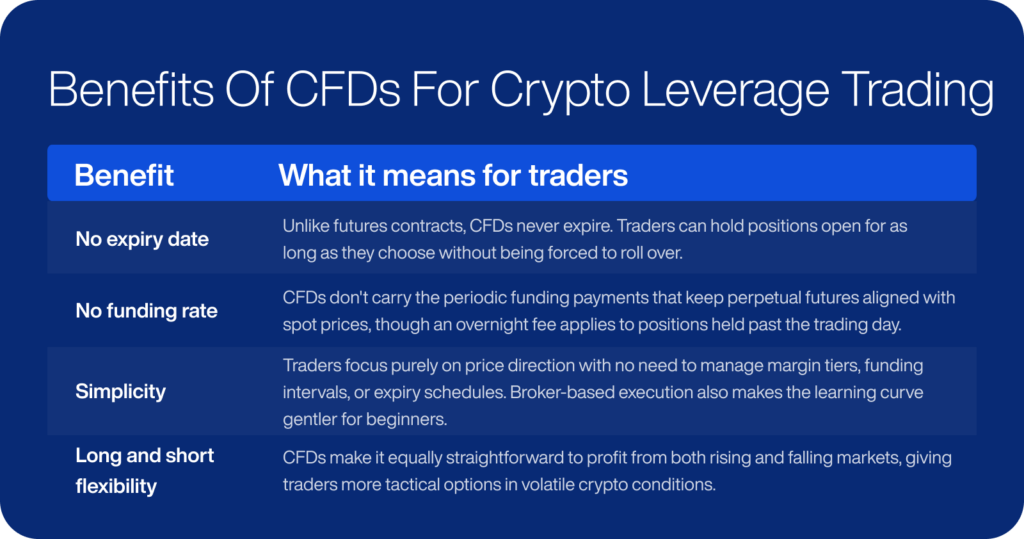
- No expiry: Unlike futures contracts, CFDs have no expiry dates. Traders can hold positions as long as they want, subject to overnight fees
- No funding rate: Perpetual futures do not have expiry dates. However, a funding rate applies to keep the perpetual price aligned with the spot price. CFDs don’t involve such periodic payments, though there is a fee on positions held overnight.
- Simplicity: With CFDs, traders focus solely on the price movements of the underlying security. There’s no need to manage margin tiers, funding intervals, expiry schedule, or the risk of physical delivery of underlying assets.
- Go long or short easily: While margin trading on spot exchanges is also simple, CFDs allow traders to speculate on both rising and falling markets.
Also, since they are broker-based rather than exchange-based, they can be easier for some beginners to grasp and execute.
“I find CFDs appealing for their simplicity, availability, and absence of need for direct holding of an underlying asset,” said Deepak Shukla, the CEO of Pearl Lemon Invest and a crypto investor.
However, he warns that this simplicity comes at the cost of higher spreads and lower transparency when compared to futures contracts.
Similarly, CFDs offer the advantage of accessing crypto price movements without dealing with wallets, custody, or derivatives infrastructure, according to Tapos Kumar, the CEO of Finance Ideas, a personal finance education platform. However, he highlights that this simplicity does not take away the risk of CFDs since leverage can quickly magnify mistakes, hence the need for risk management.
How Experienced Crypto Traders Manage Leverage
As said above, leverage is a double-edged sword. Handling it well requires strict risk management strategies that are common with advanced crypto traders.
Some of the most popular ones include:
1. Position Sizing and Risk Control
Expert traders risk only a percentage of their trading account balance (usually 1-5%) on a particular trade. They do this to ensure that a single loss, or even a series of consecutive losses, does not wipe out their trading capital, even with leverage.
“For myself, leverage will always be a means to an end but never an end in itself,” said Shukla. “I do not take a substantial portion of my capital and put it on one single trade.”
Kumar also proposes an interesting way to determine when a position is too large.
“I pay attention to how much attention a position consumes,” he says. “If a trade requires constant monitoring, disrupts sleep, or changes my behavior, the position is probably too large. In crypto markets, survival is usually determined long before liquidation occurs. It happens when leverage begins controlling the investor instead of the investor controlling the leverage. My rule is simple: if a position is large enough to change my behavior, it is probably larger than it should be.”

2. Automated Exits
Experienced traders also set automated stop-loss and take-profit orders so they can exit the market at precise points. Stop-loss orders put a cap on potential losses, ensuring some bad trades don’t blow out a trading account.
“Traders lose money because they try to squeeze out as much as they can from their positions,” said Deepak. “Those who survive do so by trying to minimize their losses.”

Similarly, take-profit orders ensure that a desire for endless profit does not end up in massive losses when the market suddenly reverses.
3. Dynamic Leverage
Expert crypto traders don’t use the maximum leverage available. Instead, they adjust their leverage usage to the asset’s volatility. For example, a common approach among experienced traders is to use lower leverage ratios for more volatile assets and higher ratios for more stable ones.
Similarly, traders like Kumar match the leverage ratio with the level of confidence in the trade.
“One concept I often use is confidence efficiency,” he said. “The less certain an investor is, the less leverage should be involved. Unfortunately, many traders do the opposite and increase leverage when conviction is weakest. In my view, leverage works best when it supports a well-defined thesis.”
4. Starting with Minor Positions
Many crypto traders vary their use of leverage by their experience level. A common pattern among newer traders is to begin with lower leverage ratios and increase exposure as familiarity with the market grows.
5. Margin Monitoring
Expert traders also monitor margin levels to ensure their trades are not liquidated due to insufficient maintenance margin.
More importantly, some traders use automated systems to reduce their exposure when the margin usage has exceeded a certain personal maximum threshold.
They can respond by adjusting leverage ratios, reducing position size, or hedging exposures through correlated assets instead of waiting for margin calls or liquidation.
6. Asset Diversification
Trading assets with low correlations to one another is another way expert traders reduce risk.
When market trends cause one asset to move against them, the same conditions can cause an asset with negative correlation to move in their favor. In some cases, the profit from one asset can partially or fully offset the losses from another asset.
How to Trade Crypto CFDs in the UAE
As noted by Finance Magnates, there are many CFD brokers in the UAE. Many of them offer leveraged access to Bitcoin, altcoins like Solana, Ethereum, Bitcoin Cash, Ripple, Tether, and Litecoin, and stablecoins like Tether and USD Coin.
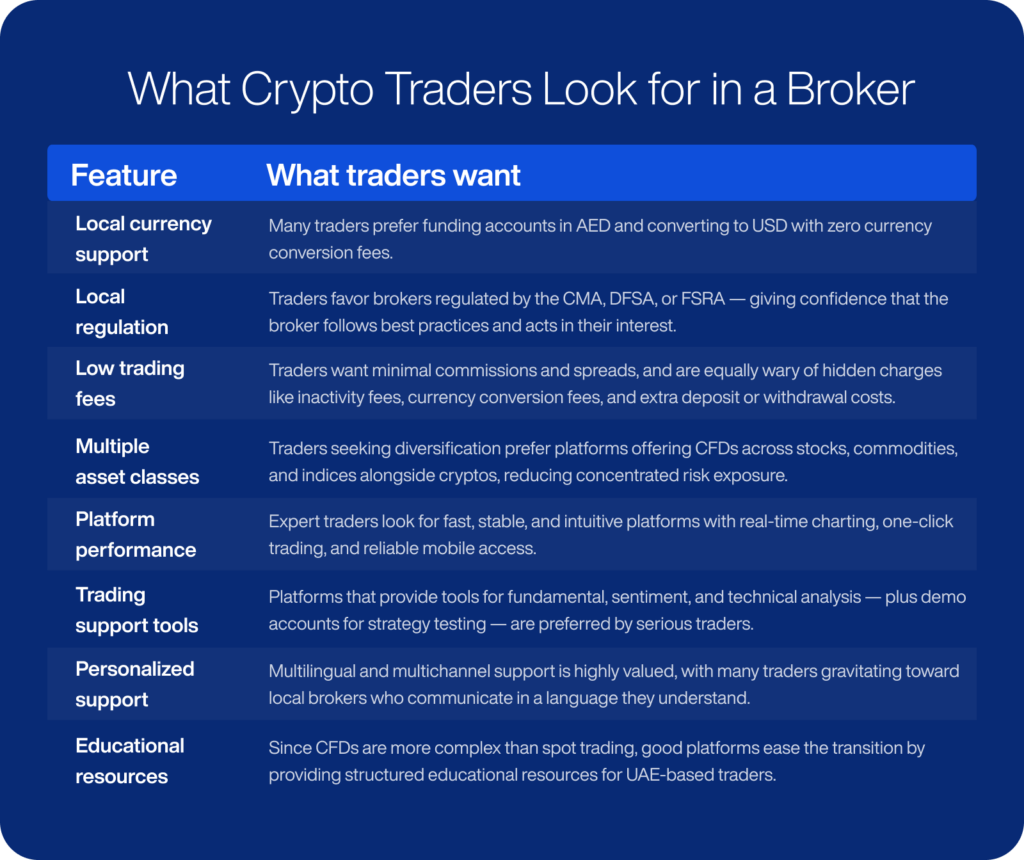
However, given the number of CFD brokers in the UAE, it is essential to know how to choose an appropriate online trading platform. Some of the features traders who use crypto leverage look for include:
- Local currency support: Many traders enjoy the possibility of funding their accounts in AED and converting to USD with zero or very low currency conversion fees.
- Local regulation: Traders prefer brokers that are regulated by local authorities like the Capital Markets Authority (CMA; formerly Securities and Commodities Authority (SCA)), Dubai Financial Services Authority (DFSA), and the Financial Services Regulatory Authority (FSRA). This gives them confidence that such brokers follow best practices and will act in their best interests.
- Low trading fees: Crypto traders want to minimize commissions and spreads. More importantly, they are also wary of platforms that charge multiple extra fees like inactivity fees, currency conversion fees, extra deposit and withdrawal fees, among others.
- Multiple asset classes: Traders who want to minimize risk exposure with diversification tend to favor platforms that provide CFDs on multiple asset classes in addition to cryptos: stocks, commodities, indices, among others.
- Platform performance: Expert traders also look for a fast, stable, and intuitive platform that offers features like real-time charting, one-click trading, and mobile access.
- Trading support tools: Crypto traders usually prefer platforms that provide the right tools for sound fundamental, sentiment, and technical analysis. Focusing on all three helps them to create and execute solid CFD trading strategies. Some traders also find a demo account to be a useful tool for testing new strategies.
- Personalized support: Multilingual and multichannel support is another feature many traders hunt for. This is one of the reasons some prefer local brokers who can speak in a language they can understand (literally and metaphorically).
- Educational resources: CFDs may be simpler when compared to other leveraged asset classes, but they are still complex for anyone only familiar with spot trading. Good platforms make the transition easier by providing educational resources on how to start CFD trading in the UAE.
At Daman Markets, we provide the tools, support, and trading conditions that many traders in the UAE find valuable when trading cryptocurrency CFDs.
We are regulated by the CMA and offer AED-based accounts for deposits and withdrawals. Crypto traders can use leverage up to 1:100 on our DM Pro account and up to 1:500 on our DM Classic account.
We offer CFDs on cryptos, stocks, indices, commodities, and forex. Through our research terminal, you gain access to trading tools like MT5, market news, sentiment analysis, economic calendar, and a preview of global macroeconomic trends.
We also provide personalized multilingual and multichannel support, backed by 25 years of group experience in the UAE. To help you build your knowledge of the financial markets, we offer a wide range of educational resources through the Market Analysis section of our website and Daman Market Academy, which contains video tutorials, interactive courses, and webinars.
Are you ready to explore CFDs on cryptocurrencies in the UAE? Sign up now with Daman Markets for access to premium trading tools and personalized support.
Takeaways
- Since leverage amplifies both gains and losses, success with crypto leverage depends as much on risk management as market direction.
- CFDs offer a flexible way to trade crypto with leverage. They provide long and short exposure, no expiry dates, and customizable leverage.
- Professional traders manage leverage risk with position sizing, stop-loss orders, margin monitoring, and asset diversification.
- Crypto traders frequently look for regulation, flexible leverage, local support, low fees, and educational resources, among others, when choosing a CFD broker.