ar

- Higher inflation reduced expectations for Australian rate cuts, but failed to sustain the currency’s initial gains.
- A weakening labor market and pressure on housing complicated the RBA’s case for further tightening.
- US rate expectations, weaker iron ore prices and the technology selloff added to pressure on the Aussie.
The Australian dollar’s initial lift from hotter inflation quickly faded. AUD/USD fell around 1% on November 25, reversing earlier gains as renewed selling in technology stocks and expectations of further Federal Reserve tightening weighed on the currency.
The inflation surprise strengthened the case for keeping Australian rates elevated. Yet the currency was also responding to weaker employment, falling export prices and a retreat from risk across global markets.
Rising Inflation Pushes Back Rate Cuts
Australia’s headline inflation rose to 4.9% in October, jumping from September’s 4.3%, while trimmed mean inflation rose to 3.8% from 3.6%. Fuel prices were the main driver in inflation, jumping 6.3% MoM. The rise in underlying inflation showed that price pressures extended beyond fuel prices. ⁽¹⁾
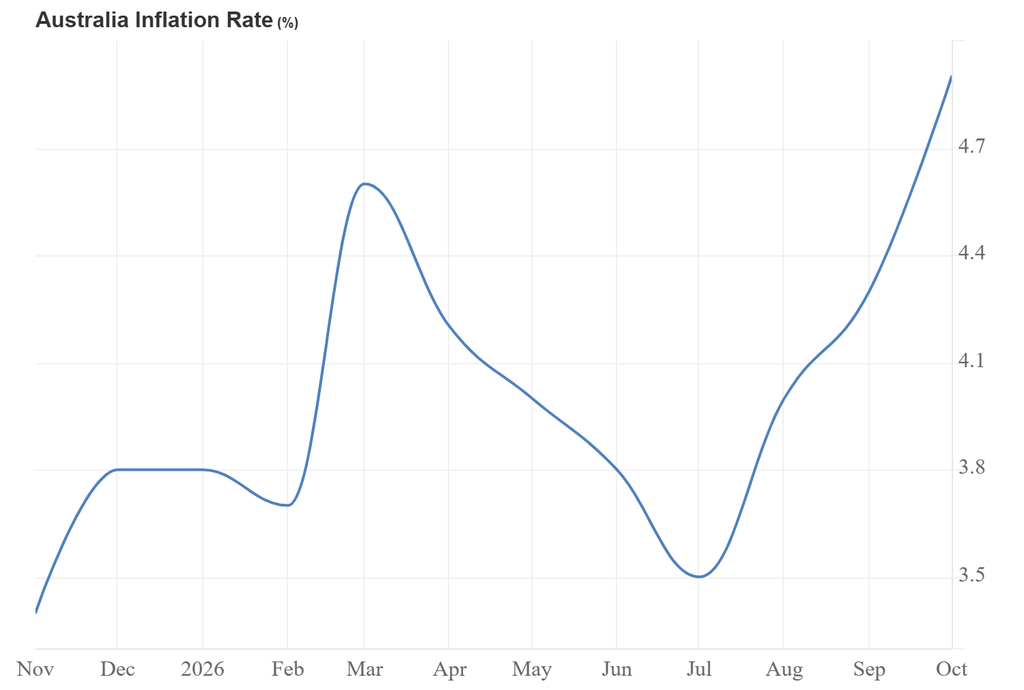
Traders scaled back on rate cut bets for next year. The probability for a rate cut in May 2027 fell from 56% to 48% while the chance of a June reduction fell to 75% from 90%. That adjustment followed five rate hikes this year, which lifted the cash rate from 3.60% to 4.85%, reaching an 18-year high. ⁽²⁾
Delaying expected rate cuts can support the Aussie dollar by keeping expected returns from yields higher for longer. But after the inflation data was released, the Aussie reversed its gains and showed that this factor alone could not support the currency due to other factors pressuring it.
A Weakening Labor Market Complicates the Decision
The RBA is caught at a crossroads between high inflation and a weakening labor market. October’s labor market data showed job losses of 43,500, with part-time positions accounting for 40,600 of the decline and full-time employment falling by 2,900. The unemployment rate rose from 4.7% to 4.9%, while the participation rate declined to 66.6%. ⁽³⁾
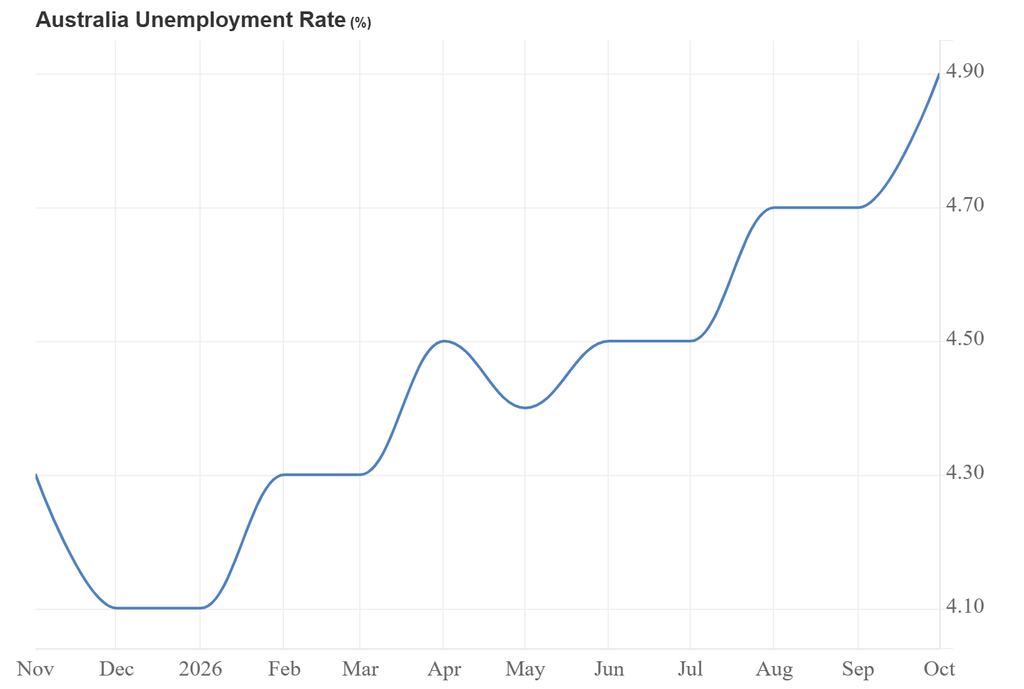
The concentration of losses in part-time work drove the headline. Trend employment, which smooths monthly volatility, still rose by 7,200. Nevertheless, the data supports the case of a weakening labor market. ⁽⁴⁾
That puts the RBA in a tough situation, as inflation remains elevated while employment weakens, indicating that the economic cost of higher interest rates is showing in full effect.
The RBA is Split Over How Much Tightening is Enough
That tension was shown at the November meeting, when six board members pushed for a rate increase to 4.85% while three voted for a hold. ⁽⁵⁾
The 6 members that voted for a rate hike argued that inflationary pressures became more persistent than what they had previously expected, including services and labor costs. They also worried that a long period of high inflation could push expectations higher and make returning inflation back to its target range of 2%-3% more difficult.
The ones that pushed for a hold stated that the 100 basis points of tightening delivered before November had yet to take full effect. They highlighted the larger-than-expected rise in unemployment, which had risen 0.5% in the last six months and the risk that the housing downturn could weaken spending and employment further.
The dissenters supported waiting for more evidence and accepted that further tightening might still be necessary. Their position was a pause, not a call for rate cuts.
Comments from the RBA’s Head of Domestic Markets David Jacobs said financial conditions are already straining economic activity, pointing to pressure on housing, while strong business borrowing and low credit spreads made the overall degree of restraint harder to judge. ⁽⁶⁾
He didn’t say whether interest rates are high enough to slow the economy. That call belongs to the Monetary Policy Board.
Rates can already be slowing activity while inflation remains too persistent to return comfortably to the RBA’s 2–3% target range.
Higher US Rate Expectations Keep the Aussie Under Pressure
The Australian dollar also depends on how domestic rate expectations compare with those overseas. Traders were pricing in a 94% chance of a Federal Reserve rate hike in December. The Australia and US 2-year yields were both around 4.6%, leaving a little gap between them.
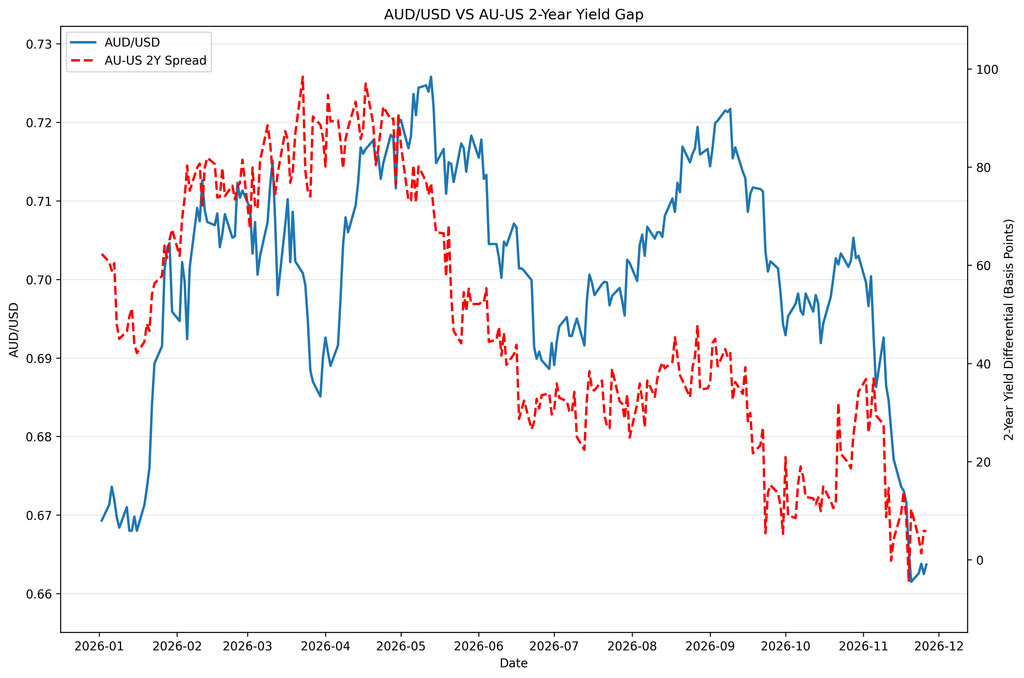
However, the spread between them has narrowed since late March from 98 basis points to 5.6 basis points as US rate expectations rose.
This also explains why the Aussie dollar didn’t rise on the hotter-than-expected inflation data and the RBA’s high cash rate.
Currency markets react to changes in expected monetary policy paths. A reduced possibility of rate cuts from the RBA could provide support, but expectations of further rate increases in the US can pull the Aussie in the opposite direction.
Iron Ore Weakness Removes Another Source of Support
Australia’s commodity exports to China matter for the AUD, especially iron ore. Iron ore prices fell 6.1% in October, Westpac said, as China made less steel and supply stayed strong. Stockpiles at Chinese ports kept rising, which added to the pressure on Australia’s exports. ⁽⁷⁾
Lower prices mean Australia earns less from the same amount of exports. That hurts mining profits and gives miners less reason to invest, which can pull the Australian dollar down.
Equity Selling Can Spill into Currency Markets
Renewed selling in technology stocks weakened global risk appetite, putting pressure on the Australian dollar as investors sought safer currencies. The Aussie’s sensitivity to global growth and financial conditions meant that the inflation surprise was competing with a broader retreat from risk.
The currency comparisons show how widely the weakness extended. Since the start of November, the Aussie has fallen against the Swiss franc and British pound, while also underperforming other commodity-linked currencies, including the Canadian and New Zealand dollars. On a broader measure, the RBA’s trade-weighted index has declined 1.13% year to date. ⁽⁸⁾
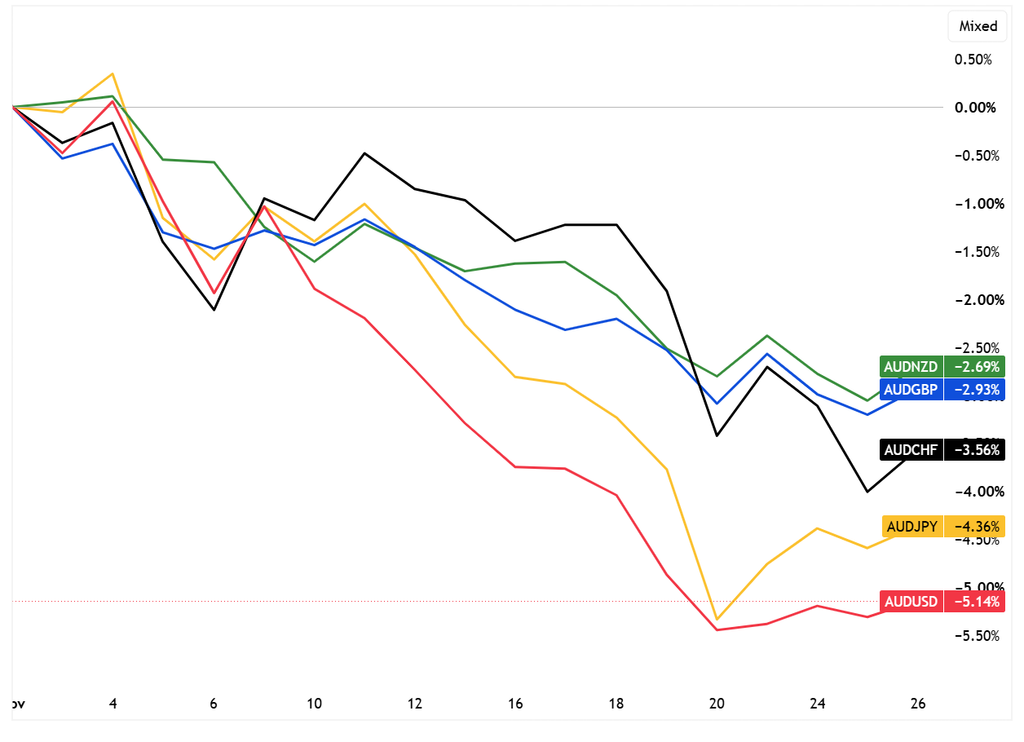
Overseas equity losses can reach the AUD through portfolio hedging as well as risk appetite.
RBA research explains that some Australian asset managers maintain fixed hedging ratios on foreign investment, meaning that they protect a set portion of their foreign investments from currency swings.
When those assets fall in value, existing currency hedges become too large relative to the portfolio. Reducing those hedges can involve selling Australian dollars, providing another channel through which overseas equities declines can add pressure on the currency. ⁽⁹⁾