ar
The AI champion has lost its founding CEO just days before earnings. Is the selloff a rational reset, or could NVIDIA’s extraordinary cash-generating business outlast the man who built it?
| 96.2B Q2 FY27 revenue +106% year over year | $63.7B GAAP operating income +124% year over year | 17 NOV Next earnings release Q3 FY27 |
On November 12, NVIDIA confirmed that co-founder Jensen Huang had resigned as chief executive and board member, with longtime CFO Colette Kress stepping in as interim CEO. Harvey C. Jones became board chair as the search for a permanent leader began.
Nvidia shares dropped 14% after the announcement of the resignation, then pared back some losses. The extent of the fall indicates how much people trusted Huang to keep Nvidia’s customers, suppliers and other AI companies working together. ⁽¹⁾ ⁽³⁾
The irony is striking: the world’s most closely watched AI company enters this leadership crisis after reporting some of the strongest growth and operating profits in corporate technology.
NVIDIA’s market value reached roughly $5.8 trillion in October, before retreating amid wider market and company-specific pressures. The question is not about whether Huang mattered. It is more about whether the market is now discounting too much of NVIDIA’s future, or too little of its leadership risk. ⁽³⁾ ⁽⁴⁾
The Growth Story Behind the Market Drama
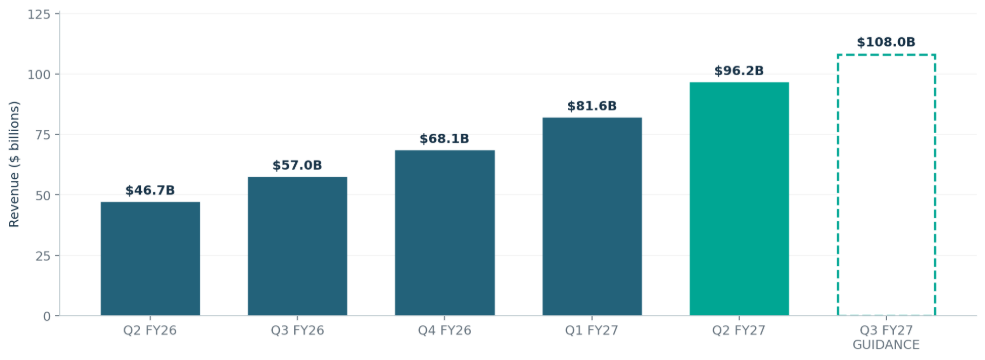
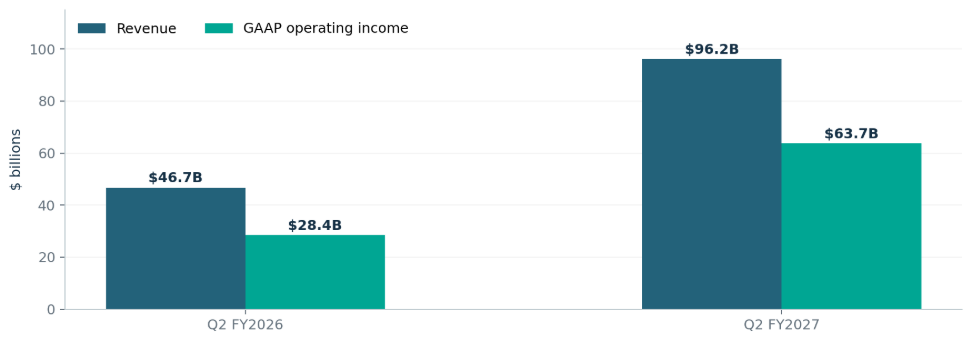
NVIDIA generated $96.2 billion in revenue in the second quarter of fiscal 2027, more than twice the $46.7 billion recorded one year earlier. The company’s GAAP operating income reached $63.7 billion, compared with $28.4 billion a year ago. Data Center alone contributed $89.0 billion, approximately 92.5% of revenue. Growth and dependence on the AI infrastructure cycle now go hand in hand. ⁽²⁾
The Bear Case: Why the Decline Could Continue
1. A founder-shaped organization faces a sudden handover
Huang did more than occupy the CEO chair. He was closely associated with product strategy, the CUDA developer ecosystem, major customer relationships and NVIDIA’s position in the global AI supply chain.
Replacing those functions is not necessarily the work of a single successor. Even with experienced executives in place, investors must weigh potential disruption, employee retention, succession decisions and governance issues. The company says it expects operations and its technology roadmap to continue without interruption; the market is still testing that assertion. ⁽¹⁾ ⁽³⁾
2. The AI investment cycle is both a strength and a vulnerability
At $89.0 billion, Data Center represented the overwhelming majority of last quarter’s sales. Nvidia isn’t just supplying chips but it has invested in its customers and provided financial support for infrastructure projects.
Financing issues can cause project delays, while guarantees can create additional exposure for NVIDIA. Conversely, financing support can help customers bring projects into operation.
NVIDIA also faces competition from AMD, Broadcom-linked custom silicon and cloud providers’ own accelerators. Export restrictions on advanced chips, especially concerning China, create another area of uncertainty. NVIDIA’s current Q3 revenue guidance explicitly assumes no Data Center compute revenue from China. ⁽²⁾ ⁽⁷⁾
3. Margins and valuation leave little room for disappointment
NVIDIA’s 75% gross margin is extraordinary, but elevated component and memory costs could pressure profitability even when revenue keeps rising. The latest Q3 outlook anticipates a 74% gross margin. Meanwhile, a lower share price does not automatically mean a bargain: estimates can be reduced, multiples can compress further, and leadership risk can persist longer than traders expect. ⁽²⁾ ⁽⁸⁾
4. China exposure may be larger than the reported geography suggests
NVIDIA reported $7.88 billion of second-quarter FY2027 revenue, or about 8.2% of the total, from customers headquartered in China and Hong Kong.
But this measure reflects where direct buyers are based, not necessarily where products ultimately operate. Short seller Culper Research alleged in May that more than 20% of fiscal 2026 compute revenue was ultimately linked to Chinese demand through intermediaries and illicit chip diversion. Its figure is disputed and has not been independently established; it also measures a different period and revenue category from NVIDIA’s official China disclosure. ⁽¹⁸⁾ ⁽¹⁹⁾
The risk is that stricter U.S. export enforcement could disrupt some indirect demand, heighten compliance costs or delay sales to intermediaries. Reuters has separately reported Chinese buyers seeking overseas NVIDIA computing capacity as they anticipate tighter rules.
However, proof of chip diversion is not proof that NVIDIA knowingly facilitated it. NVIDIA also reported that second-quarter Hopper shipments directly to China were less than 1% of Data Center revenue and has excluded China Data Center compute sales from its next-quarter revenue forecast. Those facts limit the case for treating the short seller’s estimate as an immediate, certain loss of revenue. ⁽²⁾ ⁽¹⁸⁾ ⁽²⁰⁾
5. The AI financing network could magnify a spending slowdown
Another concern is circular financing. Capital invested in AI developers and infrastructure providers can help fund purchases of NVIDIA-powered computing capacity, linking the chip supplier’s growth to the financial health of customers and partners.
NVIDIA’s latest 10-Q reported $99 billion in equity investments, $25 billion in additional equity-investment commitments and $36 billion in AI-cloud service commitments as of July 26, 2026.
It also disclosed conditional guarantees capped at $105 billion in connection with a planned OpenAI-linked data-center project. These are different types of exposures, not an additional $265 billion of immediate cash spending or losses. The guarantees are contingent, phase in over time and are triggered only under specified conditions. ⁽¹⁸⁾
The economic question is whether AI users will generate enough lasting demand and cash flow to support the capacity being built. If investment returns disappoint or financing becomes harder to obtain, customers could defer deployments, while NVIDIA could face pressure on both chip sales and the value of its ecosystem investments.
The IMF has warned that circular funding and concentrated AI exposures can transmit stress across connected companies and financial markets. Still, ecosystem investments can support genuinely productive demand, and NVIDIA’s reported operating income remains substantial. This is a vulnerability to monitor, not evidence that its reported sales are fictitious. ⁽¹⁸⁾ ⁽²¹⁾
A prolonged NVIDIA downturn could also weigh on major technology benchmarks and heavily exposed AI infrastructure companies, though a market-wide collapse is not inevitable. Some chip rivals may gain share or attract investment as investors reassess NVIDIA-specific risks. The key distinction is between a company-level leadership and compliance shock and a broader reversal in AI spending. ⁽²²⁾
The Bull Case: Can Fundamentals Overpower Fear?
The financial engine has not disappeared with the CEO transition. In Q2 FY2027, revenue advanced 106% year over year while GAAP operating income jumped 124%, giving NVIDIA a roughly 66% GAAP operating margin. NVIDIA returned approximately $26 billion to shareholders through repurchases and dividends during the quarter and reported about $99 billion remaining under its repurchase authorization. These figures show substantial financial resources, not a guarantee of support for the stock. ⁽²⁾
There is also a durable ecosystem argument. NVIDIA sells more than chips: its hardware, networking, CUDA software and developer relationships combine into a platform customers have invested years building around.
The company says its next-generation Vera Rubin systems are already ramping with major partners. That makes a sudden collapse of its commercial position less straightforward than the departure of one executive might imply. ⁽²⁾
Management’s preliminary expectation for fiscal 2028 revenue growth of approximately 70% highlights the scale of the opportunity, but should be treated as an early forecast rather than a promised outcome. If demand, deliveries and margins continue to outperform expectations, investors could refocus on earnings power instead of leadership uncertainty.⁽⁸⁾
Is the stock now relatively cheap?
The selloff has sharply reduced NVIDIA’s valuation. MarketWatch reported an approximately 11.66× forward price-to-earnings multiple on November 11, the lowest reading on its series since 2011.
Other providers show higher forward multiples, including about 14.35× at Stock Analysis, because forward earnings definitions, price timestamps and forecast sets differ. The defensible conclusion is that NVIDIA is much less expensive relative to forecast earnings than it was earlier in the year, not that any single P/E figure establishes a floor.⁽⁹⁾ ⁽¹⁰⁾
Is NVIDIA Truly A One-Man Show? History Suggests A more Nuanced Answer
Great founders build vision, culture and competitive advantages. But the most successful technology companies also develop leadership benches, processes, products and customer relationships that can endure well beyond their founders. Three major examples offer perspective, without proving that NVIDIA will follow the same path.
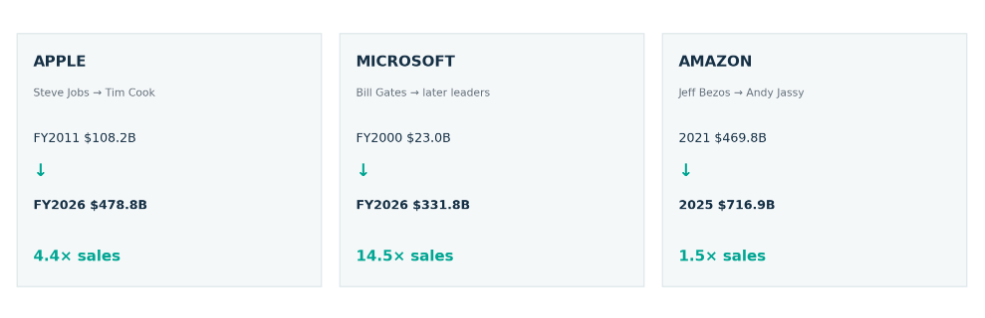
Apple: Steve Jobs stepped down as CEO in August 2011, handing leadership to Tim Cook. Apple reported $108.2 billion of revenue in FY2011 and $478.8 billion in FY2026. Its growth demonstrates that Jobs had built an enduring business, supported by an experienced operating team. ⁽¹¹⁾ ⁽¹²⁾
Microsoft: Bill Gates handed the CEO role to Steve Ballmer in January 2000. Microsoft revenue grew from $23.0 billion in FY2000 to $331.8 billion in FY2026, with a major later reinvention under Satya Nadella. Its journey was not a straight line, but the company’s long-term relevance survived multiple leadership eras. ⁽¹³⁾ ⁽¹⁴⁾
Amazon: Jeff Bezos moved to executive chair in 2021, and Andy Jassy took the CEO role. Amazon’s revenue increased from $469.8 billion in 2021 to $716.9 billion in 2025. The comparison is imperfect, but it shows that founder-led companies can continue expanding after the operational handover. ⁽¹⁵⁾ ⁽¹⁶⁾
Distinguishing here is important. Apple and Amazon had named successors before the handover, and Microsoft’s strongest later phase required another leadership change. NVIDIA is starting with an interim CEO and an ongoing search. The cases illustrate the possibility of continuity, not a forecast of NVIDIA’s share performance.
November 17: The Next Test for NVIDIA
NVIDIA’s Q3 FY2027 results are scheduled for November 17 after the U.S. market close. The company has guided to revenue of $108.0 billion, plus or minus 2%, while a published analyst consensus stands near $108.84 billion in revenue and $2.47 in adjusted earnings per share. The revenue forecasts show 91% annual growth. However, the figure sits above Nvidia’s guidance, where a result around $108 billion could be aligned with management’s forecast while falling short on the published consensus.
That makes fourth-quarter guidance particularly useful. The reported quarter measures business completed before Huang’s departure; the next outlook will provide management’s assessment of demand and delivery capacity during the transition. ⁽¹⁾ ⁽²⁾ ⁽¹⁷⁾
| WHAT COULD SUPPORT A REBOUND | WHAT COULD EXTEND THE DECLINE |
| Revenue/EPS beat consensus, with resilient margins | Revenue or EPS miss, or softer margins |
| Strong forward guidance and confidence in the 2028 outlook | Weak Q4 outlook or slower hyperscaler demand |
| Credible permanent CEO and retention of the core leadership team | Unresolved succession risk or loss of key talent |
| Evidence that product launches and customer commitments remain on track | Disruption to roadmap, major customers, supply or regulation |
| Clearer end-customer disclosures and stable export-rule compliance | Broader export enforcement, diversion scrutiny or disrupted intermediaries |
| Continued AI-cloud utilization and financially resilient customers | Funding stress, weaker AI returns or deferred data-center deployment |
The Bottom Line
NVIDIA has lost the leader who helped make it the defining company of the AI boom. That is a legitimate risk, and the market may need time to assess the new management structure. Yet NVIDIA also remains a highly profitable business with rapidly expanding revenue, a powerful developer ecosystem and ambitious forward growth expectations.
A further selloff and a recovery are both plausible. Investors should distinguish temporary uncertainty from a lasting deterioration in business fundamentals. With earnings approaching and a permanent CEO still to be named, the key question is no longer simply whether NVIDIA can live without Jensen Huang. It is how much of that uncertainty the share price has already absorbed.
Follow NVIDIA developments and explore market opportunities.
You can trade NVIDIA with Daman Markets.