ar
- New Zealand and Canada lead the week with expected 25 basis point hikes on Wednesday, while the Fed, ECB and BoJ look set to hold.
- Higher energy costs threaten broader inflation, while weaker employment, fragile spending and rising borrowing costs make further tightening more costly.
- Currency could heavily move on signals about further hikes, with French debt concerns complicating the euro’s outlook and the Fed–BoJ rate gap shaping the yen.
Five central banks decide on interest rates between 28 and 30 October, with higher energy costs threatening to make inflation harder to contain. Markets favor hikes in New Zealand and Canada, while expecting the Federal Reserve, European Central Bank and Bank of Japan to pause.
The difficult question is how much tightening their economies can handle. Higher oil prices squeeze household purchasing power, yet waiting too long risks allowing those costs to spread into broader prices and wage demands. This week’s decisions will show which risk policymakers consider more urgent.
RBNZ: A Third Hike, With More Tightening Ahead?
The Reserve Bank of New Zealand’s decision looks like the surest call, where it is widely expected to lift its Official Cash Rate by 25 basis points to 3.00% tomorrow. That would mark a third consecutive increase, leaving the outlook beyond October as the bigger question.
Annual inflation eased to 3.7% in Q3 from 4.1%, but remains above the RBNZ’s 1%–3% target range. Several underlying inflation measures accelerated, while higher oil prices and the weaker New Zealand dollar threaten another increase in imported costs. ANZ now expects inflation to reach 4.5% in Q4. ⁽¹⁾
Weakness in the data still gives policymakers reason to move carefully. GDP growth slowed to 0.2% QoQ in Q2 from 0.9% in Q1, while unemployment rose to 5.6% from 5.4%.
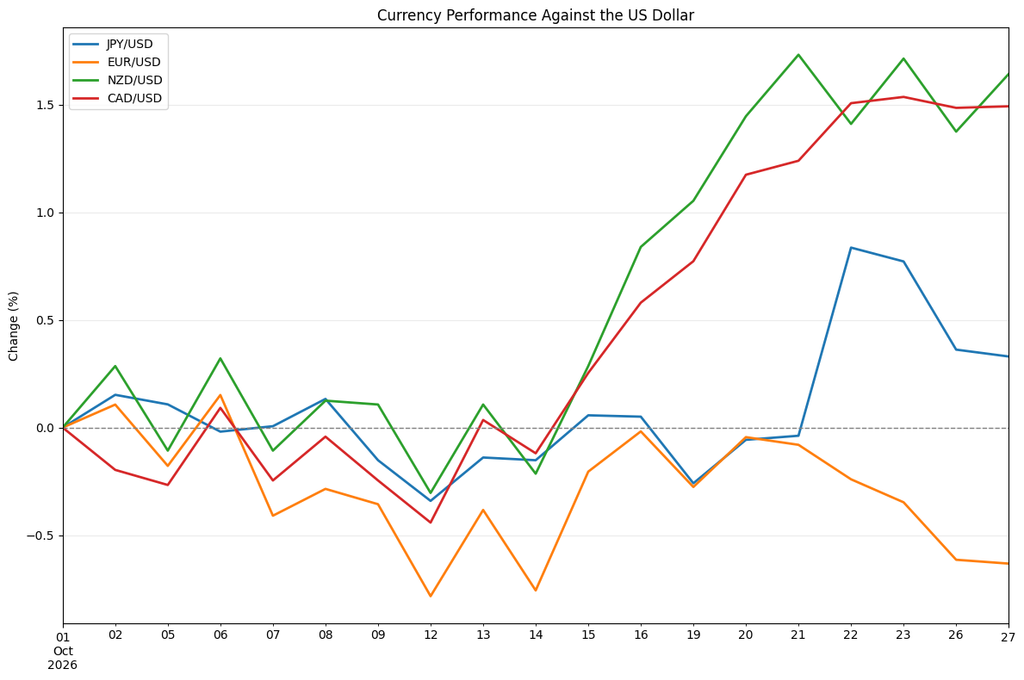
ANZ and ASB both expect further increases in December and February, taking the OCR to 3.50%. The Kiwi has recovered from its recent lows, trading near 0.57 after a 0.8% gain, but a widely anticipated October hike offers limited new information. Its reaction will depend more on whether the RBNZ strengthens the case for that faster tightening path. ⁽²⁾
Bank of Canada: Hiking into a Weaker Labor Market
Canada faces a particularly uncomfortable choice: inflation concerns are growing while employment is weakening. The BoC is expected to raise its overnight rate by 25 basis points to 2.50% on Wednesday, with LSEG pricing assigning an 84% probability. It would be the first increase since July 2023.
Annual inflation in September rose to 3.1% from 3.0%, but inflation excluding gasoline slowed to 2.2% from 2.4%. Energy is lifting the headline figure, while other price pressures remain softer. Meanwhile, employment fell by 68,000 after August’s 42,000 decline, and unemployment increased to 6.5%. ⁽³⁾

Growth offers little relief. GDP was unchanged month on month in July, although Statistics Canada’s advance estimate points to 0.2% growth in August. Raising rates against that backdrop would aim to prevent future inflation rather than cool an overheated economy. ⁽⁴⁾
The BoC’s latest surveys explain that concern: firms report plans to pass higher costs to customers, while households’ longer-term inflation expectations have risen. RBC expects a hike but describes its conviction as low, while TD Securities favors a hold followed by increases in December and January. ⁽⁵⁾
The Canadian dollar gained almost 1% last week, with USD/CAD trading near 1.40, supported by oil prices, stronger retail sales and changing rate expectations. Wednesday’s Monetary Policy Report will show how the BoC balances a higher inflation outlook against weaker growth. A hike accompanied by caution about further increases could reduce some of the currency’s support.
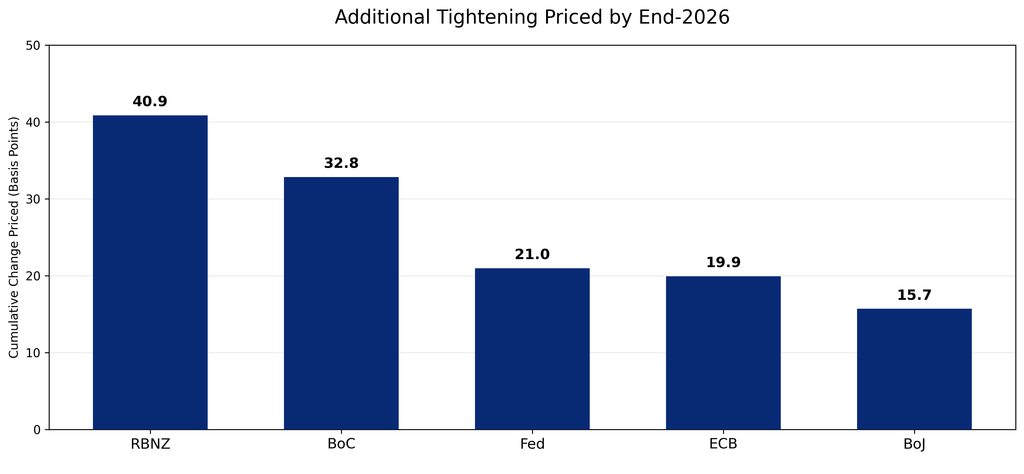
Markets expect the largest rate increases in New Zealand and Canada by year-end.
Each bar measures the difference between the current policy rate and the market-implied rate after the bank’s final 2026 meeting, converted into basis points. For New Zealand: (3.1587 − 2.75) × 100 = 40.9 bps. The Fed calculation uses its target-range midpoint.
The figures are cumulative, covering all remaining meetings, including this week, to compare banks over the same year-end horizon. They show market expectations, so they can fall between standard 25-basis-point steps.
Federal Reserve: How Long Will the Pause Last?
For the Fed, a pause at 3.75%-4.00% is likely after the BoC’s decision. Traders are looking forward to the December meeting, with a 70% chance of a rate hike. A pause now could give policymakers more time to assess September’s hike as inflation rises and hiring slows.
Gasoline drove most of the jump in annual inflation to 3.7% from 3.4% in September. Core inflation rose to 2.6%. Activity remains firmer than hiring suggests. The economy added just 29,000 jobs in September and unemployment edged up to 4.2%, yet Q2 GDP expanded at a 2.2% annualized pace. ⁽⁶⁾
October’s flash composite PMI remained strong at 57.6, with selling prices rising at their fastest pace since August 2022. ⁽⁷⁾
The dollar has faced pressure from concerns about technology investment and lower Treasury yields, touching a three-week low at 101.45 before rebounding towards 102. The 10-year yield was near 4.99% yesterday, down from an earlier October high around 5.31%, reducing some of the currency’s yield support.
There are no new economic projections or dot plot this month, putting greater weight on the policy statement and Fed Chair Warsh’s press conference.
The outlook could shift again almost immediately, with upcoming Q3 advance GDP and September PCE inflation arriving on Thursday. For the dollar, markets will judge an expected hold alongside the strength of the Fed’s inflation warning and the data that follow.
European Central Bank: Rising Inflation Meets Slow Growth
Thursday’s ECB meeting is set to bring a pause, with the deposit rate holding at 2.50% and another hike expected in December. The central bank faces a tougher choice as inflation rises, the economy slows and borrowing costs increase.
An 18.9% annual rise in energy prices pushed inflation to 3.8% in September from 3.2%. Core inflation edged up to 2.5%, while services inflation increased to 3.2%. Energy remains the main source of pressure, but the services reading gives the ECB another reason to monitor how widely higher costs are spreading. ⁽⁸⁾
October’s PMI surveys show slower expansion. Services PMI fell to 51.7 from 53, while manufacturing eased to 52.4 from 52.9. Industrial production also dropped by 0.5% MoM in August. These readings show growth cooling while prices climb, and weaker activity makes further tightening more costly. ⁽⁹⁾
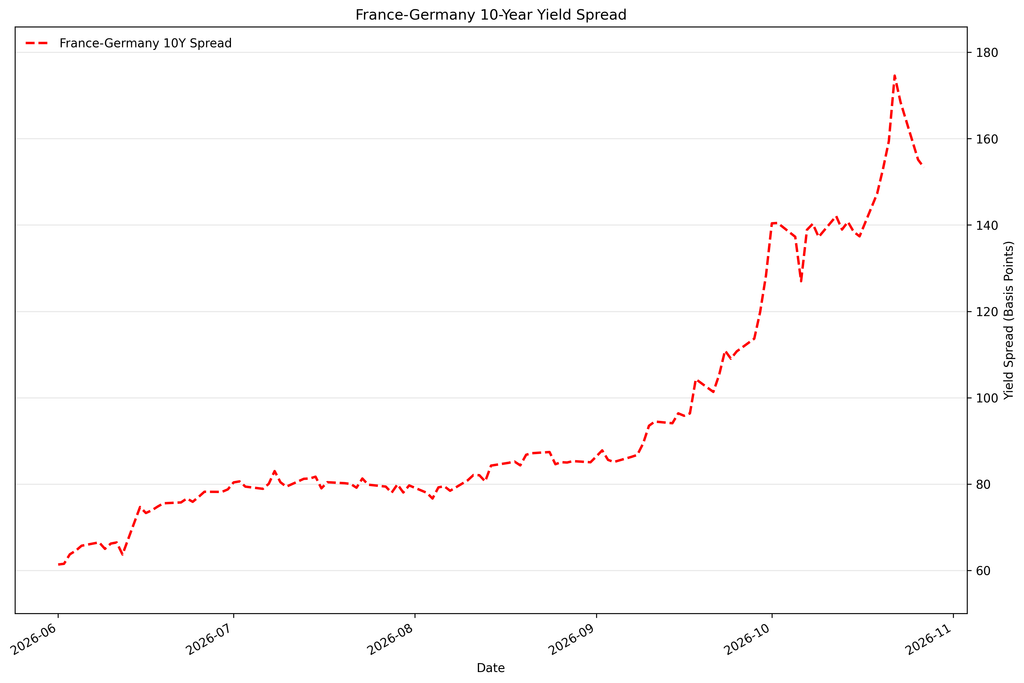
France adds another financial risk. Moody’s maintained its Aa3 rating with a negative outlook, offering some relief after French 10-year bond yields reached their highest level since 2002. ⁽¹⁰⁾
The yield spread compared with Germany narrowed toward 160 basis points yesterday after widening sharply to almost 176 basis points last week. Fiscal uncertainty continues to weigh on confidence in French debt.
Higher borrowing costs for governments, led by France, strengthen the case for taking time to assess the inflation outlook. ECB President Christine Lagarde’s comments will matter for both the December rate debate and stress in euro-area bond markets.
EUR/USD fell about 0.4% last week to near 1.12, as uncertainty over France’s finances outweighed the prospect of higher rates. A firm December signal from Lagarde could lift the euro, while a wider French spread might pull it back down.
Bank of Japan: Firmer Inflation, Fragile Domestic Demand
Japan closes the week with an expected rate hold at 1.25% on Friday, which could give it time to assess September’s increase while keeping further tightening under consideration. Its quarterly Outlook Report and Governor Kazuo Ueda’s press conference will help clarify how soon another move could follow.
Core inflation rose to 2.1% YoY from 1.7% in September, while real wages rose 1.5% YoY in August, extending the recovery in purchasing power, though growth slowed from July’s revised 2.0%. The improvement supports the case for gradual tightening, but domestic demand remains a constraint: private consumption was flat in Q2 even as GDP grew 0.4% quarter on quarter. ⁽¹¹⁾
The yen benefited from safe-haven demand during last week’s market turbulence, gaining 0.75% against the dollar on 22 October. Its broader weakness nevertheless remains relevant to the inflation outlook because it raises import costs. The BoJ has identified exchange rates, oil prices and firms’ wage-setting behavior as potential sources of upward inflation pressure.
By Friday, the yen will already have absorbed the Fed’s decision and Thursday’s US data. Any change in the expected gap between US and Japanese rates could amplify or offset the BoJ’s message. Stronger inflation forecasts could reinforce expectations of another BoJ hike, while an emphasis on weak spending could push those expectations further out.