

 ar

- France’s debt concerns and political uncertainty are weighing on the euro, despite some relief in French bond markets.
- Record borrowing needs and a divided parliament are complicating efforts to reduce France’s budget deficit.
- Pressure on other eurozone bond markets is testing the ECB as it balances inflation concerns with financial stability.
France is preparing to sell a record €340 billion of bonds next year to cover its budget deficit and replace older debt. Part of that funding will repay bonds issued during the pandemic and energy crisis that are now falling due.
The challenge is the cost of replacing that debt. Borrowing that once carried lower interest rates must increasingly be refinanced at higher rates, adding to the government’s interest bill and leaving less room for other spending.
French Bonds Find Some Relief
France’s 10-year government bond yield reached 4.99% on Friday, its highest level since the early 2000s. By Monday afternoon, it had eased to around 4.86%, while Germany’s equivalent yield stood at 3.49%.
The gap between the two narrowed to about 138 basis points, or 1.38 percentage points, after exceeding 158 basis points on Friday, its widest since late 2011.
That gap shows how much extra return investors demand to hold French debt rather than German bonds. Its sharp rise reflected growing concern about France’s finances, alongside broader pressure from high energy prices, inflation and interest rates.

Record Borrowing Meets Political Resistance
France plans to issue a record €340 billion of medium- and long-term bonds in 2027, after accounting for bond buybacks. That is roughly 10% more than this year’s program. ⁽¹⁾
The state’s total financing needs will rise by €28 billion to €339.7 billion. A major reason is a €19.4 billion increase in debt falling due, including bonds issued during the pandemic and energy crisis. ⁽²⁾
The borrowing will therefore fund both the budget deficit and repayments of older debt. However, replacing that debt at higher interest rates adds pressure to public finances.
The government’s proposed budget aims to reduce the deficit from an estimated 5.4% of economic output in 2026 to 5% next year. Passing spending cuts remains difficult in a divided parliament, with the 2027 presidential election approaching and opposition parties reluctant to support the government. ⁽³⁾
The Euro Feels the Pressure
During the Asian session on Monday, the euro touched $1.1161 before recovering towards $1.12 at the European open. The decline followed four consecutive weekly losses.
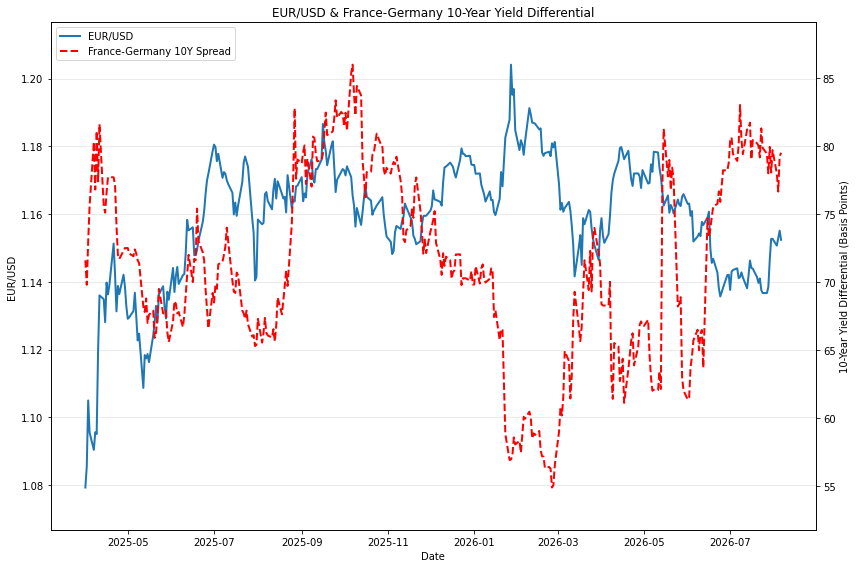
The currency’s weakness showed that investors were treating France’s problems as a concern for the wider eurozone. Last week’s French bond sell-off also affected Italian, Belgian and Greek government bonds, while German debt attracted investors seeking safety. ⁽⁴⁾
Spain added another source of uncertainty when Prime Minister Pedro Sánchez called a snap election for November 29 after parliament rejected government housing measures. Spanish 10-year yields later rose to around 4.13%. ⁽⁵⁾
A Difficult Balance for the ECB
The pressure on government bonds complicates the European Central Bank’s efforts to control inflation. Higher rates can help contain price increases, but they also make borrowing more expensive for heavily indebted governments.
Traders have reduced expectations for further tightening. Markets priced in roughly a 20% chance of an October rate increase and an 80% chance of one by December. ⁽⁶⁾
Still, analysts cautioned against assuming another eurozone debt crisis was underway. Barclays described France’s difficulties as a government-finance problem within a sound financial system, with stress well below the levels seen in the early 2010s. ⁽⁷⁾
ECB President Christine Lagarde has warned that debt close to 120% of economic output is a serious concern when there is no clear path to control it. She nevertheless rejected comparisons with the crises of 2008 and 2011. ⁽⁸⁾
For now, attention remains on whether France can secure parliamentary support for its budget and whether pressure on its bonds stays contained. Monday’s recovery eased immediate tensions, but the underlying borrowing and political challenges remained.


