ar
ar
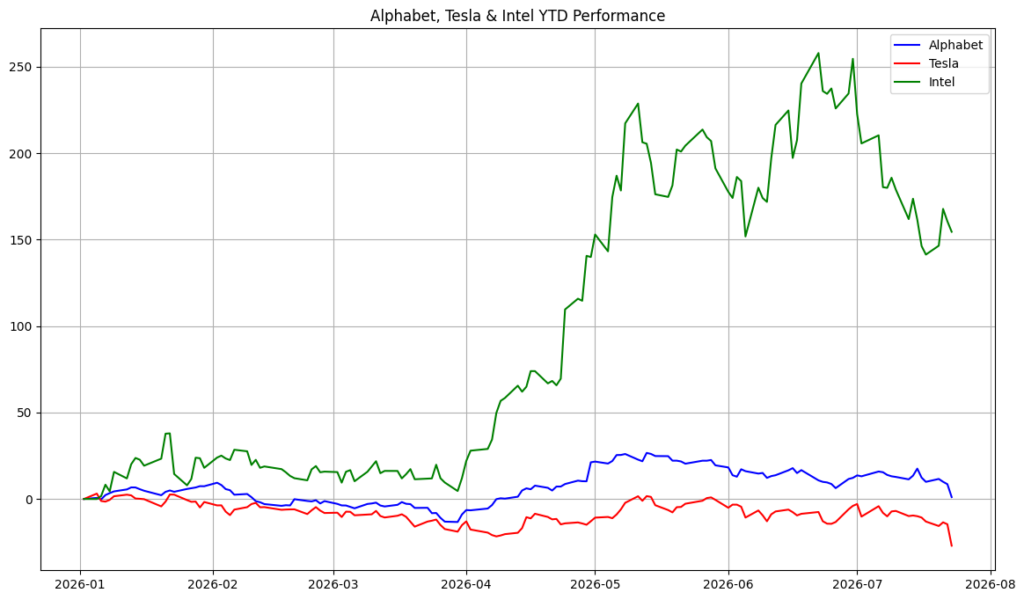
- Alphabet beat earnings and revenue forecasts, but shares fell as higher AI spending raised concerns over future returns.
- Tesla topped revenue expectations, yet weaker profits, falling margins and negative free cash flow overshadowed the result.
- Intel emerged as the strongest performer, posting its fastest revenue growth in nearly 15 years as AI demand boosted its data center business.
Big Tech earnings delivered strong headline numbers for Q2, but investors looked beyond revenue beats to focus on the rising cost of the AI race.
Alphabet and Tesla faced heavy pressure as aggressive spending plans weighed on profitability and cash flow, while Intel stood out with its fastest growth in more than a decade.
The results show that AI demand remains powerful, but markets are becoming increasingly selective about how much companies spend to dominate the environment.
Alphabet Beats Estimates but Raises Spending Plans
Alphabet reported earnings of $9.11 per share, well above analysts’ estimate of $2.88, while revenue reached $119.8 billion, topping the $117.07 billion forecast. ⁽¹⁾
The cloud segment was the main driver in revenue, growing 82% YoY at $24.77 billion, far above the $13.6 billion that the unit brought in during the same period last year. Advertising revenue also came in strong at $81.63 billion, topping forecasts of $81.12 billion. ⁽²⁾
Despite the beat, the stock sank 7% yesterday, the main reason being spending. Alphabet raised its full-year capital expenditure forecasted to a range of $195 billion to $205 billion, up from the earlier range estimate of $180 billion to $190 billion. ⁽³⁾
Finance chief Anat Ashkenazi told analysts the company is in a supply-constrained environment, with strong demand from both external cloud customers and across the rest of the business.
Is Alphabet’s Position in the AI Race Being Threatened?
Alphabet is battling to keep up in the AI arms race. Its Gemini app now has 950 million monthly active users and processes 22 billion tokens per minute. ⁽⁴⁾
However, the company faces pressure from cheaper Chinese open-weight models as businesses seek to reduce token costs. Google launched three lower-cost Gemini models this week but faced criticism over delays to Gemini 3.5 Pro. ⁽⁵⁾

CEO Sundar Pichai said the model is still being tested, while the company is already allocating computing power to Gemini 4 to compete with Anthropic and OpenAI.
Tesla Tops Revenue Forecasts but Profit Falls Short
Tesla’s results told a different story. Revenue reached $28.24 billion, surpassing its estimate of $25.71 billion. However, earnings missed expectations, coming in at $0.33 per share against an estimate of $0.51. The stock dropped almost 15%. ⁽⁶⁾
The automotive business generated $20.52 billion, up 23% from last year, while the energy segment grew 13% to $3.14 billion. Services revenue jumped 50% to $4.58 billion. Even so, gross margin slipped to 16.8% from 17.2% YoY, well below the 19.4% analysts had expected, as average vehicle prices fell and regulatory credit revenue declined. ⁽⁷⁾
Operating expenses rose 47% to $4.35 billion as Tesla poured more money into AI and research projects, pushing operating margins down to 1.4% from 4.1% YoY. Capital expenditures jumped 142% to $5.79 billion, and free cash flow turned negative, with a deficit of $1.1 billion for the quarter. ⁽⁸⁾
Much of this spending indicates CEO Elon Musk’s push to change Tesla’s focus beyond vehicle sales and towards the Robotaxi service, the Cybercab and Optimus robots. Full self-driving subscriptions climbed 56% to 1.48 million. ⁽⁹⁾
Musk also raised the possibility of merging Tesla and SpaceX, noting that the companies are becoming more closely connected through joint projects. However, he said any merger would require a formal review and could not be decided during an earnings call.
Intel Posts Fastest Growth in Over a Decade
While Alphabet and Tesla saw billions of dollars removed from their market value, Intel posted its fastest revenue growth in over 15 years.
Revenue came in at $16.1 billion, well above the estimate of $14.42 billion, while earnings rose $0.42 per share, also above its forecast of $0.21. Revenue grew 25% from a year earlier, the company’s quickest pace in almost 15 years. ⁽¹⁰⁾
CEO Lip-Bu Tan credited the AI boom, saying demand for computer chips is unprecedented and that Intel is positioned to keep growing its CPU business. For the current quarter, Intel expects earnings per share to come in at $0.38 and revenue between $15.8 billion and $16.8 billion, both ahead of Wall Street’s estimates. ⁽¹¹⁾
Intel’s data center unit drove growth, where revenue surged 59% to $6.3 billion, while the client computing group, which produces PC chips, grew 13% to $8.9 billion. The company’s foundry business, which manufactures chips for other companies, posted $5.8 billion in sales, up 31% from a year earlier. ⁽¹²⁾
Intel is now signing long-term agreements with customers for its server chips, some with locked-in pricing, as it tries to secure demand while supply stays tight. CFO David Zinsner said data center customers are asking for more chips than Intel can currently produce. ⁽¹³⁾
The company also plans a meaningful increase in capital spending next year as it pushes to expand its manufacturing capacity, including its newer 14A production process.