ar
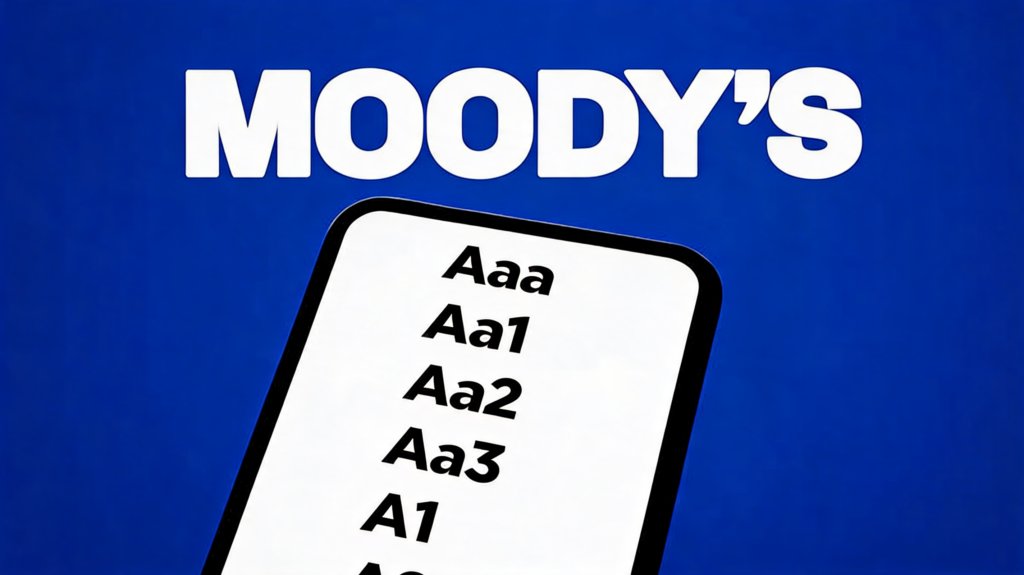
- A single letter grade from Moody’s, S&P, or Fitch can move bond prices, currency values, and government borrowing costs within hours, long before most investors have read the reasoning behind it.
- Russia’s rating fell from safe to near default in about ten days in 2022, showing how fast these grades can move markets. The US saw the opposite happen after its 2011 downgrade, when markets moved in a direction few expected.
- What matters most isn’t the size of a downgrade. It’s whether a rating crosses one specific line, known as investment grade, since many large investors are only allowed to hold bonds rated above it.
A credit rating is a grade assigned to a government or company, showing how likely it is to repay its debt on time and in full.
Three firms issue most of these grades globally. They include Moody’s, S&P Global Ratings, and Fitch Ratings. Together, they account for roughly 95% of the credit rating market. ⁽¹⁾
That grade can affect whether the debt meets an investor’s mandate, changing the pool of eligible buyers.
How Credit Ratings Move Markets
Some institutional investors have mandates that restrict them to investment-grade debt. A downgrade below that threshold can require them to sell, depending on their rules and how they use ratings from different agencies.
Forced selling can add pressure to bond prices, especially when a downgrade pushes debt below investment grade. Its timing and scale depend on investors’ mandates and market conditions.
An upgrade to investment grade can open the debt to investors whose mandates previously excluded it. Retaining that status through a period of stress can preserve access to those buyers.
Investment Grade vs Junk
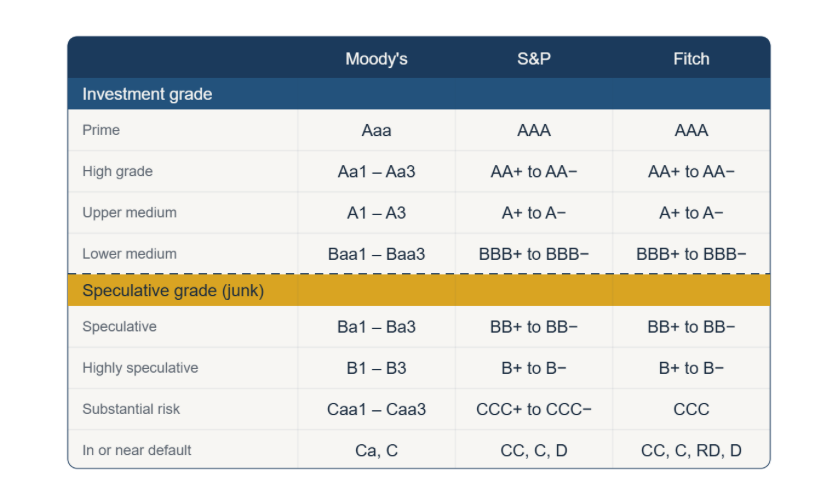
Bond ratings run on a scale. AAA is the highest grade at S&P and Fitch, while Moody’s uses Aaa. BBB- and above at S&P ⁽²⁾ and Fitch ⁽³⁾, or Baa3 and above at Moody’s ⁽⁴⁾, still counts as investment grade. But anything below that is speculative grade, commonly called junk.
Russia’s fall past that line in 2022 shows how quickly it can happen. S&P cut Russia from BBB- to BB+ on February 25, one day after the invasion of Ukraine began, pushing the country below investment grade. ⁽²⁾
Moody’s followed on March 3 with a six-notch cut, from Baa3 to B3. It cut again to Ca on March 6, citing capital controls that made repayment doubtful. ⁽⁴⁾
Sanctions and capital controls increased repayment risk and restricted market access. The downgrades reflected growing doubts about whether bondholders would receive payment as promised.
When the Downgrade Doesn’t Move the Market as Expected
Not every downgrade behaves this way, as seen when the S&P cut the United States from AAA to AA+ on August 5, 2011, the first such cut in the country’s history. Stock markets fell sharply the following Monday, and the S&P 500 dropped over 6% that day. ⁽⁵⁾
The US remained investment grade, so the downgrade did not cross the threshold described above. The 10-year Treasury yield fell from 2.56% to 2.32% that Monday as investors sought safety in Treasuries amid wider market stress. ⁽⁵⁾
Fitch also downgraded the US from AAA to AA+ in August 2023, leaving it within investment grade.
Moody’s downgrade in May 2025 left the United States without a top rating from any of the three major agencies for the first time. Yet it moved yields by only a few basis points ⁽⁵⁾, because markets had already priced in the story.
A Steady Rating Can Matter Just as Much
Ratings do not only make news when they fall. The UAE has held a Moody’s rating of Aa2 through several rounds of regional tension, most recently reaffirmed in June 2026 ⁽⁴⁾, alongside an AA- from Fitch affirmed in May 2026. ⁽³⁾
Neither agency has treated regional volatility as a reason to cut the grade. That consistency keeps the UAE’s borrowing costs anchored and its bond and sukuk issuance attractive to the same mandate-bound investors described above.
It is the same dynamic that shapes why traders track the 10-year Treasury yield as a benchmark for global borrowing costs.