ar
ar
For many experienced traders, learning how to start CFD trading is tougher than they first thought.
Knowing your way around the financial markets is one thing, but CFD trading often presents a new learning curve, including:
- Knowing how to recalibrate position sizing with extra leverage, changing the idea of what a “normal” position should look like
- Pricing in the cost of the holding, which can compound overnight in ways that don’t show up in a technical setup
- Finding the correct CFD trading strategy according to your risk appetite and trading style.
This is where most guides stop being useful. They explain what CFDs are and give you a few CFD trading tips, but they don’t explain how traders adapt their strategies to the uniqueness of this derivative instrument.
Read on to find a strategy-by-strategy breakdown of how experienced traders use what they already know to learn how to trade with CFD instruments in UAE and GCC market conditions.
We will focus on:
- Why traders use CFDs
- 7 CFD strategies used by experienced traders
- What experienced traders watch for in CFDs in the UAE
- How to start CFD trading with Daman Markets
Open a live or demo account with Daman Markets today and access a regulated, AED-denominated account built for pro traders.
Why Traders Use CFDs
A CFD (contract for difference) is a financial derivative. Instead of simply trading on whether a position’s price rises, you trade based on the difference between its starting and finishing price.
This flexibility opens up further benefits to traders who can use it.
1. Clear access to falling markets
Taking a short position in spot equity markets is usually expensive thanks to stock borrowing costs. Structural restrictions can also slow down how quickly you execute, which increases the chances of slippage.
CFD trading lets you open a short position as quickly as you would open a long position because there are no extra borrowing mechanics. This is true of forex, indices, commodities, trading stocks, or crypto trading.
GCC-linked assets are often exposed to oil shocks and macro dislocations, making them particularly useful for CFD trades. Prices can move as sharply to the downside as they do on the way up, and a CFD position can move with them in either direction.
2. Exposure to every major market from one account
One CFD trading account can open up access to many markets at the same time, including currency pairs, commodity CFDs, cryptocurrencies, indices and stock CFDs.
Reading correlations among different access classes is particularly important in the UAE, where oil links regional indices, commodity prices and currency pairs. CFD traders can act on these links without the hassle of managing positions across multiple accounts.
3. Leverage that serves the prepared trader
Experienced traders often have the discipline and preparation that can serve them well with CFDs, which come with the challenge of extra leverage.
Leverage gives traders the freedom to express high-conviction positions with greater capital efficiency than in spot markets. Yet it also means that mistakes get amplified just as strongly.
Those who prepare by adapting their trading strategies to CFD markets are often better prepared to manage the risks involved.
7 CFD Strategies Used by Experienced Traders
Learning how to start CFD trading is often much more difficult than traders expect. Techniques and habits that served them well in other areas may backfire as the nuances of CFD trading present a completely different challenge.
Unlike investors, traders don’t need to own the underlying asset. CFDs are built for capturing short-term price movements, and a well-constructed CFD portfolio can carry genuine diversification across asset classes, directions and timeframes. That said, even within a trading context, position discipline matters.
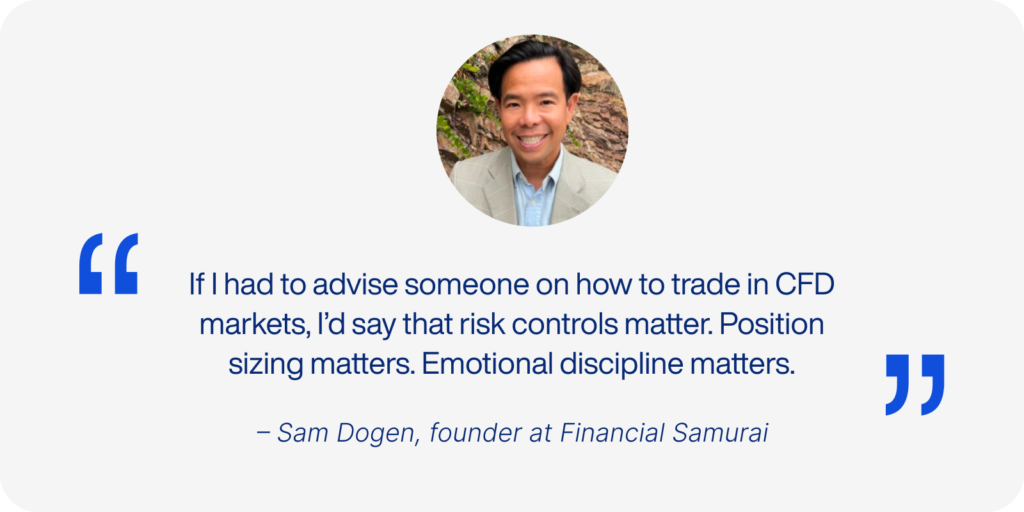
“If I had to advise someone on how to trade in CFD markets, I’d say that risk controls matter. Position sizing matters. Emotional discipline matters,” says Sam Dogen, founder at Financial Samurai, a leading finance blog.
With those words in mind, here are seven types of advanced CFD trading strategies that many expert traders employ, how they adapt them to CFD markets, and how they maintain that all-important emotional discipline in a lively UAE market.
1. Scalping
Anyone who’s traded before will know that scalping is like taking small bites rather than waiting for the full meal. These are frequent small-margin trades that target micro price movements across very short timeframes, often just a matter of minutes or even seconds.
The mechanics of CFDs make this harder than it looks. Leverage reduces the margin for error so much that spread costs must become a key part of the decision, instead of absorbing them as a spot trader would.
For scalping to work, traders must seek tight spreads and keep position sizes disciplined, so that spread costs and slippage don’t accumulate across a full trading day.
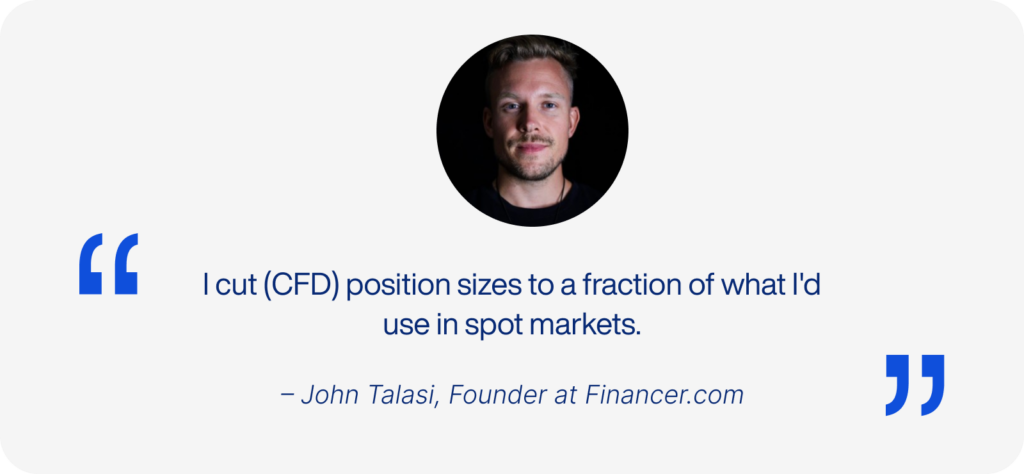
“I cut position sizes to a fraction of what I’d use in spot markets,” says John Talasi, founder of Financer.com, a leading finance products comparison platform. “This is usually 1-2% risk per trade max, sometimes less in volatile sessions.”
Speed and timing are extremely important here, and the right platform infrastructure plays a central role in a CFD trader’s approach.
This also helps UAE-based traders time the London-New York overlap well. More concentrated liquidity, tighter spreads, and price fluctuations can give scalpers the room they need to strike quickly and find clean exit points.
Outside of this window, wider spreads and slippage become too much for scalping to absorb.
2. Breakout Trading
Breakout trading works by entering on a confirmed break of an established support or resistance level. In spot markets, a false breakout is frustrating, but it’s usually much more expensive with a leveraged CFD position. “Leverage can amplify gains, but it can also amplify mistakes,” says Sam Dogen.
This changes the breakout approach. CFD traders tend to be more cautious and can often do the following:
- Wait for a candlestick close beyond the level
- Watch for retest behaviour
- Check whether volume supports the move rather than contradicting it.
CFD traders who enter before looking for these confirmation signals might be at high risk of developing a costly habit, particularly in the UAE market, where breakouts call for extra caution. Oil price announcements and OPEC decisions often trigger sharp market moves that catch rookie breakout traders off guard.
Many of these moves are simply reactions that come with different risk profiles. The most savvy traders know that the key is to let the market confirm the move before parting with capital.
3. News and Event-Driven Trading
Event-driven trading seeks to anticipate sudden price actions caused by major news events and build positions around them.
CFD trading can, however, make this simple concept much more complicated. Spreads tend to widen around the time of major announcements, which increases the risk of slippage. This effect is amplified with a leverage position (as with CFDs), which often opens at a much worse price than a chart previously suggested.
Experienced traders who like to have their stop-loss orders and take-profit levels already set before the release find this to be a headache, especially in the UAE market, where certain events carry more weight than they might elsewhere.
For example, the AED/USD peg plays a large role, with US Fed rate decisions and non-farm payrolls having a bigger influence than in floating currency markets. US-listed stock CFDs with strong local followings are prone to sharp intraday moves.
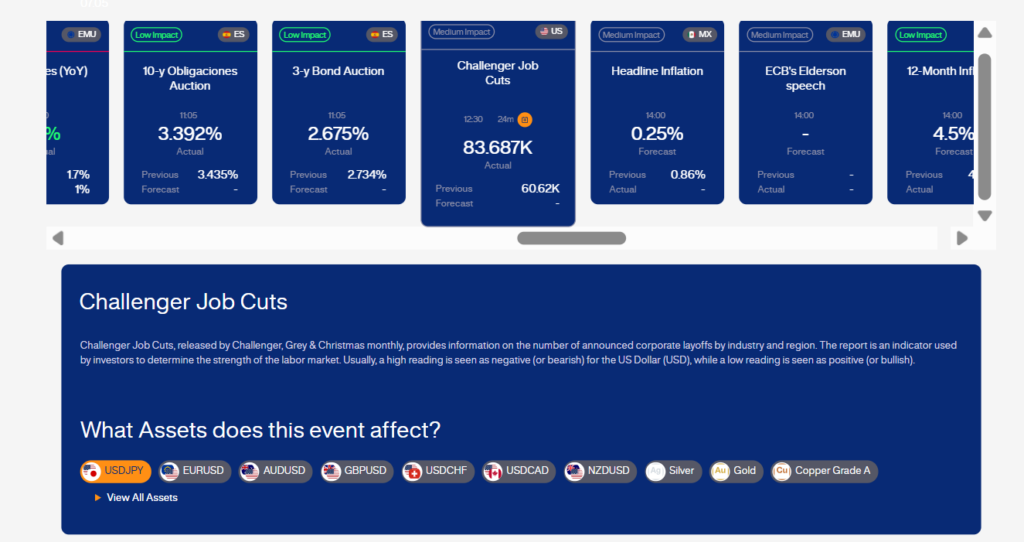
A clear economic calendar can make news trading with CFDs much more manageable. Knowing what’s scheduled should be the minimum, but an effective calendar can also tell you which events move which assets in which market.
Daman Markets’ Calendar, With Events and Assets Overview
4. Position Trading with Financing Cost Modelling
CFD trading comes with something that many beginner guides often overlook: overnight financing, which is a fee for keeping a leveraged position open past the end of the trading day.
This expense obviously doesn’t come into play for day traders, but it becomes a line item for position trading, which is built around holding a trade for weeks or even months.
Take the example of a long position we expect to move 8% over 6 weeks with overnight carry costs of 0.5% per week. By the time the position closes, three weeks of financing costs have quietly taken 1.5% off the return, and that’s before accounting for spread costs and any adverse price movement.
For a multi-week position trading setup, this expense should be built into the fundamental analysis that comes before entering a trade – and if it doesn’t fit, then it could even be a deal-breaker.
“I factor in the financing cost before I even enter, “ says John Talasi. “If the overnight carry eats into my expected return over a 5-10 day hold, the trade doesn’t make sense regardless of the setup.”
5. Pairs Trading and Relative Value
Pairs trading – taking a long position on one asset and a short position on a related one, then aiming to profit from the gap between them – is an important tool that CFD traders can make use of. Traders with experience will already know that these strategies have much of the same DNA as hedging.
In spot trading, the short position comes with borrowing costs and locate fees that slow it down. These don’t exist with CFDs, so both positions execute at the same speed. When done well, the broader market direction is less important, and the relative value trade is the main thing that matters.
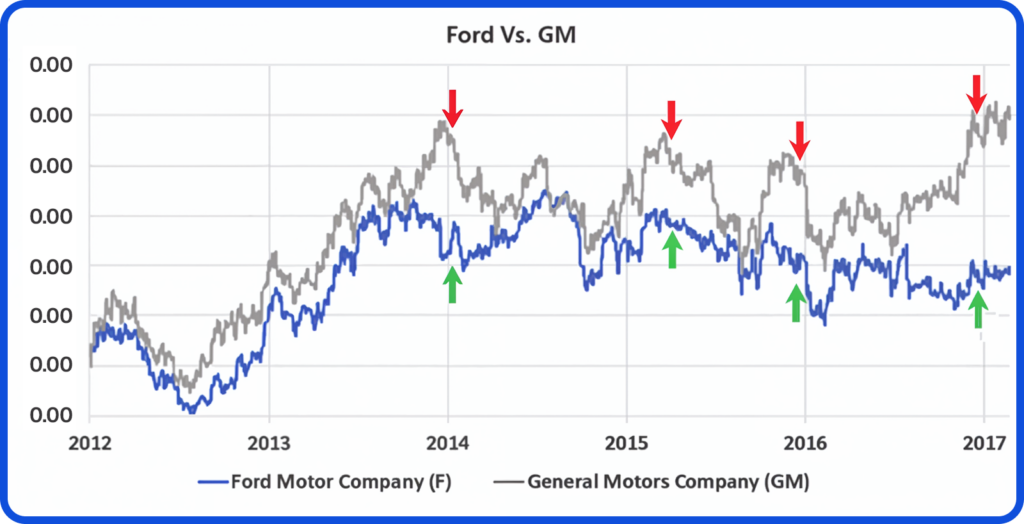
Ford and GM are a classic correlated pair that serve as a great CFD trading example. In the image, note how red arrows mark divergence points where GM outperforms and green arrows mark where Ford lags. The trade targets the gap between them, not the direction of either stock alone.
A Classic Correlated Pair – Ford Vs. GM
Anyone looking for a UAE market equivalent can study the relationship between regional index CFDs and crude oil. This is a relationship rooted in the region’s economic structure rather than an overlap with other sectors.
Yet there’s a major caveat with any pair. The correlation between assets is often under stress from macro dislocations and can even break in times of high volatility. A pair trade will lose on both legs at once if this happens.
As the most technically demanding strategy in this guide, CFD traders need to be particularly observant here. They should watch to see how GCC-linked financial instruments behave relative to the oil benchmark – something that traders elsewhere often underuse.
6. Counter-Trend and Mean Reversion
The simple premise of counter-trend trading – that every overextended move exhausts itself and reverses – is complicated by CFD mechanics.
Because leverage is involved, entering too early (or before the move has peaked) means sitting through a harder dip where potential losses accumulate faster than normal. Timing, like always, is everything.
Experienced CFD traders know to reduce this guesswork by waiting for multiple technical indicators before entering, including RSI extremes, Fibonacci retracement levels (sitting at key resistance levels), and candlestick reversal signals. When these align, it can make for a higher-quality setup, rather than just relying on one of those indicators.
Oil makes this timing challenge even more important in the UAE and GCC markets. Regional assets tend to trend for longer than expected during supply and demand cycles, so a signal that one might think is a reversal is often just a pause. Falling markets sometimes drop further and faster than historical price behaviour would suggest.
As Sam Dogen puts it, “The stock market is a game of probabilities, not certainties.” The counter-trend traders who forget this maxim tend to learn the hard way.
7. Multi-Timeframe Technical Confluence
Multi-timeframe confluence is a methodical technique that involves stacking technical analysis across multiple timeframes before committing to an entry. Traders do this by using higher timeframes to establish directional bias, and lower timeframes to pick out exact entry points.
This method can be particularly useful for CFD trading because it helps traders see past all the noise. Take the example of gold CFDs, a key part of knowing how to invest in gold in the UAE. A trader could look for these three important components:
- The daily price chart shows an uptrend, with price holding above an important moving average – this is the directional bias
- The 4-hour chart, meanwhile, shows consolidation near a support level, which is where the setup is forming
- The 15-minute chart then produces a candlestick reversal signal at that same level – that would mark the entry trigger.
Each timeframe is doing a different job, and the entry only makes sense when all three align.
In the UAE, USD-AED pairs come with a nuance thanks to the mechanical relationship between USD moves and AED-denominated positions that behave differently from other market forex pairs. Traders arriving from outside markets sometimes find their trend lines and MAs giving readings that need calibrating.
MetaTrader 5 is a practical environment for this approach. Traders can use multi-timeframe charting tools to move between timeframes without losing sight of the broader structure, where most important trading decisions tend to live.
What Experienced CFD Traders Watch For In the UAE Market
Each of the seven strategies above comes with a UAE-specific caveat that traders should look out for, but there are also several structural features that are worth knowing by heart.
1. Oil correlation is more important than people realise
Many newcomers tend to run long positions across a regional index CFD, a commodity CFD, and a GCC-correlated currency pair during an oil uptrend, thinking they’re diversifying – but this is simply placing the same directional bet three times.
“A lot of regional indices and currency pairs move in tandem with crude, says John Talasi. “So if you’re running multiple CFD positions across GCC-linked assets, you can end up with concentrated directional risk without realising it.”
The key is to track oil exposure as a factor across the board, instead of just a single position.
2. The London-New York overlap is where liquidity shows up
The London-New York overlap injects liquidity and price movement into GCC markets. Outside this, spreads tend to widen, and slippage plays a bigger role.
It’s therefore important to know when the market is deep enough to absorb your position size, which is part of execution decision-making.
3. The AED peg changes how USD events land
Fed rate decisions and non-farm payrolls transmit more directly into UAE trading than in floating currency markets simply because the dirham is pegged to the US dollar. Traders must understand this to make USD-correlated setups more readable.
4. The regulatory framework is worth knowing, not fearing
The Capital Market Authority (CMA) regulates CFD trading in the UAE, with clear requirements around leverage limits, margin disclosures, and client protections.
Experienced traders use this well-regulated environment to their advantage and use the best online trading platforms in the UAE to make sure they operate within that framework.
How to Start CFD Trading with Daman Markets
Learning a new trading instrument takes time, but the right platform can shorten the learning curve.
Daman Markets is designed for people who already understand trading, but wish to make their switch to CFD trading as stress-free as possible.
We offer a wide range of features that make risk management easier for new CFD traders, including:
- Pro-grade liquidity and ultra-fast execution that keep you ahead of market trends and news releases
- AED-denominated accounts that keep currency conversion friction at a minimum
- AI-powered analytics designed to support market research across multiple asset classes
- MetaTrader 5’s multi-timeframe charting tools are designed for the kind of technical analysis this guide covers
- A demo account, not a “CFD for beginners” tool, but a practical window into how serious traders stress-test a new instrument or strategy with virtual funds before committing real capital.
If you’re looking to trade with one of the best online trading platforms in the UAE, then Daman Markets gives you the regulated infrastructure to trade CFDs on your terms, with the platform depth and execution speed that experienced traders actually need.
Ready to start trading CFDs with confidence? Sign up with Daman Markets today to join other experienced traders with unfiltered access to our pro AI tools, deep liquidity and expert support.