

 ar

- The Bank of England is expected to keep interest rates unchanged at 3.75%, as the central bank tries to manage both labor market weakness and high inflation.
- The UK economy continues to navigate through mixed signals, with business activity picking up while the labor market continues to weaken.
- Inflation in the UK remains high, ranking it the highest among the G7 nations.
- The MPC vote is expected to come in at 2-7 in favor of holding rates, marking a more decisive stance compared with December’s narrow 5–4 split.
All eyes turn to the Bank of England this Thursday, February 5, at 16:00 (GMT+4) as policymakers gather to deliver their latest interest rate decision.
While rates are widely expected to stay put for now, there’s a twist. Officials have been dropping hints that we could see further cuts rolling out across 2026.
The BOE’s Monetary Policy Committee (MPC) is currently walking a tightrope, weighing a cooling labor market against early signs the economy may finally be finding its footing.
Current Rate Decision and Expectations
The MPC is set to hold rates at 3.75%, after cutting rates by 25 basis points back in December 2025. Financial markets will mainly focus on the BOE’s future guidance, with markets pricing in only a small chance of a rate cut this year ⁽¹⁾
However, some economists differ and expect two rate cuts this year, potentially in March and June.
UK Economy Remains Sluggish
The UK economy continues to remain sluggish, with business activity improving since the Autumn Budget in 2025. Manufacturing PMI has improved since November and reached 51.6, its highest level since August 2024.
Manufacturing output increased for a fourth consecutive month, reaching its highest level since September 2024, supported by stronger export demand, broadly stable domestic conditions, and a lift from customer restocking. ⁽²⁾
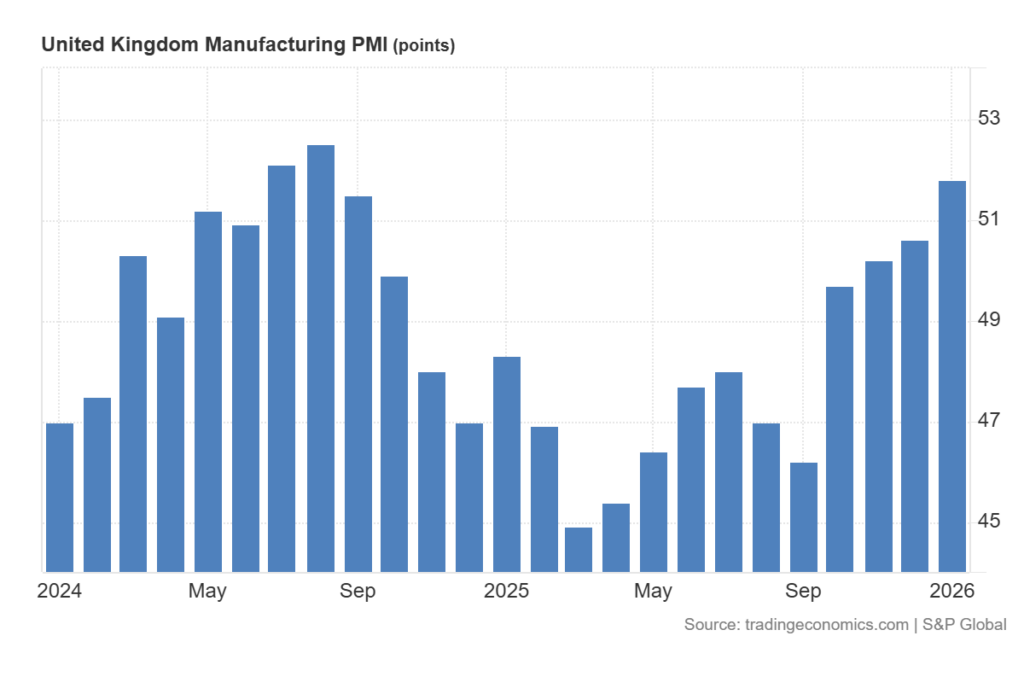
UK Manufacturing PMI / Source: Trading Economics
UK services PMI remained in expansion mode since May 2025 after facing a sharp contraction in April after facing tariffs from US President Trump.
Services PMI came in at 54.3 in January, marking its ninth consecutive month of expansion. The survey respondents noted that post-Budget clarity spurred new projects and boosted client investment, even amid a weak UK outlook. ⁽³⁾
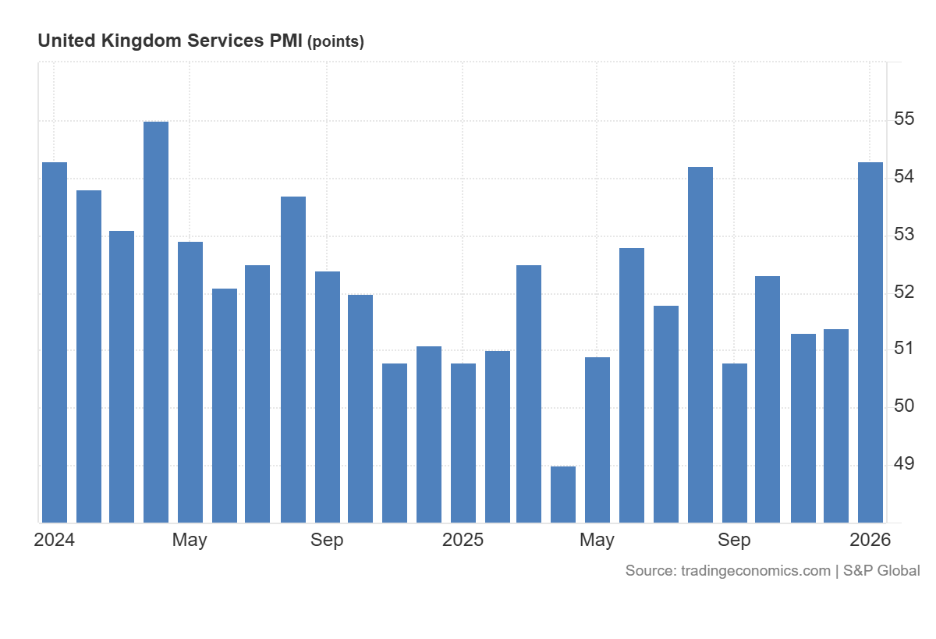
UK Services PMI / Source: Trading Economics
Despite strong business activity, growth remains sluggish. The monthly GDP data showed that the UK economy expanded by 0.3% in November, after facing a contraction of 0.1% in October. Growth was mainly driven by the services sector.
Quarterly GDP showed an expansion of 0.1% in Q3, indicating that total economic performance remained weak despite a rebound in the monthly data. Combining both readings, the data could indicate that the UK economy has started to stabilize. ⁽⁴⁾
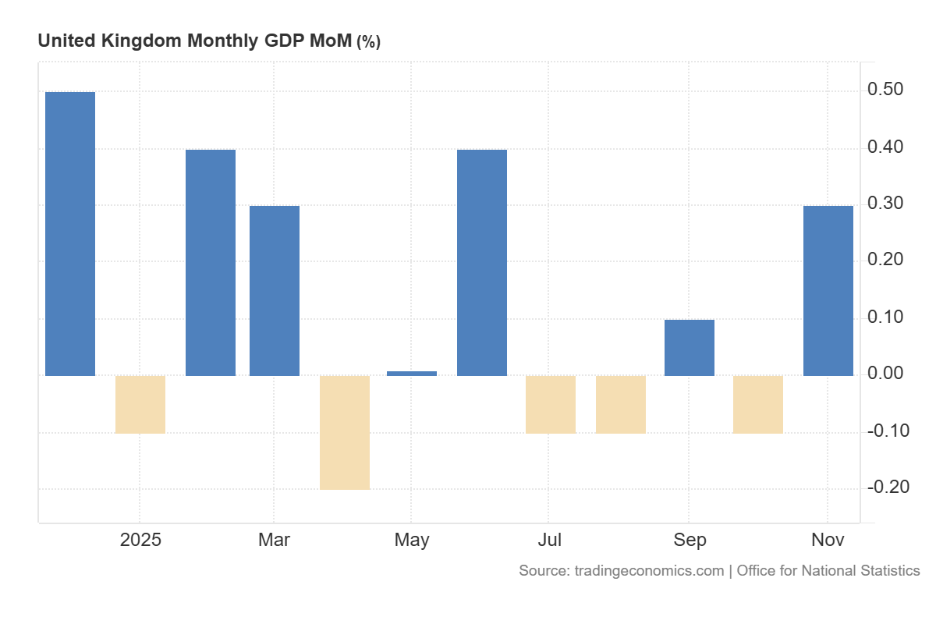
UK Monthly GDP / Source: Trading Economics
The labor market continues to weaken, with the unemployment rate sitting at 5.1% in November, its highest level since March 2021 and above the BOE’s earlier forecast. The number of payrolled employees fell by 155,000 in November. ⁽⁵⁾
Wage Growth and Inflation Pressures
Private sector wage growth slowed to 3.6%, excluding bonuses in the three months to November, down from 3.9% in the prior period.
This is a key indicator for the BoE, as it links to underlying inflation. However, the bank’s own surveys suggest higher pay rises ahead. Corporate decision makers pointed to a 3.7% increase this year. Some MPC members worry that these levels remain above what is needed for 2% inflation. ⁽⁶⁾
Inflation came in at 3.4% in December, down from its high of 3.8% during the summer, but still ranks the highest reading among the G7 nations. The BOE expects inflation to return back to its 2% target, supported by the Autumn Budget.
New forecasts in the February Monetary Policy Report will give more detail on inflation, wages, and the path ahead. ⁽⁷⁾
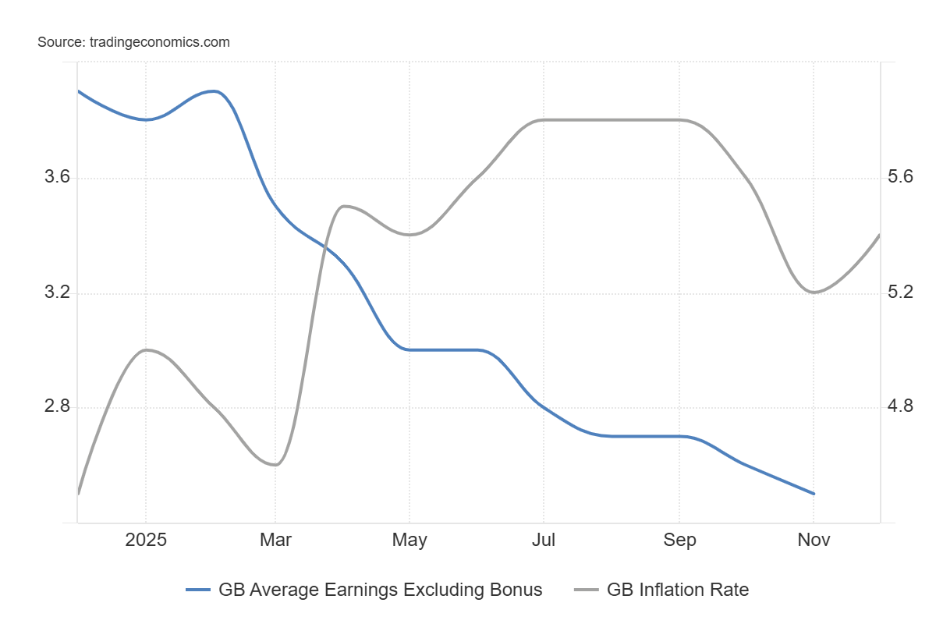
nflation and Average Earnings Comparison / Source: Trading Economics
With inflation overtaking wage growth, UK real incomes have slipped back into negative territory, reinforcing the Bank of England’s caution despite signs of economic stabilization.
Divided Views Within the MPC
The MPC continues to remain divided, with some members seeing that the labor market’s weakness could help control inflation, which would lead to lower interest rates.
Other members see improved business activity and stable wage growth as rising risks that could keep inflation elevated. In December, the MPC described future decisions as a “closer call” and said rates were likely on a gradual downward path, but with caution about cutting too much. ⁽⁸⁾
The MPC voted 5-4 to cut interest rates in December, the fourth quarter-point reduction of 2025. But most of its members suggested the pace of rate cuts could slow. Markets expect a vote of 2-7, with seven members thought to vote in favor of keeping interest rates steady, while two are expected to vote for a rate cut. ⁽⁹⁾
Some tentative signs of a recovery among consumers and businesses, after months of speculation about tax hikes in Reeves’ November 26 budget, could add to the case for slow rate cuts.
Market and Broader Context
The UK has the highest interest rates among major economies, despite six rate cuts since 2024. Future rate cuts could support the UK’s slow economy. Geopolitical risks, such as tariffs, have brought risks, but UK financial markets have remained stable for now.
The focus at the February announcement and press conference afterward will be on any shifts in the BOE’s messaging. The updated forecasts will also provide key insights into wage trends and policy thinking.


