

 ar

- The BOJ, BOC, RBA, and SNB remained cautious about making further monetary policy moves, focusing on data assessment as inflation pressures eased unevenly and growth signals remained mixed.
- While hawkish holds from the BOC, RBA, and steady SNB supported their respective currencies amid widespread US dollar weakness, rising JGB yields have kept the BOJ vigilant.
While the Federal Reserve cut rates this week, other central banks have signaled caution on future monetary policy moves, with policymakers balancing easing financial conditions against lingering inflation and growth risks.
From the Bank of Japan’s careful stance on intervention to steady policy holds by the Bank of Canada, RBA, and SNB, markets were left parsing signals on how close major economies are to their next policy shift and what that means for currencies, bonds, and risk sentiment.
BOJ Remains Cautious on Intervention
The Bank of Japan doesn’t see the need for an intervention in the FX markets to control the rise in bond yields.
As expectations are rising for a BOJ rate hike, 10-year JGB yields rose to 18-year highs. BOJ Governor Ueda stated that the recent rise in bond yields was fast and repeated his readiness to respond in troubling circumstances. ⁽¹⁾
BOJ policymakers are monitoring market moves but are hesitant to take action, such as ramping up bond purchases or conducting emergency operations, citing a high threshold for intervention.
They also don’t need to modify the BOJ’s plan to reduce bond purchases gradually. The central bank will focus on what is driving the markets instead of specific yield levels and will remain cautious on intervening in order not to cause a wrong move. ⁽²⁾
The Japanese yen remained supported by these factors and from US dollar weakness after the Federal Reserve reduced interest rates two days ago. Financial markets will focus on next week’s Bank of Japan policy meeting, where markets expect a rate hike after Governor Kazuo Ueda said the central bank is getting closer to attaining its inflation target.
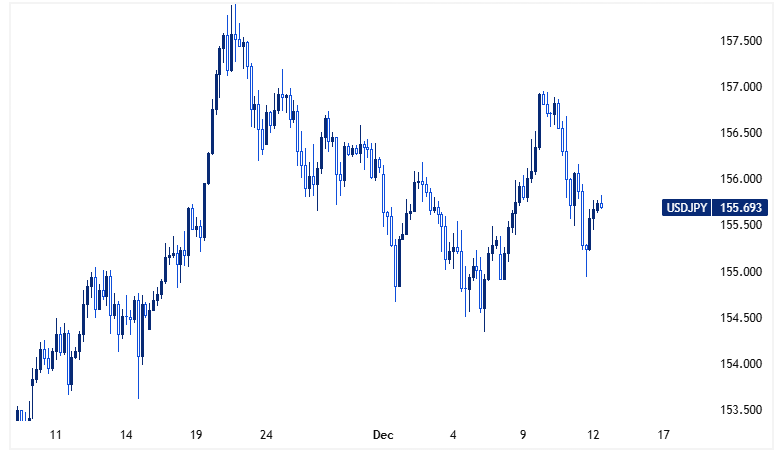
USD/JPY Chart / Source: TradingView
BOC Holds as Growth Steadies and Inflation Remains Near Target
The Bank of Canada kept rates unchanged this week, with BOC Governor Macklem stating that the policy rate is at the right level to keep inflation close the central bank’s 2% target while supporting the Canadian economy.
He said a policy rate at the lower end of the neutral range was appropriate to support the economy while keeping inflationary pressures contained.
Policymakers said trade tensions could cause GDP to fall more than expected by the end of 2026. Q3 GDP growth came in stronger than expected at 2.6% and is anticipated to reach an average of 1.4% in 2026 and 2027. Macklem said that the central bank will continue to assess upcoming data and is prepared to respond if the data leads to outlook changes. ⁽³⁾
Canada’s unemployment rate fell to a 16-month low in November at 6.5% due to solid gains in part-time jobs, which boosted the number of people employed for the third time in a row. ⁽⁴⁾
Inflation is at 2.2% in October, which is expected to remain near the target next year. The economy isn’t running at full strength, which should help keep inflation close to target even with US tariffs. Macklem pointed to stronger than expected consumer spending, business investment and productivity growth. While steel and aluminum have been hit hard by US tariffs, there hasn’t been an impact on other sectors. ⁽⁵⁾
The Canadian dollar reached twelve-week highs as markets balanced the anticipated Fed cut with a relatively hawkish Bank of Canada stance and firmer domestic data.
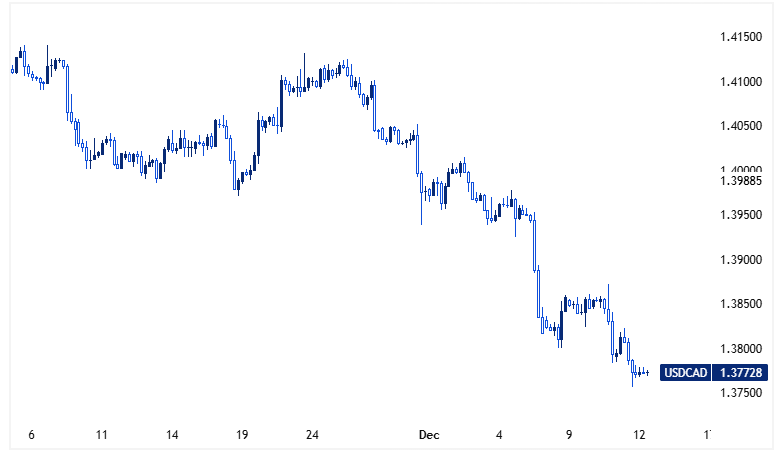
USD/CAD Chart / Source: TradingView
RBA Holds to Assess Persistent Inflation
The Reserve Bank of Australia kept rates unchanged at 3.6% due to inflation rising again. The recent rise in inflation, which reached 3.8% in October, was due to the housing sector that saw price growth of 5.9%. Food prices also rose to 3.2% YoY. ⁽⁶⁾
Economic activity continues to recover, with growth in private demand strengthening, while credit liquidity remains available due to the previous easings of financial conditions.
The labor market remains tight, where the unemployment rate sits at 4.3% while employment growth slowed somewhat. Wage growth, as measured by the Wage Price Index, has eased from its peak, but broader measures of wages continue to show strong growth and a rise in unit labor costs remains high. ⁽⁷⁾
Uncertainties for economic activity and inflation continue to linger, which kept monetary policy restrictive. Uncertainty in the global economy remains significant, but so far, there has been minimal impact on overall growth and trade in Australia’s major trading partners.
The RBA board will continue to assess economic data and monitor macro developments.
The Australian dollar surged to 3-month highs following the RBA decision and US dollar weakness.
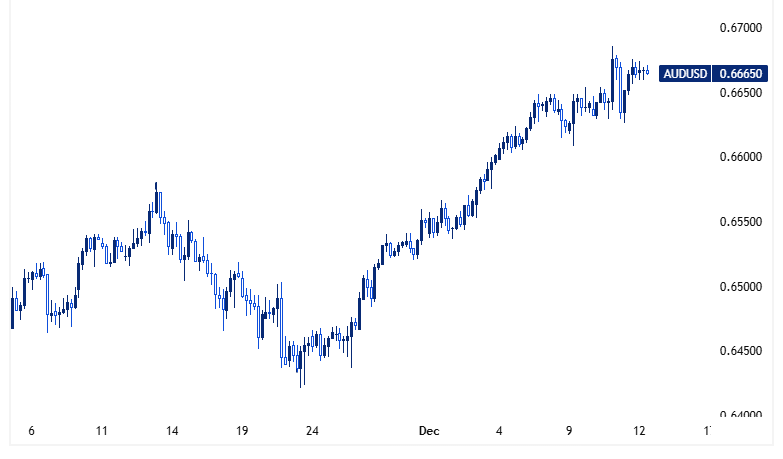
AUD/USD Chart / Source: TradingView
SNB Holds at 0% as Inflation Falls and Growth Rebounds
The Swiss National Bank kept its policy rate at 0% and will continue remunerating banks’ sight deposits at that rate up to a set threshold. It also remains ready to intervene in FX markets if needed.
Inflation slightly declined, reaching 0% in November and is expected to remain within the range of the SNB’s price stability, reaching an average of 0.3% in 2026, and 0.6% in 2027. ⁽⁸⁾
Global growth was stronger than expected in Q3, with inflation high in the US and near target in the euro area. The SNB expects moderate global growth ahead.
Swiss GDP contracted due to weakness in pharmaceuticals, while unemployment has been on the rise. The SNB also said the economic outlook has improved slightly following a recent deal to lower US tariffs on Swiss goods.
GDP is projected to grow just under 1.5% in 2025 and around 1% in 2026, with unemployment edging higher. ⁽⁹⁾
The Swiss franc edged higher to around 0.799 per USD, hovering near its highest levels since 2011 after the rate decision.
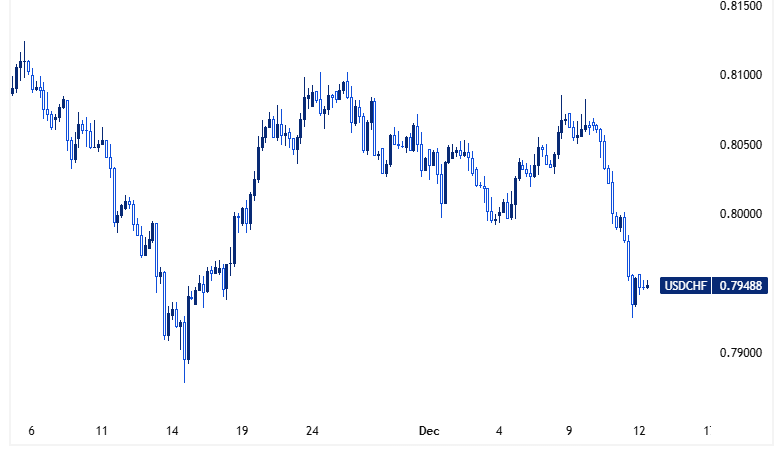
USD/CHF Chart / Source: TradingView
What to Watch Next Week:
- UK Labor Market Data
- Eurozone, UK and US PMI
- US NFP
- Bank of England Interest Rate Decision
- European Central Bank Interest Rate Decision
- US CPI
- Bank of Japan Interest Rate Decision


