

 ar

- Strong growth, soft inflation, and EU-driven investment have kept Poland’s economy resilient and supported the zloty despite a recent trade deficit.
- Markets remain positive but cautious, with UBS forecasting a stronger zloty while Moody’s cut Poland’s outlook to negative due to rising fiscal pressures.
Poland has become one of the most resilient economies in Europe. The country has managed to overcome a challenging environment with robust growth, soft inflation and stable currency.
Poland’s economic performance has led to its currency, the zloty, to outperform most emerging market currencies, being weighed down by inflationary pressures, political instability and volatile exchange rates.
Main Drivers of Zloty’s Strength
Poland’s economy continues to support the zloty, as Poland’s GDP reported its best performance since 2022 in Q3, growing by 3.7%. After rising by 2.9% in 2024, Poland’s GDP is expected to increase by 3.2% in 2025 and 3.5% in 2026. Strong consumer demand, a robust labor market, and investments from the European Union all contributed to Poland’s growth. ⁽¹⁾
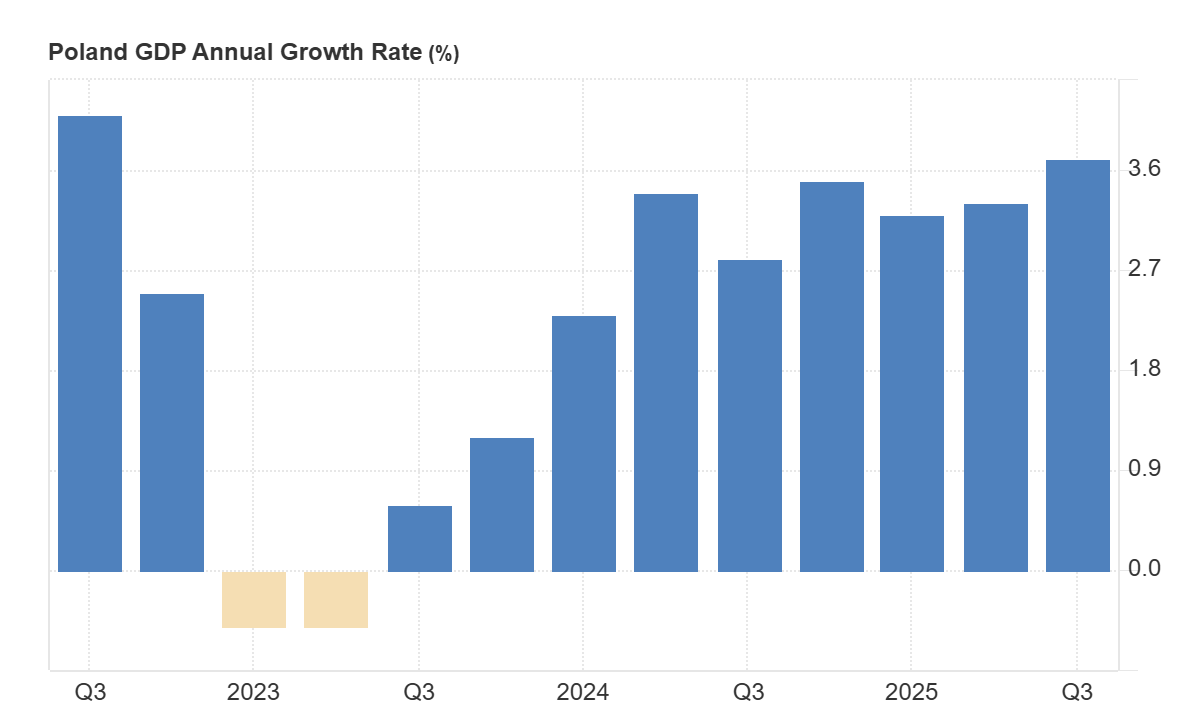
Poland GDP Annual Growth Rate Chart / Source: Trading Economics
Inflation remains weak in Poland, with headline CPI falling to 2.8% in October, while core CPI declined to 3%, reaching its lowest level in 5 years. Poland’s disinflationary process has allowed its central bank to reduce interest rates to 4.25% and prepare for more easing towards 3.5% in 2026, but in a gradual way without weakening the zloty. ⁽²⁾
However, Poland’s trade balance changed from a surplus to a modest deficit since the country is still dependent on international supply chains. Poland reported a €4.6 billion surplus in the first six months of 2024 but then reported a deficit of €919 million in February 2025 as imports increased by 3.7%. ⁽³⁾
Despite the recent weakness in trade, Poland’s trade-to-GDP (which measures the trade performance of an economy) remains way higher than other emerging market nations such as Brazil, India, and South Africa, indicating its major participation in global trade. ⁽⁴⁾
Poland vs. Other Emerging Markets
Comparing Poland’s economic performance with that of other emerging economies, Brazil continues to face high inflation despite high interest rates. India remains sluggish in growth, which is pressured by tariffs amid low inflation. South Africa’s economy is underpinned by high inflation and domestic issues that weakened growth. As such, Poland stands out as an emerging-market exception, delivering both stability and expansion simultaneously.
Market Outlook and Institutional Assessments
Financial markets are reacting to Poland’s strong economy, with UBS revising its forecast for EUR/PLN to stronger levels for 2026, with the currency pair expected to stabilize around 4.2.
The zloty continues to benefit from Poland’s strong growth prospects and its carry advantage over the euro, UBS noted. The currency is also expected to strengthen from an anticipated acceleration in German economic growth over the coming quarters. ⁽⁵⁾
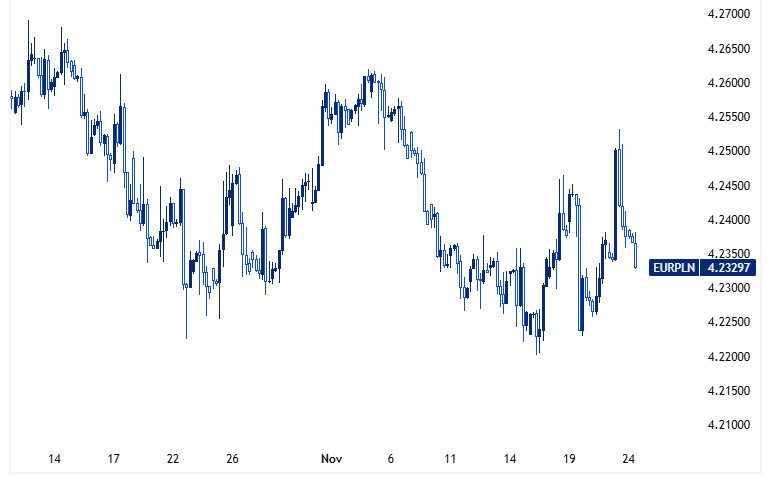
EUR/PLN 4H Chart / Source: TradingView
UBS has identified some downside risks for the zloty, especially from geopolitical tensions due to weakening relations between NATO and Russia and rising fiscal concerns. Conversely, a Russia-Ukraine ceasefire or stronger-than-expected growth in Germany could support Poland’s currency.
Credit ratings agency Moody’s lowered Poland’s outlook to “negative” from “stable” last week amid rising spending pressure and political gridlock. The outlook could become stable again if Poland enters a credible path of fiscal consolidation, significantly slowing down the growth of public debt. ⁽⁶⁾


