

 ar
Inflation is back in focus, with PPI and CPI landing just days before the Fed’s decision on 16 September. The PPI and CPI reports will show whether prices kept declining like they did earlier in the summer, or whether pressures are building up again.
Across the Atlantic, the ECB announces its own rate decision, with traders pricing a hike and closely watching the press conference for hints about a further move later this year.
Meanwhile, the UK’s July GDP report will show whether June’s strong services growth carried through the summer. Here’s everything to watch.
Calendar Events
- Japan Q2 Final GDP – Sep. 8
- China CPI – Sep. 9
- European Central Bank Interest Rate Decision – Sep. 10
- US PPI – Sep. 10
- UK Monthly GDP – Sep. 11
- US CPI – Sep. 11
Top Things to Watch
1. Oil Nears $100 as Hormuz Disruptions Intensify
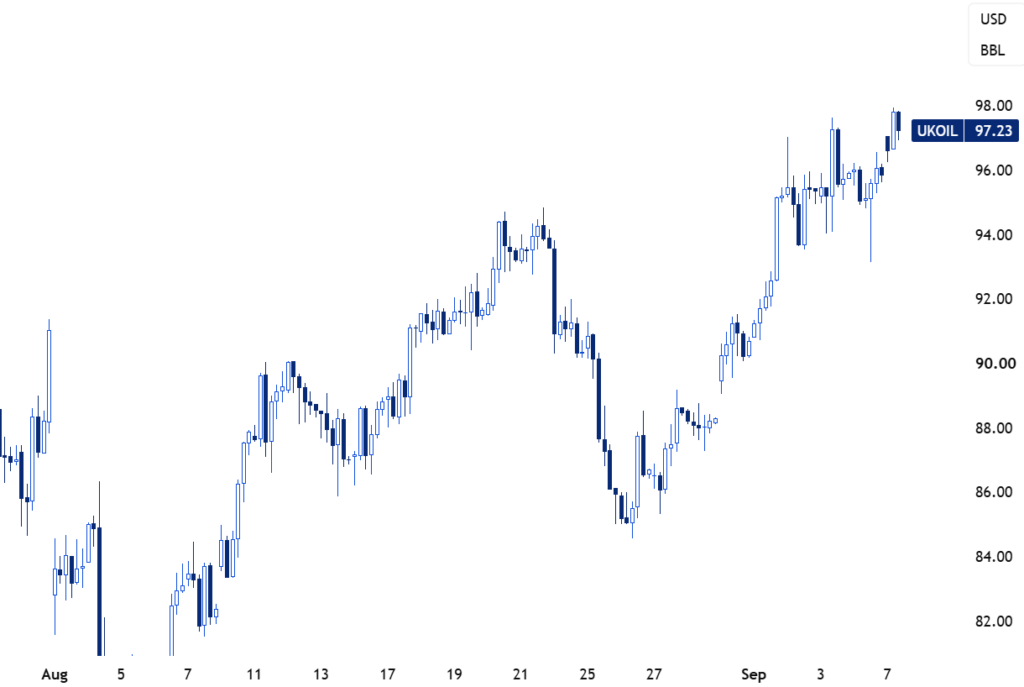
Oil prices extended their rally, with Brent trading above $97 per barrel and WTI above $92 after renewed US-Iran attacks revived concerns over Middle Eastern supply. Shipping through the Strait of Hormuz has fallen to its lowest level since May, while Iran’s planned exclusion zone could further restrict tanker movements.
Supply concerns were reinforced by OPEC+’s decision recent decision to keep production unchanged in October.
2. US CPI & PPI
Back-to-back inflation data lands this week, with August PPI due Thursday and CPI on Friday, just five days before the September 16 FOMC meeting. These will be the Fed’s final major inflation readings before its decision.
July’s data showed inflation holding relatively steady. Headline CPI rose 0.1% monthly and 3.4% annually, while core CPI increased 0.2% and 2.5%, respectively. PPI was unchanged monthly but remained elevated at 4.7% annually.
August’s figures will help determine whether the Fed will lean towards another hold or considers raising rates.
3. European Central Bank Interest Rate Decision
The European Central Bank will announce its rate decision on Thursday, with analysts widely expecting a 25-basis-point hike to 2.50%. It would be the second increase since June, and officials have strongly signaled the move.
With inflation at 3.3% and risks tilted higher, attention will focus on what comes next. Lagarde is expected to keep the door open to further hikes without making a firm commitment.
Europe also remains exposed to energy-price swings driven by the Middle East conflict, making the ECB’s guidance important to monitor.
4. UK GDP Monthly
The UK’s July GDP report comes on Friday after the economy grew 0.3% in June, helped by lower energy costs, World Cup football and hot weather, while second-quarter GDP expanded by 0.4%.
Growth was led by services, while production remained weak. July’s data will show whether momentum continued through the summer or faded as those temporary boosts disappeared. The result will also offer an important signal for the Bank of England’s next rate decision.


