

 ar
- The Reserve Bank of New Zealand held interest rates steady and expects inflation to return to its target range of 1-3%.
- Economic growth was supported by earlier rate cuts and commodity prices which helped pushed the economy out of contraction.
- The RBNZ expects that interest rates could rise later this year, but gradually, causing the New Zealand dollar to drop.
The Reserve Bank of New Zealand (RBNZ) decided to hold its Official Cash Rate (OCR) at 2.25%.
The message behind that decision is fairly straightforward. Things are moving in the right direction, but not fast enough to start tightening the screws just yet.
It’s the kind of call you’d expect from a central bank that sees light at the end of the tunnel, but isn’t ready to sprint toward it.
Inflation Is Easing, Just Not Quite There Yet
Inflation ended 2025 still sitting just above the RBNZ’s 1–3% target band, largely driven by rising food and electricity costs.
That said, the bank isn’t overly concerned. It expects inflation to drift back toward the 2% midpoint next year, pointing to slack in the economy, modest wage growth, and well-behaved core inflation as reasons for that confidence. In plain terms, the economy still has room to grow without prices running away from it. ⁽¹⁾
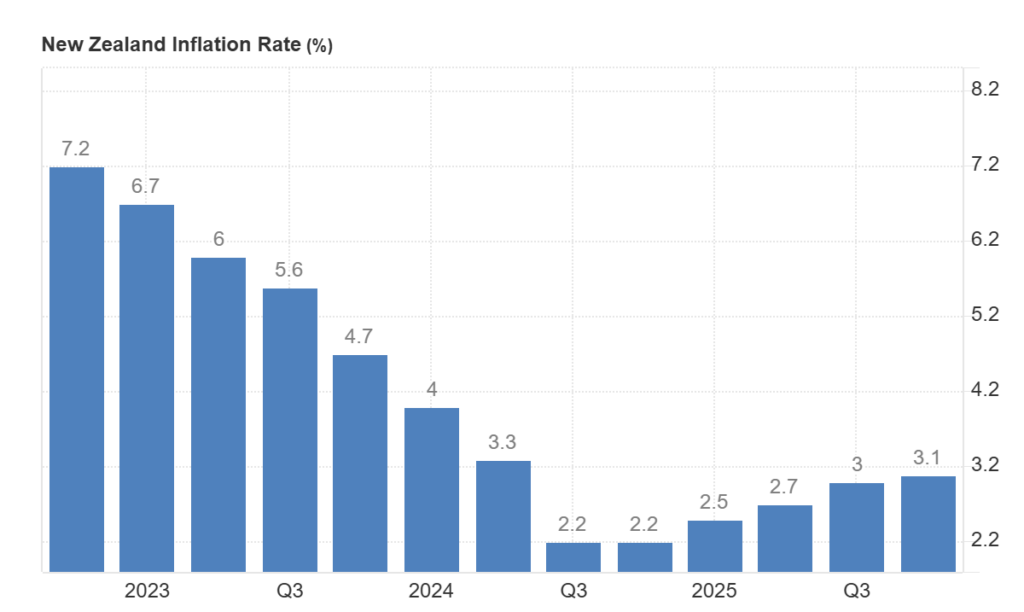
New Zealand Annual Inflation / Source: Trading Economics
A Recovery, But a Cautious One
New Zealand’s economy is finding its footing again. GDP bounced back 1.1% in Q3 2025 after shrinking 1% the quarter before, a welcome turnaround, though the RBNZ was careful to flag that these numbers have been choppier than usual, partly due to one-off factors and how the data is measured. ⁽²⁾
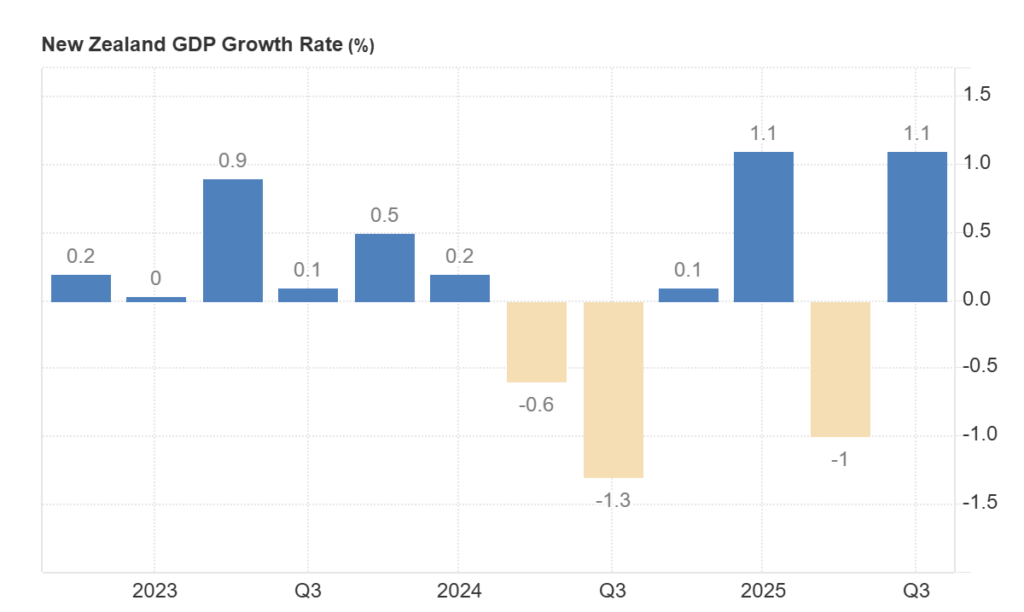
New Zealand Quarterly GDP / Source: Trading Economics
The brighter spots are in farming, manufacturing, construction, and retail, all of which have benefited from stronger commodity prices and the earlier rounds of rate cuts. But households are still holding back, the housing market remains soft, and unemployment while showing early signs of stabilizing is still elevated. The recovery is real, but fragile. ⁽³⁾
? Did you know?
New Zealand is one of the world’s largest exporters of dairy products, meaning commodity prices, particularly for milk and butter, have an outsized impact on its economy compared to most other developed nations. When global dairy prices rise, it’s genuinely good news for the whole country.
The Global Backdrop Isn’t Making Things Simpler
Internationally, 2025 turned out to be better than many had feared. Tariffs didn’t hit growth as hard as expected, AI-driven investment gave Asian export markets a meaningful boost, and looser fiscal policy in several major economies helped keep momentum going. ⁽⁴⁾
Looking ahead, though, the RBNZ is cautious. It expects tariffs to continue dragging on global growth into 2026. Inflation dynamics are uneven, prices are nudging higher in the US while parts of Asia are still wrestling with deflationary pressure. And with geopolitical tensions keeping energy and precious metal prices elevated, volatility doesn’t seem to be going away anytime soon. ⁽⁵⁾
Rates Will Rise, Just Slowly
The RBNZ isn’t ruling out rate hikes, it’s just in no rush to deliver them. The bank’s forecasts point to the OCR climbing to around 2.4% by Q4 2026 and 2.5% by early 2027. Policy, in its own words, will remain accommodative “for some time.” ⁽⁶⁾
Markets had been hoping for a more hawkish signal and didn’t quite get it. The probability of a rate hike before October was quickly revised down to around 70%, and the New Zealand dollar slipped 0.8% on the news.
It wasn’t a dramatic reaction, but it reflected a market recalibrating expectations to match a central bank that’s clearly in no hurry. ⁽⁷⁾


