

 ar
Global growth forecasts have been upgraded by the Organization for Economic Co-operation and Development (OEC) in a report released on Tuesday.
The outlook highlighted strong growth in 2025 resulting from strong performances in the global economy, particularly in emerging markets and AI innovation/investments despite looming tariff issues and other geopolitical factors.
But the OECD also warned that the full impact of tariffs has yet to be felt and that if trade tensions persist, they could pose future risks to growth.
Upgraded Growth Forecast Figures
The OECD now forecasts the global economy to grow by 3.2% in 2025, which is higher than its previous forecast of 2.9% in June, but slightly below 2024’s 3.3% figure.
The forecast for 2026 remains the same at 2.9%. Strong performance from emerging markets regions such as India and Brazil have contributed to this resilience, supported by front-loading exports to the US before “Liberation Day”, the day when US President Trump announced tariff rates on all nations. ⁽¹⁾
The OECD, however, expects a slowdown in the second half of 2025 as the impact of large inventory stockpiling starts to fade and higher tariff rates could continue to impact trade and investment.
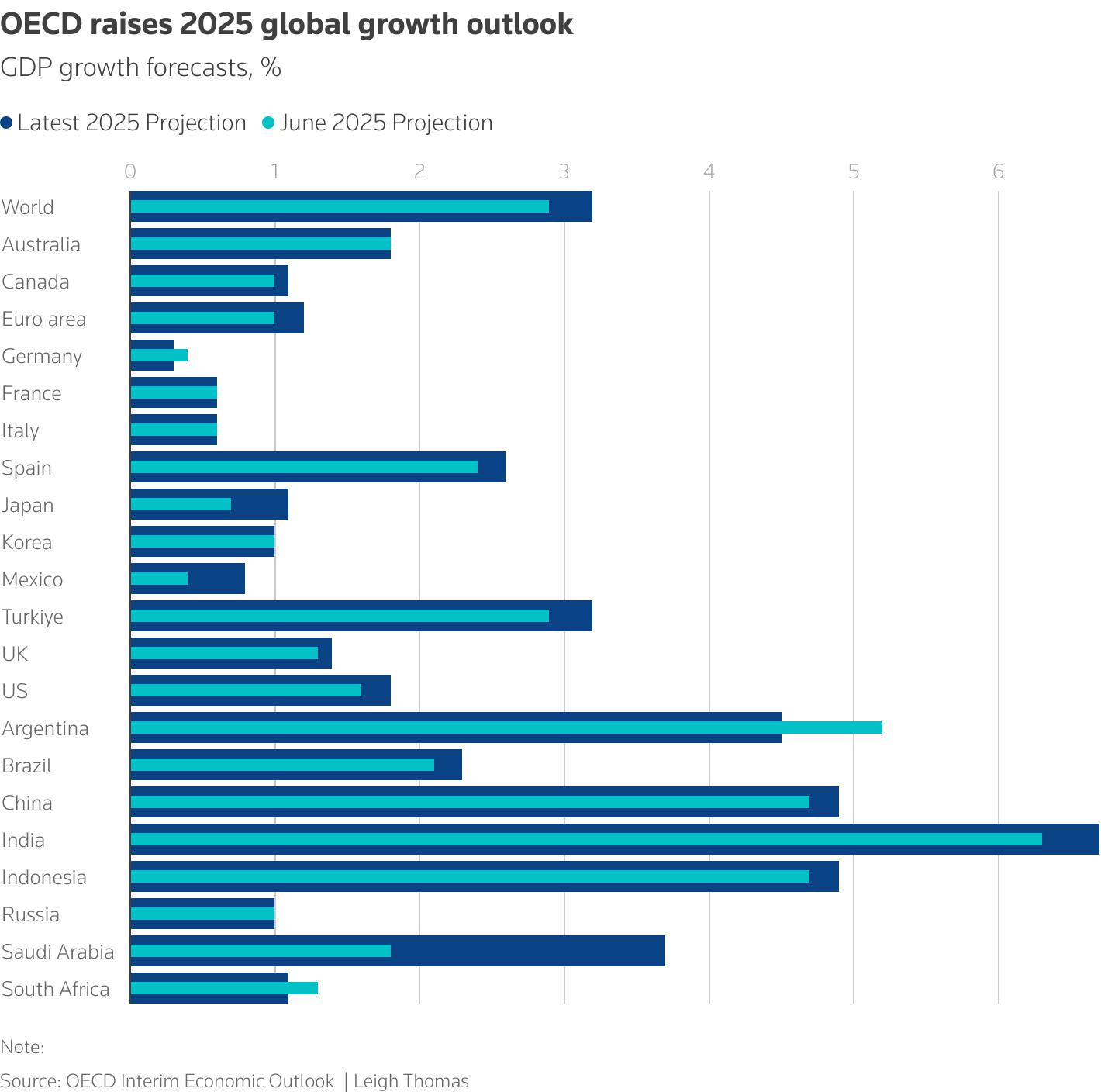
Source: Reuters Chart Showing OECD Forecasts Changes of the Global Economy
US AI Innovation Could be Threatened by Tariffs
The OECD upgraded its 2025 forecast for growth for the US economy to 1.8%, higher than its previous forecast of 1.6%, but also indicates a drop from last year’s 2.8%. Growth is projected to slow even more in 2026 to 1.5%. ⁽²⁾
Investments in artificial intelligence and interest rate cuts from the Federal Reserve have been supporting economic growth, but higher tariffs could bring more concerns on growth. The US effective tariff rate rose to 19.5% back in August, its highest level since the “Great Depression” in 1933. ⁽³⁾
The report from the OECD also highlights a softening labor market in the US, unemployment rising and less job openings. Businesses had to take on tariff costs with smaller profits and inventory surplus, causing them to pass on these higher costs to consumers. The report also showed warnings about higher tariff rates and geopolitical uncertainty.
Inflation forecasts from the OECD have been slightly lowered, with a forecast of 3.4% for headline inflation across G20 nations in 2025, lower than the previous forecast of 3.6%. However, further tariff hikes could refuel inflationary pressures and threaten growth. ⁽⁴⁾
Monetary Policy and Future Risks
The OECD expects major central banks to apply loose monetary policies or cut interest rates in 2025, as inflation continues to decline despite forecasts of slow growth.
The Federal Reserve has cut rates recently and is expected to deliver two more rate cuts by year’s end in order to support the labor market. That is unless tariff-driven inflation continues to be persistent.
The Reserve Bank of Australia (RBA), the Bank of England (BoE) and the Bank of Canada (BoC) are likely to continue to cut rates gradually, while the ECB is expected to keep rates unchanged for now as inflation is near its 2% target. The BOJ is expected to hike rates as it leaves its ultra-loose monetary policies, but the timeline of these rate cuts is still unknown. The BOJ will likely continue to assess economic data to determine their next monetary policy decisions. ⁽⁵⁾
The OECD has flagged additional tariff rate rises, persistent inflation and fiscal policy challenges as main risks for the global economy. Reductions in trade disputes or more AI investments could continue to boost growth. ⁽⁶⁾


