

 ar

In financial markets, no asset moves in isolation.
Prices are constantly reacting to a broader macro environment where currencies, commodities, interest rates, and expectations are all interconnected. Understanding these relationships is often what separates reactive trading from informed decision making.
One of the clearest examples today is the dynamic between oil and metals.
The Chain Reaction from Oil to Metals
When oil prices rise, the impact goes far beyond the energy market. It sets off a sequence of macro adjustments:
- Higher oil prices tend to lift inflation expectations
- Rising inflation often leads to higher bond yields
- Higher yields can support a stronger US dollar
- A stronger dollar combined with rising yields typically creates pressure on commodities, especially metals
This transmission mechanism is not theoretical. It is actively shaping price behavior across markets right now.
What We Are Seeing in the Market
Recent price action highlights how powerful these relationships can be:
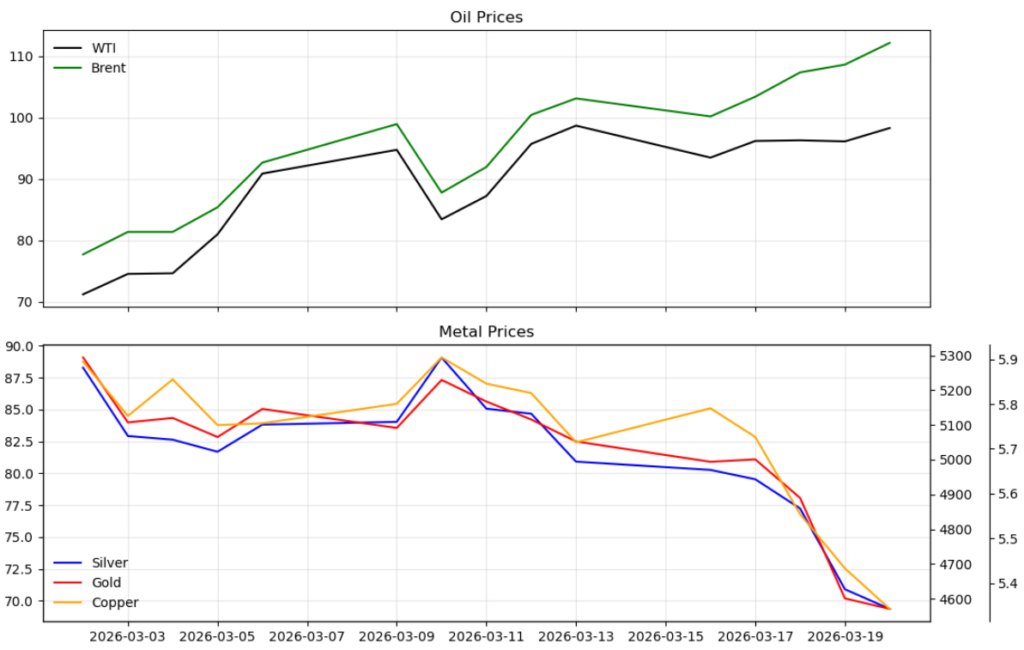
- Brent crude has risen by 49% since the beginning of the conflict (from the Friday, February 27 close)
- WTI crude surged as much as 77% at its peak on Monday, March 9
At the same time, metals have moved in the opposite direction:
- Gold is down 22% over the same period, including a 5% decline from last Friday alone
- Silver has dropped 34%
- Copper is down by 12%
Notably, gold and silver have just recorded their largest weekly declines in more than 40 years, despite no major structural change in their underlying fundamentals.
Why Metals Are Under Pressure
Metals, particularly precious metals like gold and silver, are highly sensitive to:
- Real yields
- US dollar strength
- Liquidity conditions
When yields rise and the dollar strengthens, holding non-yield-generating assets such as gold becomes less attractive. This can lead to broad selling pressure even if the longer-term narrative around inflation or safe haven demand remains intact.
This is why metals can decline even during periods of geopolitical tension. Short-term positioning, margin pressures, and macro flows can dominate price action.
Correlation Over Isolation
Looking at metals alone may give an incomplete picture.
A rebound in gold or silver might appear attractive on the surface, but without a shift in the broader macro drivers, such moves can remain limited or temporary.
In the current environment:
- Strength in oil continues to reinforce inflation concerns
- Inflation concerns are feeding into yields and the dollar
- These forces are collectively weighing on metals
This is a classic example of why correlation analysis is essential.
What to Watch Next
Market participants are closely monitoring whether oil prices begin to stabilize or correct. A meaningful shift in oil could:
- Ease inflation expectations
- Reduce upward pressure on yields
- Weaken the dollar
Such a shift may provide a more supportive backdrop for metals.
Until then, cross-asset relationships remain a key factor influencing price behavior.
Final Thoughts
Markets are interconnected systems, not isolated charts.
Understanding how one asset influences another can provide valuable context, especially during periods of heightened volatility.
At times like these, observing the broader macro picture may offer clearer insights than focusing on a single asset in isolation.


