

 ar

- With inflation close to target and policymakers declaring that policy is in a good place, the ECB is anticipated to maintain rates at 2.15% for the fourth time this year.
- The eurozone economy remains resilient, but trade and inflation threats are keeping the ECB cautious.
- Updated forecasts from the ECB will provide insights on what to expect in 2026, with markets pricing a small chance of rate hikes by next year.
The European Central Bank is expected to hold interest rates steady for a fourth consecutive time on Thursday, December 18th.
However, policymakers are still in debate about future policy. After its rate cut cycle, the ECB has been holding rates at 2.15% since July.
Inflation has settled around the central bank’s 2% target in recent months, and Europe has weathered President Trump’s tariff onslaught better than initially feared.
Economic Resilience Supports a “Good Place” Narrative
Despite sluggish growth, Europe’s economy remained resilient, with Q3 growth in the Eurozone revised up to 0.3%, with ECB policymakers sounding more confident. ⁽¹⁾
ECB governing council member Schnabel stated that the euro area has been more resilient than expected in the face of the greatest disruption of international trade since WW2. ECB President Christine Lagarde has repeated that policy remains in a “good place,” reinforcing expectations of no immediate action. ⁽²⁾
Uncertainty Keeps the ECB on Hold
However, uncertainty remains in play due to changes in global trade policies and responses to them. Lagarde stated recently that uncertainty remains high where inflation could rise again.
While a stronger euro, cheaper energy and slowing wage growth could restrain inflation, a resilient eurozone economy combined with Germany’s investment plans could see price growth accelerate.
Updated Projections and the Role of the Dot Plot
During the interest rate decision, the ECB will publish updated growth and inflation forecasts, which also include forecasts for 2028 for the first time. Markets will be watching closely for clues on how policymakers view the future rate path. ⁽³⁾
Lagarde said she had a “suspicion” that the growth forecast could be revised higher. Lagarde will speak at a press conference shortly after the decision with more insights on the current and future outlooks.
Hawkish Signals Fuel Rate-Hike Speculation
Schnabel, considered a hawk, has been commenting about possible rate hikes in 2026 after saying she was rather comfortable seeing traders price in hikes, though she said they would not come soon. ⁽⁴⁾
Since the ECB’s last meeting in October, there has been more evidence supporting the ECB’s view that policy is in a good place, with rate cuts taken off the table. Traders are now pricing in around a 30% chance of a rate hike by the end of 2026. ⁽⁵⁾
Key Factors Shaping the 2026 Outlook
The euro is up almost 15% this year and could appreciate further depending on how German fiscal stimulus supports growth, and how lower energy prices and cheap Chinese imports affect inflation. ⁽⁶⁾
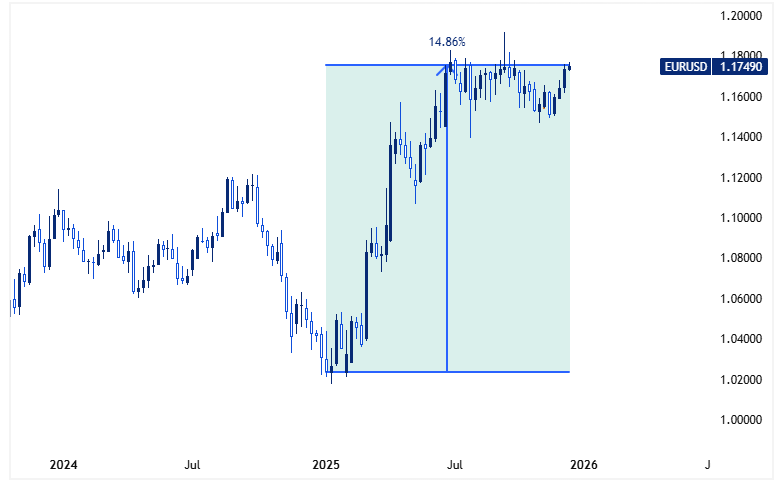
EUR/USD Weekly Chart / Source: TradingView
Progress in Ukraine peace talks could support European growth and lower energy prices, but economists said it would not change the ECB’s immediate thinking. Europe has made clear it does not want Russian gas again. ⁽⁷⁾
An EU plan to use frozen Russian assets to fund a loan to Ukraine is being watched by the ECB due to concerns about the euro’s standing as a reserve currency. The bloc agreed to indefinitely freeze the assets, removing a key obstacle. ⁽⁸⁾
Lagarde previously called the use of the assets legally and financially “stretched,” but has since said the latest plan is closest to complying withinternational law.


