ar
- Stagflation combines high inflation, weak growth and high or rising unemployment, a combination that has renewed concerns in 2026.
- Central banks normally fight inflation and unemployment with the same interest rate tool pointed in the same direction. Stagflation forces the two goals apart.
- When weak demand slows growth and pushes inflation below target, lower interest rates can support both employment and price stability. Stagflation puts those goals in conflict.
Stagflation is what happens when high inflation, weak growth, and rising unemployment take hold of an economy at the same time.
Normally these problems don’t move together. Fast growth pushes prices higher. A slowdown cools prices while unemployment rises. However, stagflation breaks that link.
The United States experienced its most familiar stagflation episode during the 1970s and early 1980s.
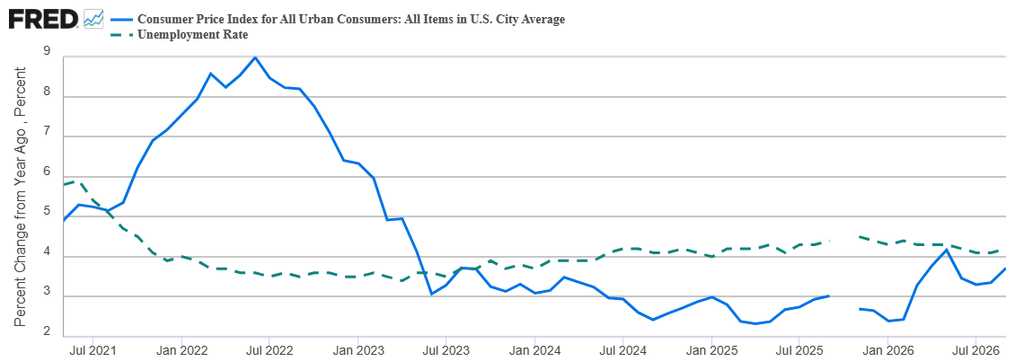
In September 2026, US employers added 29,000 jobs, while unemployment remained at 4.2%. ⁽¹⁾
Headline CPI inflation rose to 3.7% year on year, up from 3.4% in August. ⁽²⁾
The Federal Reserve’s 2% inflation target applies to the personal consumption expenditures price index, or PCE, a different measure from CPI. ⁽³⁾
These figures alone do not establish stagflation. Unemployment remains relatively low, and the economy is still growing. But weak hiring alongside persistent inflation raises concerns about how much room policymakers have to respond.
Why One Interest Rate Can’t Fix Both Problems
The Federal Reserve has two main monetary policy goals, stable prices and maximum employment. Its main tool for pursuing them is the policy interest rate.
When weak demand pushes inflation below target and unemployment higher, cutting rates can support spending and hiring while helping inflation return to target. When excessive demand fuels inflation, raising rates can help bring spending back into balance with the economy’s productive capacity.
Stagflation makes that choice harder. Cutting rates to support employment risks adding to price pressures. Raising rates to contain inflation can further weaken spending and hiring. The trade-off depends on the shock’s duration, underlying demand and inflation expectations.
Higher interest rates cannot restore disrupted oil supplies. They can, however, restrain spending and reduce the risk that an energy shock leads to persistent price and wage increases. Policymakers must judge whether the initial inflation surge will fade or spread through the economy.
What Usually Triggers It
Stagflation is typically triggered by a supply shock, not a demand shock. Something raises costs and disrupts output at the same time, rather than the economy simply overheating.
The clearest recent example is the disruption to the Strait of Hormuz, the narrow waterway carrying around a fifth of the world’s oil consumption.
The conflict that shut down shipping there triggered what the International Energy Agency called the largest oil supply shock on record, pushing Brent crude more than 60% above pre-conflict levels before prices eased. ⁽4⁾
Tariffs can also raise costs. Dallas Fed researchers estimated that realized tariff increases added approximately 0.80 percentage points to 12-month core PCE inflation in March 2026. ⁽⁵⁾
The Cost of Actually Fighting It
Iain Macleod, a British politician, coined the term “stagflation” in a 1965 speech to Parliament, describing “the worst of both worlds.” ⁽6⁾
The concept became reality after two oil shocks. The 1973 Arab oil embargo quadrupled crude prices. The 1979 Iranian revolution nearly tripled them again. ⁽7⁾
Paul Volcker became chair of the US Federal Reserve in August 1979, when inflation exceeded 11% and unemployment was just under 6%. The period challenged the belief that policymakers could rely on a stable trade-off between inflation and unemployment. ⁽⁸⁾
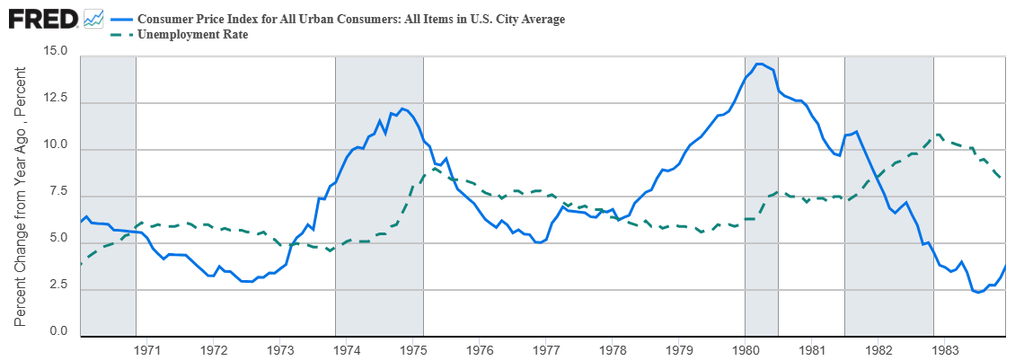
Volcker made controlling inflation the priority. Monetary tightening allowed the federal funds rate to approach 20% in late 1980 and early 1981. By late 1982, unemployment had reached nearly 11%, while inflation had fallen below 5%. ⁽⁹⁾
Breaking stagflation with the tools available then required accepting a deep recession first.
Not Every Rough Patch Is Stagflation
Today’s US backdrop still falls short of the 1970s in severity. Weak hiring and persistent inflation warrant attention, but they do not establish that stagflation has taken hold.
Under Fed Chair Kevin Warsh, the central bank raised its policy rate to 3.75%–4.00% in September, citing elevated inflation alongside solid economic growth. ⁽¹⁰⁾ The concern is whether inflation could remain persistent as that economic resilience weakens.