ar
You’ve probably heard that the US dollar is the world’s primary currency. But there’s a growing conversation about how China is trying to change that, and a big part of its strategy involves an ancient asset – gold.
Let’s break down what’s happening in simple terms.
The Basic Idea: Why Would China Want to Move Away from the Dollar?
Think of the US dollar as the world’s default currency for international trade, like oil or major business deals. This gives the US significant influence. China wants more independence and to build its own financial influence.
To do this, it needs to make its currency, the yuan, more attractive and trustworthy for other countries to use. This is where gold comes in.
How Gold Fits Into China’s Plan
- Building a Financial Safety Net: China is buying a lot of gold. This isn’t just a theory, but a documented fact. As the chart below shows, the People’s Bank of China (PBoC) has steadily increased its gold reserves since 2019, and gold now makes up a larger percentage of its total foreign reserves than it did five years ago. Why? Because gold is universally valued and isn’t tied to any single country. By building up a massive gold reserve, China creates a solid foundation of value that backs its economy. It’s like saving money in a universal asset that everyone agrees is valuable, instead of keeping all its savings in another country’s currency.
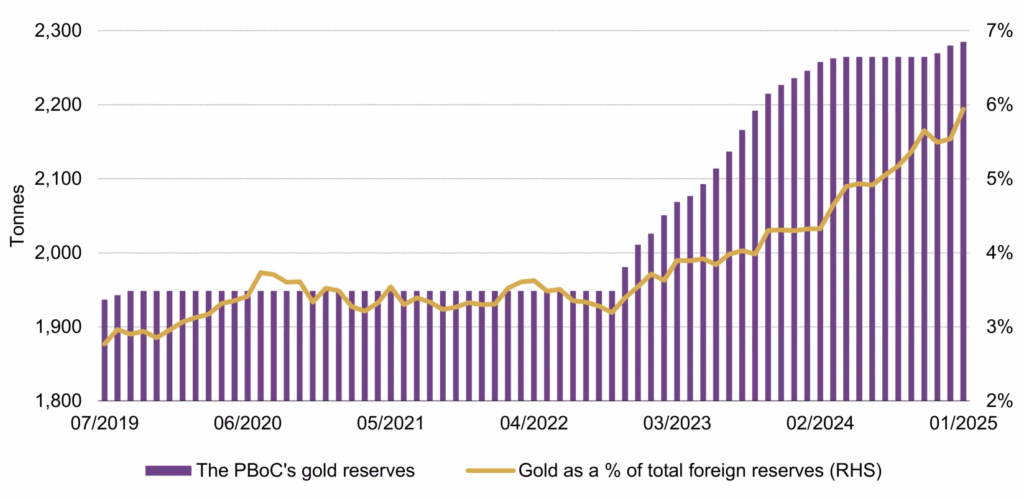
People’s Bank of China Gold Purchases. Source: World Gold Council
- Making the Yuan More Attractive: The ultimate goal is to encourage other nations to use the Chinese yuan. By having vast gold reserves, China can signal to the world that the yuan is a stable and reliable currency, potentially making others more willing to hold and use it. It’s a way of building confidence.
- Protecting Itself from Sanctions and Shocks: Relying less on the dollar system means China is less vulnerable to US policies, like financial sanctions. If China can trade with other countries using yuan or gold-backed agreements, it operates more independently.
What’s Realistic and What’s Exaggerated?
What’s Plausible: It is absolutely true that China is actively trying to reduce its dependence on the dollar. Its massive gold purchases are a clear, documented fact and a logical move for a country of its size and ambitions. A gradual shift towards a more “multi-currency” world is already happening.
What’s a Long Shot (For Now): The idea that gold will replace the dollar anytime soon is highly unlikely. The US dollar’s dominance is supported by decades of trust, incredibly deep financial markets, and its use in countless global transactions. It’s the financial habit the world is used to. A true “gold-backed yuan” is also speculative and not currently official policy.
The Bottom Line for Regular People
For the average person, this isn’t about an immediate change in your wallet. You won’t be paying for groceries with yuan or gold bars next week. However, this long-term strategy could lead to:
- More volatile markets: As the global financial system evolves, we might see more fluctuations in currency and gold prices.
- A shift in global influence: If successful over many decades, this could reduce some of the financial power the US holds and increase China’s role in setting global economic rules.
In short, China is using gold as a key piece in a very long, strategic game to increase its financial independence.
While a full-scale takeover of the dollar’s role is a distant and uncertain possibility, the moves China is making are real and signify a meaningful shift in the global economic landscape.